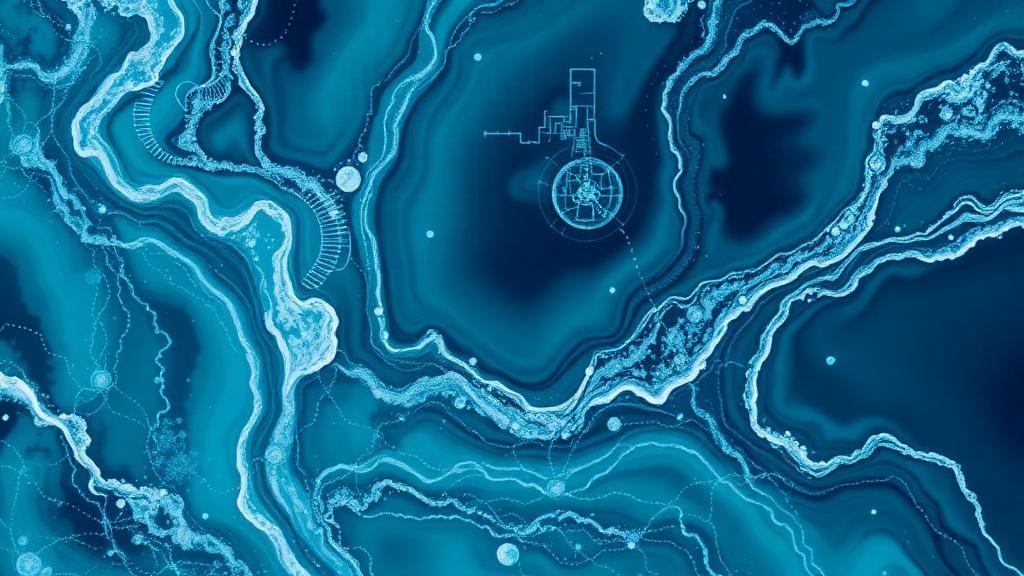
Turbidity currents—sediment-laden flows that race downslope under gravity through oceans, lakes, reservoirs, and estuaries—are among the most powerful sediment-moving agents on the planet. They carve submarine canyons, build deep-sea fans, and lay down turbidite deposits that can host significant hydrocarbon reservoirs, while also threatening telecommunication cables, pipelines, and offshore foundations. Yet because these events are ephemeral, destructive, and exceptionally hard to observe in the deep sea, researchers increasingly rely on numerical simulation to study them. A new review published in GeoEnergy Communications surveys how numerical modeling and artificial intelligence are transforming this field, and where the two approaches must converge.
The review, authored by Wei Huang, Cheng Zhang, Huaqiao Zhong, Xiangfeng Guo, Guochao Wu, Xingsen Guo, and Dongfang Liang, was published on 19 November 2025 as an open-access article. Its motivation is partly statistical: an analysis of literature indexed in Engineering Village, with data as of July 2025, shows a 180 percent increase in numerical simulation studies of turbidity currents over the past five years, with AI-enhanced approaches emerging as a distinct research trajectory since 2023. The authors argue that this rapid growth has created a fragmented landscape, in which researchers working in parallel domains may be unaware of complementary advances in neighboring fields, and that no systematic review focusing specifically on numerical and modeling approaches for turbidity current analysis existed before theirs.
The first pillar of the review is the one-fluid model, which treats a turbidity current as a single, variable-density continuum in which sediment and fluid move with identical velocity. Density differences are represented solely by the local volumetric concentration of suspended sediment. The model works most accurately when the sediment has a narrow grain-size distribution, transport distances are large compared with flow thickness, the Stokes number is small enough for a no-slip assumption to hold, and particle volume content stays low—generally below one percent—so that the continuum approximation remains valid. Under these conditions, its computational efficiency makes it one of the most widely adopted tools for large-scale simulations, including predictions of long-runout behavior, large-scale deposition patterns, event forecasting, geohazard assessment for submarine infrastructure, and sediment routing in basin-scale stratigraphic models.
Those efficiencies come at a physical price. By enforcing instantaneous velocity equilibrium between fluid and sediment and neglecting vertical gradients in velocity and concentration, the one-fluid model cannot reproduce internal structures such as stratification, particle-size segregation, or shear-induced layering. The limitation becomes pronounced when the Stokes number is non-negligible, because the resulting slip velocity violates the passive-scalar assumption. The model therefore shows limited predictive accuracy for localized erosion, micro-bedform development, or detailed depositional architecture. The authors suggest this gap is a natural niche for data-driven methods: machine learning models trained on high-fidelity data could parameterize sub-grid processes or correct systematic biases while preserving computational speed.
The second pillar, the two-fluid model, explicitly distinguishes the fluid and particulate phases, typically through Euler–Euler formulations that treat both phases as interpenetrating continua, or Euler–Lagrange formulations that track individual particles. When particle volume fraction ranges between one and twenty percent, interphase momentum exchange dominates and Euler–Lagrange models can resolve particle trajectories effectively. Above twenty percent, collisions and contact stresses become significant, prompting coupling with the Discrete Element Method, while at concentrations exceeding roughly fifty percent, sustained contact, frictional sliding, and local jamming dominate, requiring rheological constitutive models such as the strain acceleration-based μ(I) formulation. Two-fluid models can reproduce transitions between suspended load and bedload, particle resuspension, local scour in confined topographies, and the sedimentary architecture of deep-marine depositional units, supporting interpretation of sedimentary records, geohazard quantification, and offshore resource development.
Two-fluid modeling nonetheless faces persistent challenges. Particle contact dynamics are highly sensitive to constitutive parameters such as friction and restitution coefficients, which demand empirical calibration and reduce generalizability. No universal drag law yet exists that accommodates particle size, shape, and particle–turbulence interactions. High-resolution three-dimensional simulations must resolve flow structures down to particle wake scales, so computational cost scales rapidly with particle size polydispersity, and widespread assumptions of spherical, uniform particles misrepresent natural platy, angular, or elongated grains. The review notes that hybrid strategies, in which AI surrogates learn optimized closure relations from targeted high-fidelity simulations, could bypass some explicit phenomenological laws.
The third pillar comprises high-fidelity methods: Direct Numerical Simulation, which solves the full Navier–Stokes equations without turbulence models and offers the most accurate depiction of flow physics but at prohibitive cost, restricting it to low Reynolds numbers and simplified, small-scale domains; Large Eddy Simulation, which resolves large turbulent structures and models subgrid motions, striking a tractable balance suited to laboratory flumes and nearshore environments; and fully coupled CFD-DEM, which resolves individual sediment grains within a turbulent carrier fluid, enabling grain-scale study of clustering, collision dynamics, hindered settling, and micro-scale erosion–deposition mechanisms. All face strict time-step constraints from the CFL condition, demand finely resolved meshes, and require high-quality inputs such as friction coefficients and granulometry distributions, so their field-scale application remains limited and field validation sparse.
Against this modeling hierarchy, the review charts the rise of AI. Machine learning algorithms—artificial neural networks, support vector machines, K-nearest neighbors, Gaussian processes, and random forests—have been applied to predict suspended sediment load and concentration. Asadi and colleagues evaluated six models across 68 river basins in Iran’s Lorestan and Gilan provinces, finding ANN architectures particularly effective at capturing nonlinear sediment transport relationships. Joshi and colleagues applied cascade correlation and feedforward neural networks to forecast daily suspended sediment concentration at stations in India’s Sheonath Basin. In a different application domain, Babikir and colleagues used nine machine learning classifiers with twenty seismic attributes to distinguish turbidite facies from background, achieving over 99 percent accuracy, with SVM, random forest, KNN, decision tree, and neural network models performing best. Idrees and colleagues ranked six models for reservoir suspended sediment load prediction, with ANN first and genetic programming last.
Deep learning extends these capabilities to complex, non-stationary signals. Latif and colleagues compared LSTM, ANN, and SVM models for sediment transport prediction, with the LSTM recurrent network performing best at capturing time-varying, spatially distributed characteristics. Achite and colleagues found a deep neural network most consistent among several architectures against a traditional sediment rating curve baseline. Most strikingly, inverse modeling powered by deep learning can reconstruct flow conditions from deposits: Mitra and colleagues trained a deep neural network on synthetic data from deposit characteristics to reconstruct the 2011 Tohoku-oki tsunami deposits with high precision, while Naruse and colleagues verified a neural-network inverse model at field scale, turning static geological records into dynamic flow reconstructions with implications for paleo-hazard assessment. Hybrid models push further: Subramaniyan and colleagues found an autoencoder–fully connected network hybrid most accurate for predicting sediment volume, Roushangar and colleagues showed signal decomposition combined with deep learning outperformed standalone models for concentration prediction, Yadav and colleagues coupled ANN with a multi-objective genetic algorithm for sediment load forecasting in the Mahanadi River, and Mojtahedi and colleagues built a CNN-LSTM model that transfers knowledge from CFD simulations to field observations for real-time turbidity current forecasting, directly addressing data scarcity.
The review’s comparative verdict is measured. Numerical simulations offer physical interpretability grounded in fluid mechanics but carry high computational cost and sensitivity to boundary conditions; AI methods handle large datasets and nonlinear patterns rapidly but behave as black boxes whose outputs are hard to validate and whose performance depends heavily on training data quality. The authors identify paradigm shifts toward data-centric, multi-scale, real-time approaches and highlight physics-informed neural networks as a promising hybrid, while flagging unresolved obstacles: scarce field and laboratory datasets for training and validation, difficulty transferring models across sediment regimes and topographies, and the absence of standardized benchmarks for fair comparison. Their forward agenda calls for open-access benchmark datasets combining experiments, observations, and synthetic simulations; early-warning systems integrating in-situ sensor networks with AI predictions; and continued innovation in physics-informed machine learning that respects fundamental fluid–sediment mechanics. As subsea infrastructure, carbon storage, and offshore renewable energy expand, the stakes of predicting these hidden, sediment-charged avalanches are only rising.
Subject of Research: A review of numerical simulation methods and artificial intelligence approaches for studying turbidity currents and their sediment transport.
Article Title: Advances in numerical and AI approaches for turbidity current research: a brief review
Article References: Huang, W., Zhang, C., Zhong, H., Guo, X., Wu, G., Liang, D., & Guo, X. (2025). Advances in numerical and AI approaches for turbidity current research: a brief review. GeoEnergy Communications, 1(1), Article 9. https://doi.org/10.1007/s44421-025-00009-y
Image Credits: AI Generated
DOI: 10.1007/s44421-025-00009-y
Keywords: turbidity currents, numerical simulation, machine learning, deep learning, sediment transport, submarine geohazards, one-fluid model, two-fluid model, physics-informed neural networks, subsea infrastructure, turbidites, inverse modeling
Cite Scienmag News
Blake Davidson. (October 29, 2026). Turbidity Currents Meet AI: Review Maps Numerical Models and Machine Learning. Scienmag. https://scienmag.com/turbidity-currents-meet-ai-review-maps-numerical-models-and-machine-learning/
Blake Davidson. "Turbidity Currents Meet AI: Review Maps Numerical Models and Machine Learning." Scienmag, 29 October 2026, https://scienmag.com/turbidity-currents-meet-ai-review-maps-numerical-models-and-machine-learning/. Accessed 30 October 2026.
Blake Davidson. "Turbidity Currents Meet AI: Review Maps Numerical Models and Machine Learning." Scienmag. October 29, 2026. https://scienmag.com/turbidity-currents-meet-ai-review-maps-numerical-models-and-machine-learning/