Sorghum breeders now have a new statistical toolkit for picking the best-performing lines, according to a study published in Agriculture & Food Security on 23 August 2026. A team led by Mulugeta Tesfa, with Temesgen Zewotir, Solomon Assefa Derese, Denekew Bitew Belay and Hussein Shimelis, applied nonparametric multivariate techniques to phenotypic data from sorghum genotypes grown under both irrigated and non-irrigated conditions, and identified three genotypes, G190, G149 and G145, as the best performers in major yield-related traits.
Sorghum (Sorghum bicolor) is a major cereal crop cultivated primarily in arid and semi-arid regions because of its drought tolerance and adaptability to low-moisture environments. It serves multiple roles, including food, fodder, bioenergy and industrial uses, which makes reliable selection of superior genotypes an important goal for breeding programmes targeting water-limited production systems.
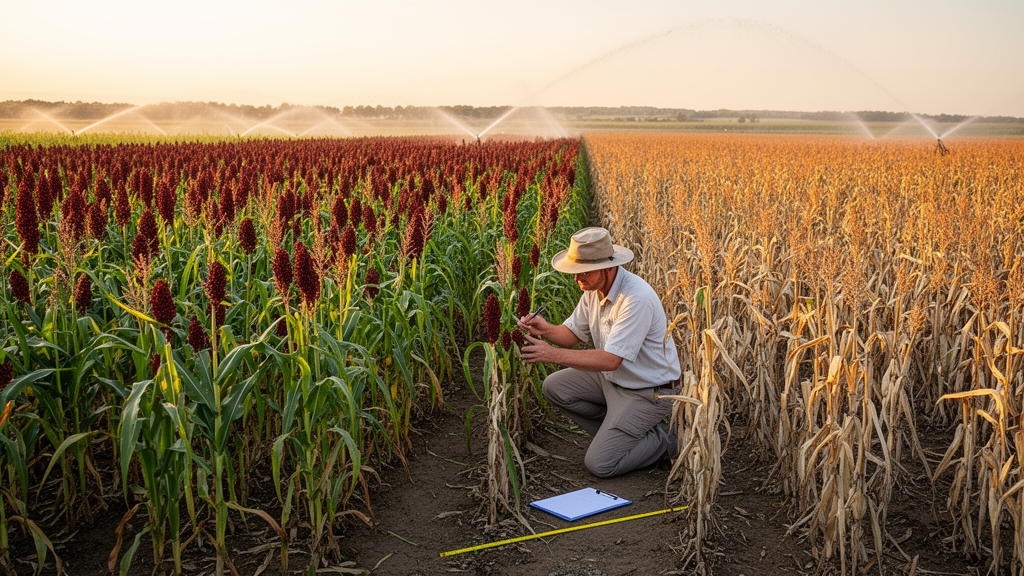
The study aimed to assess phenotypic variability among sorghum genotypes under irrigated and non-irrigated conditions and to select genotypes with superior performance in major traits using nonparametric multivariate techniques.
Four complementary techniques were employed: nonparametric multivariate analysis of variance (PERANOVA), nonmetric multidimensional scaling, nonparametric principal component analysis, and exploratory factor analysis. Together, these approaches allowed the researchers to test for differences among genotypes and treatments, visualise the structure of the trait data, and group traits into meaningful clusters without relying on normality assumptions.
PERANOVA revealed significant differences in phenotypic traits among the genotypes. Genotypes and between-treatment differences together explained 91.6% of the variance in phenotypic traits, with the between-treatment component accounting for 4.6% of the trait variance. The authors note that these figures describe how much of the observed phenotypic variation was associated with genotypic differences and with the irrigation treatments in this dataset.
The ordination and clustering methods, including nonmetric multidimensional scaling, nonparametric principal component analysis and nonparametric factor analysis, grouped the phenotypic traits into three clusters. The first cluster contained days to 50% maturity, above-ground dry matter, grain-filling period and days to 50% flowering. The second cluster comprised panicle height and seedling vigor. The third cluster, labelled as the major phenotypic traits, included grain yield, panicle yield, number of green leaves, thousand seeds weight, panicle width, panicle length, harvest index and panicle exertion.
Selection of high-performing genotypes was based on these major yield components. The genotypes identified as best performers in the major phenotypic traits were G190, G149 and G145, which together formed Cluster 3 of the classification produced by the nonparametric multivariate analysis. This clustering-based selection offers breeders a way to identify lines that combine strong performance across multiple yield-related traits simultaneously rather than focusing on a single character.
According to the authors, when phenotypic traits are non-normally distributed, nonparametric multivariate analysis is advised for selecting the best-performing genotype in subsequent breeding and for generating reliable results. The recommendation is framed as guidance for the analytical stage of breeding programmes, and the study’s conclusions apply to the genotypes and conditions evaluated in this experiment.
The authors also outline the direction of future work. The next phase will focus on genomic prediction of genotype performance in major sorghum traits and on validation of the identified genotypes under different environments. Until that validation is completed, the current findings represent a statistical demonstration of phenotypic differentiation among the tested genotypes under irrigated and non-irrigated conditions rather than a broadly validated recommendation for all production settings.
The article is published open access, and the version shared at publication is a peer-reviewed, accepted manuscript carrying a permanent DOI, subject to further editorial edits before the final Version of Record. For breeding teams working with morphological and yield data that resist standard parametric analysis, the study offers a concrete demonstration of how nonparametric multivariate methods can structure trait information, separate genotypes, and flag candidate lines for the next stage of evaluation.
Subject of Research: Nonparametric multivariate analysis of phenotypic traits to select high-performing sorghum genotypes under irrigated and non-irrigated conditions
Article Title: Nonparametric multivariate analysis of phenotypic traits of sorghum genotypes evaluated under non-irrigated and irrigated conditions
Article References: Tesfa, M., Zewotir, T., Derese, S. A., Belay, D. B., & Shimelis, H. (2026). Nonparametric multivariate analysis of phenotypic traits of sorghum genotypes evaluated under non-irrigated and irrigated conditions. Agriculture & Food Security. https://doi.org/10.1186/s40066-026-00649-1
Image Credits: AI Generated
DOI: 10.1186/s40066-026-00649-1
Keywords: sorghum, phenotypic traits, nonparametric multivariate analysis, PERANOVA, genotype selection, plant breeding, drought tolerance, grain yield, irrigation, multidimensional scaling, factor analysis, Nonparametric
Cite Scienmag News
Alan Morgan. (October 29, 2026). Nonparametric analysis pinpoints top sorghum genotypes under irrigated and dry conditions. Scienmag. https://scienmag.com/nonparametric-analysis-pinpoints-top-sorghum-genotypes-under-irrigated-and-dry-conditions/
Alan Morgan. "Nonparametric analysis pinpoints top sorghum genotypes under irrigated and dry conditions." Scienmag, 29 October 2026, https://scienmag.com/nonparametric-analysis-pinpoints-top-sorghum-genotypes-under-irrigated-and-dry-conditions/. Accessed 29 October 2026.
Alan Morgan. "Nonparametric analysis pinpoints top sorghum genotypes under irrigated and dry conditions." Scienmag. October 29, 2026. https://scienmag.com/nonparametric-analysis-pinpoints-top-sorghum-genotypes-under-irrigated-and-dry-conditions/