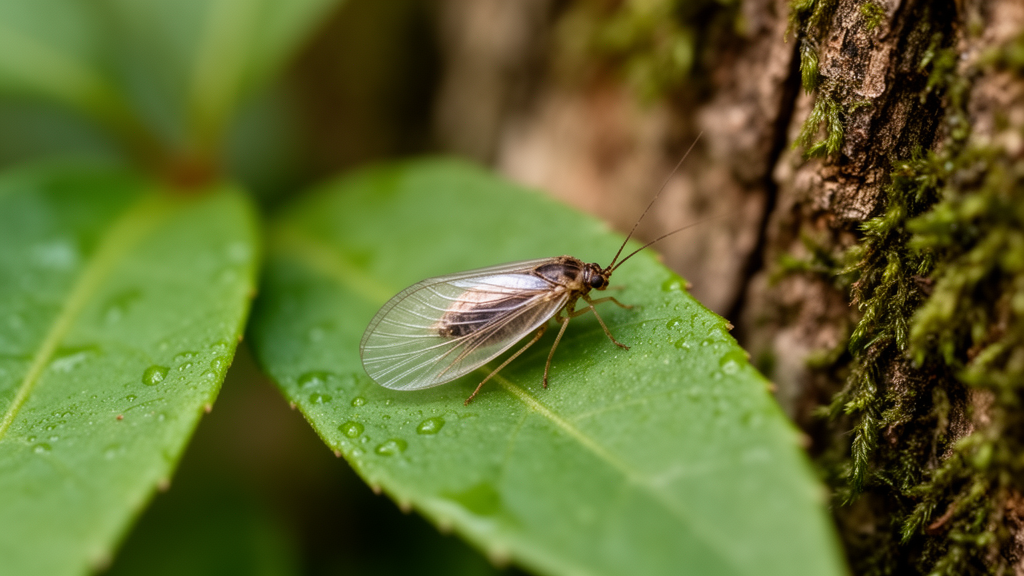
Two species of psocid insects in the genus Valenzuela have been recorded from South Korea for the first time, according to a taxonomic study published in the Biodiversity Data Journal. The species, Valenzuela badiostigma (Okamoto, 1910) and Valenzuela flavidus (Stephens, 1835), were identified among specimens hand-collected from numerous localities across the country between 2023 and 2025. With these additions, the number of Valenzuela species known from South Korea rises from one to three, and the study provides descriptions, measurements, illustrations of diagnostic structures and an identification key covering all three.
Psocids, commonly known as barklice and booklice, are small free-living insects whose diets include fungi, algae, lichens and organic debris. Despite their taxonomic diversity, they have often received limited attention in faunistic research. The family to which Valenzuela belongs, Caeciliusidae, sits within the infraorder Caeciliusetae of the suborder Psocomorpha in the order Psocodea. According to the Psocodea Species File, the family currently comprises 36 genera and 644 extant species worldwide.
Within Caeciliusidae, the genus Valenzuela Navás, 1924 is by far the largest, comprising 297 extant species and accounting for nearly half of the extant species currently assigned to the family. For a genus of this size, regional taxonomic accounts serve as an important link between global catalogues and locally collected material. Occurrence records accompanied by descriptions, measurements and illustrations allow the morphological basis of identifications to be evaluated, and they provide a reference for comparing specimens collected later and for assessing the species composition of regional faunas.
Before this study, only a single Valenzuela species had been documented in South Korea. A 2017 review by Soysouvanh and colleagues, which examined museum collections and recently collected specimens, reported ten additional psocid species from the country and included the first Korean record of Valenzuela oyamai (Enderlein, 1906), a species also reported from Japan, China, Taiwan and the Russian Far East. That left V. oyamai as the sole Korean representative of the genus, and the authors of the new study argued that further specimen-based investigations were needed to improve the national inventory and to provide a firmer basis for comparisons with other East Asian faunas.
The new records rest on a series of adult specimens collected by hand from several provinces between July 2023 and September 2025. Each specimen was preserved individually in a microtube containing 99% ethanol and stored at −20°C. General morphology of the body, head and wings was examined with a Leica M205C stereomicroscope, and the right wings were dissected for detailed study. To examine genitalia, the abdomen was dissected and cleared in 10% potassium hydroxide for one hour, stained with Wilkey’s double stain, and mounted in Canada balsam alongside the dissected wings for examination under a Leica DM6B microscope. Species identifications were based on established taxonomic literature, and all examined specimens are deposited in the Insect Collection of Gyeongsang National University in Jinju, Republic of Korea.
Valenzuela badiostigma was recorded from eight localities spanning much of the southern half of the country. The examined specimens were taken from the foliage and branches of broad-leaved trees and ornamental shrubs, including Prunus species, Ligustrum species and Zelkova serrata. The authors note that these records suggest V. badiostigma occurs widely, from inland regions to southern coastal areas of South Korea.
Morphologically, female V. badiostigma show a generally dark brown to reddish-brown body, with a thorax that is dark brown to nearly black and pale yellowish-brown legs. The abdomen is pink dorsally and ventrally, darkening to red laterally. The head is reddish-brown with darker markings on the vertex, frons and ocellar region, and the fore-wing is brown, darker posterior to the vertex of the pterostigma, with a distinct hyaline area near the base of the pterostigma and often an elongate hyaline window between veins r and m. Males resemble females in general colouration but have larger eyes. Quantitative measurements based on Korean specimens place female fore-wing length at 2.85 to 3.25 millimetres (n = 8) and male fore-wing length at 2.70 to 3.05 millimetres (n = 5), with hind-wing, leg-segment and flagellomere lengths reported alongside. Globally, the species is known from the Palaearctic Region, including Japan and now South Korea, from the Oriental Region in Indonesia, and from the Oceanian Region in the Hawaiian Islands.
Valenzuela flavidus, the second new record, presents a strikingly different appearance. Females are generally bright yellow to creamy-yellow, with the meso- and metanotum medium brown, a distinct brown median stripe along the face, and fore-wings that are hyaline to very pale tawny yellow, with wing markings emphasised along the veins, especially in the distal half where the veins are bordered with reddish-brown; additional pigmentation occurs in the posterior part of the anal area. Males are similar in general colouration but have relatively larger compound eyes and parameres that are relatively thickened basally on the phallosome. Measured Korean females (n = 10) have fore-wings of 2.85 to 3.20 millimetres, and males (n = 10) 2.70 to 3.05 millimetres. This species has an extensive documented range: the Palaearctic Region, including Japan, Mongolia, Europe, Türkiye and the former USSR; the Nearctic Region, including Canada and the USA; Central America, including Mexico and Nicaragua; and Atlantic islands including the Azores, Bermuda, the Canaries and Madeira. In South Korea, the study documents it from Jinju-si in Gyeongsangnam-do, Jung-gu in Ulsan-si, Seogwipo-si on Jeju-do, Taean-gun in Chungcheongnam-do and Wonju-si in Gangwon-do, with collections from July 2023 through August 2025. The authors describe it as widely distributed throughout the country, where it has been found on various tree species including Zelkova serrata, Quercus mongolica and Castanopsis sieboldii.
To separate the three Korean species, the study presents an identification key built on wing and pterostigma characters. Valenzuela flavidus is distinguished by a distinctly pigmented anal area of the fore-wing, whereas in the other two species the fore-wing is generally darkened. Among those, V. badiostigma has a brown pterostigma with a darker posterior margin, while V. oyamai has a yellowish pterostigma with black longitudinal stripes. Such keys, together with the illustrated genital structures — for example, the two distinct apical lobes of the subgenital plate in both new species, and the trapezoidal median portion of the dorsal valve in V. badiostigma versus the acutely produced basal part of the dorsal valve in V. flavidus — are intended to make future identifications verifiable against physical reference material.
The authors frame the contribution as an update to the national inventory of the genus rather than an ecological survey: the records document where the species were found and on which plants, but the study does not test hypotheses about how the species arrived in Korea or how their populations are changing. What the material does establish is a specimen-backed baseline. By combining occurrence data with morphological documentation, the study provides a reference for identifying Korean Valenzuela and a foundation for further faunistic investigation, both within South Korea and in comparative work across East Asia, where closely related faunas in Japan, China, Taiwan and the Russian Far East offer natural points of comparison.
Subject of Research: First records of two Valenzuela barklice species in South Korea, based on specimens collected between 2023 and 2025
Article Title: Two species of the genus Valenzuela ( Psocodea , Psocomorpha , Caeciliusidae ), newly recorded from South Korea
Article References: Kim, J., & Lee, W. (2026). Two species of the genus Valenzuela (Psocodea, Psocomorpha, Caeciliusidae), newly recorded from South Korea. Biodiversity Data Journal, 14, Article e216503. https://doi.org/10.3897/bdj.14.e216503
Image Credits: AI Generated
Keywords: Valenzuela, barklice, psocids, Psocodea, Caeciliusidae, South Korea, new records, taxonomy, faunistics, biodiversity, identification key, insect morphology
Cite Scienmag News
Gavin Prescott. (October 28, 2026). Two Barklice Species Recorded in South Korea for the First Time. Scienmag. https://scienmag.com/two-barklice-species-recorded-in-south-korea-for-the-first-time/
Gavin Prescott. "Two Barklice Species Recorded in South Korea for the First Time." Scienmag, 28 October 2026, https://scienmag.com/two-barklice-species-recorded-in-south-korea-for-the-first-time/. Accessed 29 October 2026.
Gavin Prescott. "Two Barklice Species Recorded in South Korea for the First Time." Scienmag. October 28, 2026. https://scienmag.com/two-barklice-species-recorded-in-south-korea-for-the-first-time/