Thursday, October 29, 2026
Science
No Result
View All Result
  • Login
  • HOME
  • SCIENCE NEWS
  • CONTACT US
  • HOME
  • SCIENCE NEWS
  • CONTACT US
No Result
View All Result
Scienmag
No Result
View All Result
Home Science News Biology

Devonian shark relative reveals how ancient fin spines grew in length and width

October 28, 2026
in Biology
Gavin Prescott
By Gavin Prescott Scienmag Editorial Profile - Ecology and Ecosystem Dynamics
Reading Time: 2 mins read
0
Devonian shark relative reveals how ancient fin spines grew in length and width

Devonian shark relative reveals how ancient fin spines grew in length and width

65
SHARES
587
VIEWS
Share on FacebookShare on Twitter
ADVERTISEMENT

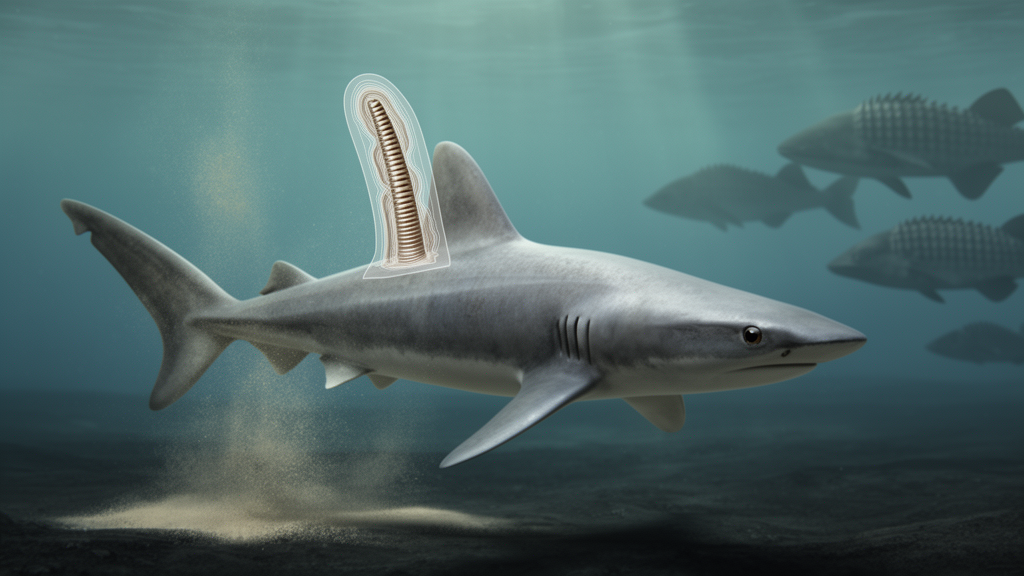
The study, published in Developmental Biology Advances, focuses on Wellerodus priscus, a Middle Devonian chondrichthyan recovered from the Cairo Quarry Lagerstätte in New York State, USA.

Although previous research had described the morphology and histology of these elements, their developmental patterns remained poorly understood. The research team, led by Richard Flament with Nathaniel Bertrand-Maltais, Daniel Potvin-Leduc and Richard Cloutier, set out to close that gap by combining paleohistological thin sections with micro-CT scanning, scanning electron microscopy and light microscopy.

Based on the ornamentation pattern of the spines and their paleohistological characteristics, the researchers identified two distinct modes of growth: a longitudinal component, in which the spine grows in length, and a transverse component, in which it grows in width. Each mode was associated with specific zones of tissue production in the pectoral and dorsal fin spines of Wellerodus priscus.

This dual-growth architecture means the spines did not simply elongate from a single growth zone but added material along both axes through spatially separated regions of tissue formation. The finding provides a concrete developmental framework for interpreting how these prominent dermal structures were built during the animal’s lifetime.

To place the result in an evolutionary context, the team compared the developmental patterns observed in Wellerodus with those of other Paleozoic total-group chondrichthyans, a group that includes both the stem-chondrichthyans traditionally called “acanthodians” and the crown group that contains modern sharks, rays and chimaeras.

The authors report that their framework offers a new line of evidence for understanding the evolution of fin spine development, showing that Wellerodus priscus fin spines grew in both length and width. They state that the work enhances comprehension of developmental similarities between early chondrichthyans and more derived Carboniferous, Permian and even extant chondrichthyans.

Beyond reconstructing the biology of a single species, the study carries methodological value. The histo-morphological criteria used to describe the developmental pattern provide characters that the researchers suggest are potentially suitable for phylogenetic analyses, meaning they could be coded as traits in future studies of relationships among early jawed vertebrates.

Because the article is being shared early to provide faster access to peer-reviewed, accepted research, it is citable and carries a permanent DOI, though the published version remains subject to further edits before the final Version of Record replaces it.

Subject of Research: Developmental growth patterns of fin spines in the Devonian chondrichthyan Wellerodus priscus

Article Title: Fin spine ontogeny in the Devonian chondrichthyan Wellerodus priscus: Paleo-Evo-Devo insights into early chondrichthyan dermal skeleton development

Article References: Flament, R., Bertrand-Maltais, N., Potvin-Leduc, D., & Cloutier, R. (2026). Fin spine ontogeny in the Devonian chondrichthyan Wellerodus priscus: Paleo-Evo-Devo insights into early chondrichthyan dermal skeleton development. Developmental Biology Advances. https://doi.org/10.1186/s13227-026-00273-x

Image Credits: AI Generated

DOI: 10.1186/s13227-026-00273-x

Keywords: Wellerodus priscus, chondrichthyans, Devonian, fin spines, paleohistology, micro-CT, paleo-evo-devo, dermal skeleton, Cairo Quarry, growth zones, phylogenetics, acanthodians

Cite Scienmag News

Gavin Prescott. (October 28, 2026). Devonian shark relative reveals how ancient fin spines grew in length and width. Scienmag. https://scienmag.com/devonian-shark-relative-reveals-how-ancient-fin-spines-grew-in-length-and-width/

Gavin Prescott. "Devonian shark relative reveals how ancient fin spines grew in length and width." Scienmag, 28 October 2026, https://scienmag.com/devonian-shark-relative-reveals-how-ancient-fin-spines-grew-in-length-and-width/. Accessed 29 October 2026.

Gavin Prescott. "Devonian shark relative reveals how ancient fin spines grew in length and width." Scienmag. October 28, 2026. https://scienmag.com/devonian-shark-relative-reveals-how-ancient-fin-spines-grew-in-length-and-width/

Tags: acanthodiansancient fin spine growthCairo Quarrychondrichthyansdermal skeletonDevonianDevonian period vertebrate anatomyDevonian shark relativesdual growth modes in fish dermal structuresevolutionary development of fish finsfin spine development in early chondrichthyansfin spinesgrowth zoneshistological analysis of ancient spine tissuesmicro-CTmicro-CT scanning in paleontologyMiddle Devonian fish fossilspaleo-evo-devopaleohistologypaleohistology of Devonian fishespaleontological techniques in fish evolutionphylogeneticsWellerodus priscusWellerodus priscus morphology
Share26Tweet16
Previous Post

3D Printing Is Quietly Rebuilding the Entire Sensor, From Sample to Signal

Next Post

How Hippo, Wnt, NRG1 and Notch pathways could unlock heart regeneration

Related Posts

Lamb-Derived Probiotic Strain Eases Colitis Symptoms in Mice Study Finds
Biology

Lamb-Derived Probiotic Strain Eases Colitis Symptoms in Mice Study Finds

October 29, 2026
Research report: Comparative transcriptomics reveals genotype-specific mechanisms of saline-alkali tolerance in highland barley
Biology

Research report: Comparative transcriptomics reveals genotype-specific mechanisms of saline-alkali tolerance in highland barley

October 29, 2026
Gharial genomes reveal ancient and recent population decline
Biotechnology

Gharial genomes reveal ancient and recent population decline

October 29, 2026
Body Fat May Set the Stage for Lymphedema, Researchers Propose
Biology

Body Fat May Set the Stage for Lymphedema, Researchers Propose

October 29, 2026
Lab-made octaploid rock cress shows promise for locking heavy metals in soil
Biology

Lab-made octaploid rock cress shows promise for locking heavy metals in soil

October 29, 2026
Whole milk replacer boosts calf growth, but pea starter falls short
Biology

Whole milk replacer boosts calf growth, but pea starter falls short

October 29, 2026
Next Post
How Hippo, Wnt, NRG1 and Notch pathways could unlock heart regeneration

How Hippo, Wnt, NRG1 and Notch pathways could unlock heart regeneration

  • Mothers who receive childcare support from maternal grandparents show more optimized

    Mothers who receive childcare support from maternal grandparents show more parental warmth, finds NTU Singapore study

    27656 shares
    Share 11059 Tweet 6912
  • University of Seville Breaks 120-Year-Old Mystery, Revises a Key Einstein Concept

    1061 shares
    Share 424 Tweet 265
  • Bee body mass, pathogens and local climate influence heat tolerance

    682 shares
    Share 273 Tweet 171
  • Researchers record first-ever images and data of a shark experiencing a boat strike

    546 shares
    Share 218 Tweet 137
  • Groundbreaking Clinical Trial Reveals Lubiprostone Enhances Kidney Function

    531 shares
    Share 212 Tweet 133
Science

Embark on a thrilling journey of discovery with Scienmag.com—your ultimate source for cutting-edge breakthroughs. Immerse yourself in a world where curiosity knows no limits and tomorrow’s possibilities become today’s reality!

RECENT NEWS

  • Lamb-Derived Probiotic Strain Eases Colitis Symptoms in Mice Study Finds
  • Self-Chosen Rest After Velocity-Loss Squats Matches Best Fixed Recovery for Jump Gains
  • Weekend Warriors and Regular Exercisers Show Lower Kidney and Urinary Tract Disease Risk in UK Biobank Study
  • Machine Learning Outperforms Design Codes at Predicting Concrete Crack Spacing

Categories

  • Agriculture
  • Anthropology
  • Archaeology
  • Athmospheric
  • Biology
  • Biotechnology
  • Blog
  • Bussines
  • Cancer
  • Chemistry
  • Climate
  • Earth Science
  • Editorial Policy
  • Marine
  • Mathematics
  • Medicine
  • Pediatry
  • Policy
  • Psychology & Psychiatry
  • Science Education
  • Science News
  • Social Science
  • Space
  • Technology and Engineering

Subscribe to Blog via Email

Enter your email address to subscribe to this blog and receive notifications of new posts by email.

Join 5,150 other subscribers

© 2025 Scienmag - Science Magazine

Welcome Back!

Login to your account below

Forgotten Password?

Retrieve your password

Please enter your username or email address to reset your password.

Log In
No Result
View All Result
  • HOME
  • SCIENCE NEWS
  • CONTACT US

© 2025 Scienmag - Science Magazine

Discover more from Science

Subscribe now to keep reading and get access to the full archive.

Continue reading