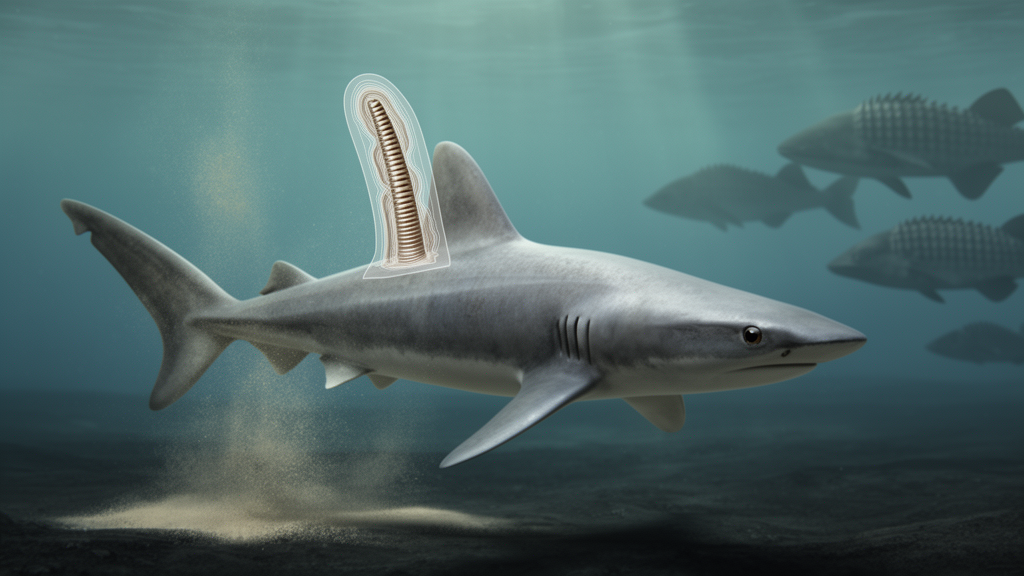
The study, published in Developmental Biology Advances, focuses on Wellerodus priscus, a Middle Devonian chondrichthyan recovered from the Cairo Quarry Lagerstätte in New York State, USA.
Although previous research had described the morphology and histology of these elements, their developmental patterns remained poorly understood. The research team, led by Richard Flament with Nathaniel Bertrand-Maltais, Daniel Potvin-Leduc and Richard Cloutier, set out to close that gap by combining paleohistological thin sections with micro-CT scanning, scanning electron microscopy and light microscopy.
Based on the ornamentation pattern of the spines and their paleohistological characteristics, the researchers identified two distinct modes of growth: a longitudinal component, in which the spine grows in length, and a transverse component, in which it grows in width. Each mode was associated with specific zones of tissue production in the pectoral and dorsal fin spines of Wellerodus priscus.
This dual-growth architecture means the spines did not simply elongate from a single growth zone but added material along both axes through spatially separated regions of tissue formation. The finding provides a concrete developmental framework for interpreting how these prominent dermal structures were built during the animal’s lifetime.
To place the result in an evolutionary context, the team compared the developmental patterns observed in Wellerodus with those of other Paleozoic total-group chondrichthyans, a group that includes both the stem-chondrichthyans traditionally called “acanthodians” and the crown group that contains modern sharks, rays and chimaeras.
The authors report that their framework offers a new line of evidence for understanding the evolution of fin spine development, showing that Wellerodus priscus fin spines grew in both length and width. They state that the work enhances comprehension of developmental similarities between early chondrichthyans and more derived Carboniferous, Permian and even extant chondrichthyans.
Beyond reconstructing the biology of a single species, the study carries methodological value. The histo-morphological criteria used to describe the developmental pattern provide characters that the researchers suggest are potentially suitable for phylogenetic analyses, meaning they could be coded as traits in future studies of relationships among early jawed vertebrates.
Because the article is being shared early to provide faster access to peer-reviewed, accepted research, it is citable and carries a permanent DOI, though the published version remains subject to further edits before the final Version of Record replaces it.
Subject of Research: Developmental growth patterns of fin spines in the Devonian chondrichthyan Wellerodus priscus
Article Title: Fin spine ontogeny in the Devonian chondrichthyan Wellerodus priscus: Paleo-Evo-Devo insights into early chondrichthyan dermal skeleton development
Article References: Flament, R., Bertrand-Maltais, N., Potvin-Leduc, D., & Cloutier, R. (2026). Fin spine ontogeny in the Devonian chondrichthyan Wellerodus priscus: Paleo-Evo-Devo insights into early chondrichthyan dermal skeleton development. Developmental Biology Advances. https://doi.org/10.1186/s13227-026-00273-x
Image Credits: AI Generated
DOI: 10.1186/s13227-026-00273-x
Keywords: Wellerodus priscus, chondrichthyans, Devonian, fin spines, paleohistology, micro-CT, paleo-evo-devo, dermal skeleton, Cairo Quarry, growth zones, phylogenetics, acanthodians
Cite Scienmag News
Gavin Prescott. (October 28, 2026). Devonian shark relative reveals how ancient fin spines grew in length and width. Scienmag. https://scienmag.com/devonian-shark-relative-reveals-how-ancient-fin-spines-grew-in-length-and-width/
Gavin Prescott. "Devonian shark relative reveals how ancient fin spines grew in length and width." Scienmag, 28 October 2026, https://scienmag.com/devonian-shark-relative-reveals-how-ancient-fin-spines-grew-in-length-and-width/. Accessed 29 October 2026.
Gavin Prescott. "Devonian shark relative reveals how ancient fin spines grew in length and width." Scienmag. October 28, 2026. https://scienmag.com/devonian-shark-relative-reveals-how-ancient-fin-spines-grew-in-length-and-width/