Friday, October 30, 2026
Science
No Result
View All Result
  • Login
  • HOME
  • SCIENCE NEWS
  • CONTACT US
  • HOME
  • SCIENCE NEWS
  • CONTACT US
No Result
View All Result
Scienmag
No Result
View All Result
Home Science News Technology and Engineering

Magnesium-Doped Bioactive Glass Hydrocolloid Dressing Associated With Faster Acute Wound Closure in Rabbit Model

October 28, 2026
in Technology and Engineering
Denise Maddox
By Denise Maddox Scienmag Editorial Profile - Mechanical Engineering
Reading Time: 3 mins read
0
Magnesium-Doped Bioactive Glass Hydrocolloid Dressing Associated With Faster Acute Wound Closure in Rabbit Model

Magnesium-Doped Bioactive Glass Hydrocolloid Dressing Associated With Faster Acute Wound Closure in Rabbit Model

65
SHARES
587
VIEWS
Share on FacebookShare on Twitter
ADVERTISEMENT

A composite hydrocolloid dressing that pairs carboxymethyl cellulose with magnesium-doped bioactive glass has shown promise for acute wound management, according to a study published in Frontiers in Materials. The research, led by Wang Chen of the Wenzhou Institute, University of Chinese Academy of Sciences, together with colleagues at Wenzhou Medical University, evaluated the material’s physicochemical properties and its healing performance across several laboratory and animal models.

The dressing, referred to as MgBG/CMC, was designed to combine two functions that are often treated separately in wound care: managing wound exudate and actively regulating cell behaviour. By incorporating the bioactive glass into the CMC matrix, the team created a single material intended to absorb fluid while also supporting the repair process.

Physicochemical testing showed that adding the magnesium-doped bioactive glass enhanced the fluid absorption capacity of the CMC matrix.

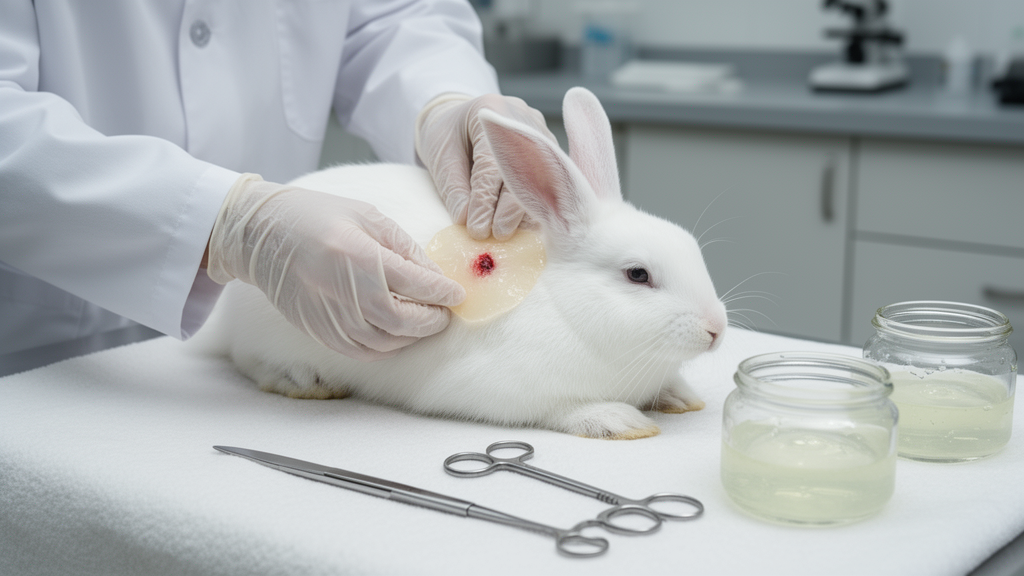
The most striking result came from an acute wound model in New Zealand white rabbits, where the MgBG/CMC dressing was associated with faster wound closure. This finding supports the study’s central conclusion that the formulation is best suited to acute wound management, where the combination of improved fluid handling and bioactive stimulation of keratinocytes may work together to accelerate repair.

However, the benefits were not uniform across all wound types examined. In a chronic wound model established in Sprague-Dawley rats, in which healing was impaired by glucocorticoid treatment, the additional benefit of MgBG/CMC over the CMC dressing alone was limited. The team also carried out an exploratory assessment of hypertrophic scar outcomes, and again the composite dressing did not show a clear advantage over the base material in that setting.

In vitro experiments helped clarify which cell types respond to the material. Extracts of the MgBG dressing selectively increased the viability of HaCaT keratinocytes. By contrast, the extracts showed minimal effects on dermal fibroblast viability and on endothelial tube formation.

The authors are careful to note that the mechanisms behind the observed effects remain to be fully elucidated. The relative contributions of ionic dissolution products from the bioactive glass, the intrinsic properties of the matrix, and other factors have not yet been separated experimentally. The hypertrophic-scar assessment was exploratory, and the study's conclusions about the formulation's application boundaries are correspondingly cautious.

Overall, the study presents a simple bioactive hydrocolloid dressing strategy for acute wound management and, importantly, maps the limits of the current formulation. Rather than claiming a universal solution for all wound types, the researchers identify the specific conditions under which MgBG/CMC appears advantageous and the conditions under which it does not, providing a realistic picture of where this dressing approach may fit in future wound care practice.

The work was carried out by researchers from the Wenzhou Institute, University of Chinese Academy of Sciences, and the Second Affiliated Hospital and Yuying Children’s Hospital of Wenzhou Medical University, and was published as an open-access original research article in the Biomaterials and Bio-Inspired Materials section of Frontiers in Materials.

Subject of Research: A magnesium-doped bioactive glass and carboxymethyl cellulose hydrocolloid dressing for skin wound repair

Article Title: Magnesium-doped bioactive Glass/CMC hydrocolloid dressings promote acute wound repair

Article References: Wang, C., Yu, J., Zhang, L., Ge, H., Chen, Y., Sun, Z., Chen, S., & Wang, L. (2026). Magnesium-doped bioactive Glass/CMC hydrocolloid dressings promote acute wound repair. Frontiers in Materials, 13, Article 1995518. https://doi.org/10.3389/fmats.2026.1995518

Image Credits: AI Generated

DOI: 10.3389/fmats.2026.1995518

Keywords: hydrocolloid dressing, magnesium-doped bioactive glass, carboxymethyl cellulose, acute wound healing, keratinocytes, wound closure, exudate management, biomaterials, rabbit ear wound model, chronic wounds, Frontiers in Materials, Magnesium-doped

Cite Scienmag News

Denise Maddox. (October 28, 2026). Magnesium-Doped Bioactive Glass Hydrocolloid Dressing Associated With Faster Acute Wound Closure in Rabbit Model. Scienmag. https://scienmag.com/magnesium-doped-bioactive-glass-hydrocolloid-dressing-associated-with-faster-acute-wound-closure-in-rabbit-model/

Denise Maddox. "Magnesium-Doped Bioactive Glass Hydrocolloid Dressing Associated With Faster Acute Wound Closure in Rabbit Model." Scienmag, 28 October 2026, https://scienmag.com/magnesium-doped-bioactive-glass-hydrocolloid-dressing-associated-with-faster-acute-wound-closure-in-rabbit-model/. Accessed 30 October 2026.

Denise Maddox. "Magnesium-Doped Bioactive Glass Hydrocolloid Dressing Associated With Faster Acute Wound Closure in Rabbit Model." Scienmag. October 28, 2026. https://scienmag.com/magnesium-doped-bioactive-glass-hydrocolloid-dressing-associated-with-faster-acute-wound-closure-in-rabbit-model/

Tags: accelerated wound closureacute wound healingbioactive glass and cellulose compositesbioactive glass for tissue regenerationbioactive materials in wound managementbiomaterialscarboxymethyl cellulosechronic woundscomposite wound dressingsexudate managementfluid management in wound dressingsFrontiers in Materialshydrocolloid dressinghydrocolloid wound careinnovative acute wound treatmentkeratinocyte stimulationkeratinocytesMagnesium-dopedmagnesium-doped bioactive glassMagnesium-doped bioactive glass wound dressingsphysicochemical properties of wound dressingsrabbit ear wound modelwound closurewound healing in rabbit models
Share26Tweet16
Previous Post

Researchers Challenge Claim That C1 Inhibitor Beats Sebetralstat in Hereditary Angioedema

Next Post

New karst-dwelling shrub Euonymus saxatilis described from Guangxi, China

Related Posts

Review maps how lignocellulosic waste can be turned into nanocellulose
Chemistry

Review maps how lignocellulosic waste can be turned into nanocellulose

October 30, 2026
Gold nanoparticles turn blue in the presence of milk fatty acids, pointing toward low-cost fat sensing
Biotechnology

Gold nanoparticles turn blue in the presence of milk fatty acids, pointing toward low-cost fat sensing

October 30, 2026
Water quality, not just quantity, drives India’s deepening scarcity crisis
Climate

Water quality, not just quantity, drives India’s deepening scarcity crisis

October 30, 2026
AI and Omics Converge to Decode the Gene Regulatory Logic of the Brain
Medicine

AI and Omics Converge to Decode the Gene Regulatory Logic of the Brain

October 30, 2026
Tailored Etching Recipes Reveal Hidden Nanoscale Precipitates in Nickel Superalloys
Technology and Engineering

Tailored Etching Recipes Reveal Hidden Nanoscale Precipitates in Nickel Superalloys

October 30, 2026
LiDAR maps full bridge deflection fields that point sensors miss in scaled model tests
Technology and Engineering

LiDAR maps full bridge deflection fields that point sensors miss in scaled model tests

October 30, 2026
Next Post
New karst-dwelling shrub Euonymus saxatilis described from Guangxi, China

New karst-dwelling shrub Euonymus saxatilis described from Guangxi, China

  • Mothers who receive childcare support from maternal grandparents show more optimized

    Mothers who receive childcare support from maternal grandparents show more parental warmth, finds NTU Singapore study

    27656 shares
    Share 11059 Tweet 6912
  • University of Seville Breaks 120-Year-Old Mystery, Revises a Key Einstein Concept

    1061 shares
    Share 424 Tweet 265
  • Bee body mass, pathogens and local climate influence heat tolerance

    682 shares
    Share 273 Tweet 171
  • Researchers record first-ever images and data of a shark experiencing a boat strike

    546 shares
    Share 218 Tweet 137
  • Groundbreaking Clinical Trial Reveals Lubiprostone Enhances Kidney Function

    531 shares
    Share 212 Tweet 133
Science

Embark on a thrilling journey of discovery with Scienmag.com—your ultimate source for cutting-edge breakthroughs. Immerse yourself in a world where curiosity knows no limits and tomorrow’s possibilities become today’s reality!

RECENT NEWS

  • Review maps how lignocellulosic waste can be turned into nanocellulose
  • Coronary calcium on lung scans may flag heart risk in pulmonary embolism patients
  • Trainees With Weaker School Records Learn Best When Companies Offer Varied Work
  • Gold nanoparticles turn blue in the presence of milk fatty acids, pointing toward low-cost fat sensing

Categories

  • Agriculture
  • Anthropology
  • Archaeology
  • Athmospheric
  • Biology
  • Biotechnology
  • Blog
  • Bussines
  • Cancer
  • Chemistry
  • Climate
  • Earth Science
  • Editorial Policy
  • Marine
  • Mathematics
  • Medicine
  • Pediatry
  • Policy
  • Psychology & Psychiatry
  • Science Education
  • Science News
  • Social Science
  • Space
  • Technology and Engineering

Subscribe to Blog via Email

Enter your email address to subscribe to this blog and receive notifications of new posts by email.

Join 5,151 other subscribers

© 2025 Scienmag - Science Magazine

Welcome Back!

Login to your account below

Forgotten Password?

Retrieve your password

Please enter your username or email address to reset your password.

Log In
No Result
View All Result
  • HOME
  • SCIENCE NEWS
  • CONTACT US

© 2025 Scienmag - Science Magazine

Discover more from Science

Subscribe now to keep reading and get access to the full archive.

Continue reading