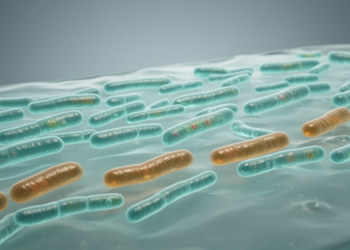
In one of the most hostile bodies of water on Earth, a team of researchers has recovered a bacterium that tolerates calcium concentrations far beyond anything previously recorded for prokaryotes. The organism, Virgibacillus flavescens strain DJP025-4, was isolated from ephemeral microbial mats at the edge of Don Juan Pond in Antarctica’s McMurdo Dry Valleys, a shallow, calcium chloride-saturated brine so extreme that its central waters are considered devoid of life. The findings, published in Frontiers in Microbiology, combine cultivation, microscopy, genome sequencing, transcriptomics and DNA methylation analysis to explain how the strain withstands conditions that destabilize the very molecules of life.
Don Juan Pond, located in the South Fork of Wright Valley at 162 meters above sea level, is a small, shallow pond roughly 200 by 700 meters with an average depth of 15 to 25 centimeters. Its brine is dominated almost entirely by calcium and chloride ions, with salinity reported to exceed 600 grams per liter and calcium concentrations reaching up to 6.0 molar. The pond remains liquid even in the austral winter, with an estimated eutectic point of minus 52 degrees Celsius. Its extreme salinity drives water activity down to 0.41 to 0.45, well below the theoretical limit for replication and metabolism of all known organisms, while the dense calcium ions exert a powerful chaotropic effect, disrupting hydrogen-bonding networks, stripping hydration shells from proteins and denaturing membrane lipids.
Despite these theoretical arguments against life, microbial communities have been occasionally detected on the pond’s western margins for more than half a century, particularly where glacial meltwater enters the basin. In the austral summer of 1978-79, an extensive mat-like structure two to five millimeters thick was observed across much of the western salt marsh, and a similar formation reappeared only 40 years later, yielding four cultured isolates. According to the current understanding described by the researchers, there is no autochthonous microbial community at Don Juan Pond, only a transient marginal community resilient to ultraviolet radiation, desiccation, low water activity and extreme chaotropicity.
The new study focused on sparse bubble-containing microbial mats observed on the southern periphery of the pond in November and December 2022, during the XXXVIII Italian Antarctic Expedition. There, calcium chloride-rich subsurface brine mixes with meltwater from a nearby glacier to form a slow-flowing shallow stream, designated DJP025, with a calcium gradient of 1.05 to 2.75 molar from surface to bottom. The stream’s surface salinity measured 83.5 grams per liter while the bottom reached 300 grams per liter, and laboratory analysis showed values rising from 45.3 grams per liter in the overlying ice to 307 grams per liter at the stream bottom, corresponding to water activities of 0.980 and 0.753 respectively. The central brine, by comparison, measured 485 grams per liter salinity, 4.34 molar calcium and a water activity of 0.425.
Metabarcoding of the mat community revealed 27,009 16S rRNA gene sequences representing 787 distinct amplicon sequence variants, spanning seven bacterial phyla and three eukaryotic phyla, all unicellular phototrophs. No archaeal sequences were detected even with archaea-specific primers. Four genera dominated approximately 40 percent of the reads: Yoonia at 14.9 percent, Gilissia at 11.1 percent, Luteolibacter at 9.1 percent and Virgibacillus at 4.7 percent. The researchers note that the high diversity indices likely reflect intrageneric and intraspecific 16S rRNA gene variation rather than an abundance of distinct species.
Back in the laboratory, enrichment cultures in a medium mimicking the stream’s chemistry yielded four calcium-tolerant isolates: Sutcliffiella horikoshii DJP025-1, Vreelandella glaciei DJP025-2, Virgibacillus arcticus DJP025-3 and Virgibacillus flavescens DJP025-4. All grew at calcium chloride concentrations up to 1.25 molar, but DJP025-4 stood out, showing slight growth at 2.0 molar calcium with a total salinity of 180 grams per liter, a level the authors describe as unattainable for all bacteria known before its discovery. In survival experiments, cells of DJP025-4, most likely in the form of highly resistant spores, remained viable and cultivable after three months of exposure to 2.75 molar calcium, retaining 12 plus or minus 5 percent culturability relative to a calcium-free control. Surviving individuals were even recovered after three months in 3.0 molar calcium, corresponding to a water activity of approximately 0.653 and a total chaotropicity of 262.8 kilojoules per kilogram, thermodynamically similar to the brine of Lake Discovery in the Mediterranean. The strain also resisted the full range of sodium and magnesium perchlorate concentrations tested, salts of direct interest to Mars research.
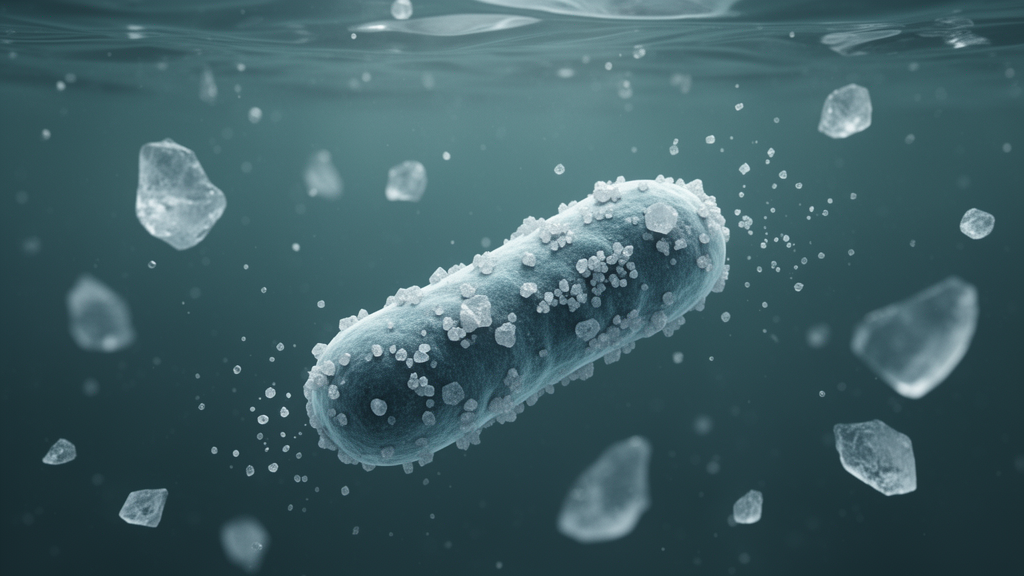
Microscopy revealed how the bacterium manages this feat. Energy-dispersive X-ray spectroscopy showed that cells grown at 1.25 to 1.75 molar calcium chloride became encased in microcrystalline shells in which calcium, not sodium, was deposited, and the carbon and oxygen distribution maps indicated the calcium was bound to carbonate rather than chlorine. Scanning electron microscopy showed cells continuing to grow while coated with precipitated carbonate layers, with calcite encrusting filamentous matrices of extracellular polymeric substances that form mineral bridges between adjacent cells. At 1.75 molar calcium, calcite accumulated at the cell ends as framboidal or spherical aggregations typical of biovaterite. Cryo-electron tomography showed the cell wall thickening from 15 to 40 nanometers, and up to 55 nanometers at the cell poles, likely through increased peptidoglycan and extracellular polymeric matrix, hindering calcium penetration. Polyhydroxyalkanoate-like granules, virtually absent in control cells, appeared at the cell poles under calcium stress, a positioning that ensures each daughter cell inherits a carbon and energy reserve during division.
The genome, a single circular chromosome of 3,584,655 base pairs with 3,650 genes, provided molecular context. The strain lacks a urease gene entirely and showed no ureolytic activity, ruling out the most common microbial calcification pathway, which depends on urea hydrolysis and would be unavailable in the organic-poor pond. Instead, carbon dioxide produced by respiration is hydrated by one beta-class and two gamma-class carbonic anhydrases, generating bicarbonate that precipitates calcium as calcite or vaterite on the cell wall. Anionic peptidoglycans and extracellular polymeric substances containing teichoic, lipoteichoic, N-acetylmuramic and hexuronic acids provide negatively charged groups that capture calcium ions and serve as nucleation sites for crystal formation. The complete gene set for synthesizing these anionic wall components is present in the genome.
Transcriptomics comparing growth in standard medium with growth in medium supplemented with 1 molar calcium chloride identified 2,330 differentially expressed genes, 1,185 upregulated and 1,145 downregulated, with upregulated genes concentrated in transport, osmoadaptation and stress response and downregulated genes in translation, biosynthesis and central metabolism, a coordinated shift from growth to survival. Notably, the pathway converting choline to glycine betaine was repressed under calcium stress, while at least four high-affinity osmoprotectant transport systems were strongly induced, indicating that the strain preferentially imports external compatible solutes rather than synthesizing them. Genes for flagellar proteins, tight pili adherence machinery, peptidoglycan modification and biofilm matrix formation were also upregulated, expanding the cell surface area and the number of calcite nucleation sites. The genome itself carries no genes for de novo choline synthesis, marking the strain as dependent on external sources of this precursor.
Whole-genome analysis added two further layers of adaptation. Twenty-three putative genomic islands, identified by atypical tetranucleotide usage patterns and enriched in central metabolic genes but free of phage or plasmid markers, suggest that natural transformation, the uptake of naked environmental DNA, may be a major mechanism of horizontal gene transfer in this community. And a differential methylome analysis showed that adenine methylation at CAGTNaG motifs was essentially unchanged between conditions, consistent with a constitutively active restriction-modification system, while cytosine methylation shifted substantially under calcium stress: methylation of GcAGCH sites rose from 57 to 66 percent and methylation of cYCANYAD sites fell from 67 to 57 percent. The authors emphasize this is an association rather than a demonstrated causal effect on transcription, but it points to DNA methylation as a possible additional regulatory component of the stress response. Taken together, the researchers propose that within the stratified stream ecosystem, moderate halophiles in the lower-salinity surface mats release dissolved organic matter and osmolytes that DJP025-4 consumes in the deeper, calcium-saturated horizons, allowing a tightly interdependent microbial network to function in conditions otherwise incompatible with survival.
Subject of Research: Isolation and adaptive mechanisms of a highly calcium-tolerant Virgibacillus bacterium from microbial mats at Don Juan Pond, Antarctica
Article Title: Mechanisms of unique chaotropic resistance and biocalcification in a halophilic Virgibacillus isolated from ephemeral microbial mats of the calcium-rich Don Juan pond in Antarctica
Article References: Marturano, L., La Cono, V., Smedile, F., La Spada, G., Crisafi, F., Selivanova, E. A., Ignatenko, M. E., Mudaliyar, M., Ghosal, D., Messina, E., Modica, A., Reva, O. N., Gavrilov, S. N., & Yakimov, M. M. (2026). Mechanisms of unique chaotropic resistance and biocalcification in a halophilic Virgibacillus isolated from ephemeral microbial mats of the calcium-rich Don Juan pond in Antarctica. Frontiers in Microbiology, 17, Article 1980805. https://doi.org/10.3389/fmicb.2026.1980805
Image Credits: AI Generated
DOI: 10.3389/fmicb.2026.1980805
Keywords: Don Juan Pond, Antarctica, extremophiles, Virgibacillus flavescens, biocalcification, chaotropicity, water activity, transcriptomics, DNA methylation, carbonic anhydrase, astrobiology, perchlorate resistance
Cite Scienmag News
Morgan Morrow. (October 28, 2026). Antarctic Pond Bacterium Survives Calcium Levels Once Thought Fatal to Life. Scienmag. https://scienmag.com/antarctic-pond-bacterium-survives-calcium-levels-once-thought-fatal-to-life/
Morgan Morrow. "Antarctic Pond Bacterium Survives Calcium Levels Once Thought Fatal to Life." Scienmag, 28 October 2026, https://scienmag.com/antarctic-pond-bacterium-survives-calcium-levels-once-thought-fatal-to-life/. Accessed 28 October 2026.
Morgan Morrow. "Antarctic Pond Bacterium Survives Calcium Levels Once Thought Fatal to Life." Scienmag. October 28, 2026. https://scienmag.com/antarctic-pond-bacterium-survives-calcium-levels-once-thought-fatal-to-life/