Saturday, October 31, 2026
Science
No Result
View All Result
  • Login
  • HOME
  • SCIENCE NEWS
  • CONTACT US
  • HOME
  • SCIENCE NEWS
  • CONTACT US
No Result
View All Result
Scienmag
No Result
View All Result
Home Science News Space

JWST finds methane in interstellar object 3I/ATLAS is unusually rich in deuterium

October 28, 2026
in Space
Grant Pearson
By Grant Pearson Scienmag Editorial Profile - Observational Astronomy
Reading Time: 3 mins read
0
JWST finds methane in interstellar object 3I/ATLAS is unusually rich in deuterium

JWST finds methane in interstellar object 3I/ATLAS is unusually rich in deuterium

65
SHARES
587
VIEWS
Share on FacebookShare on Twitter
ADVERTISEMENT

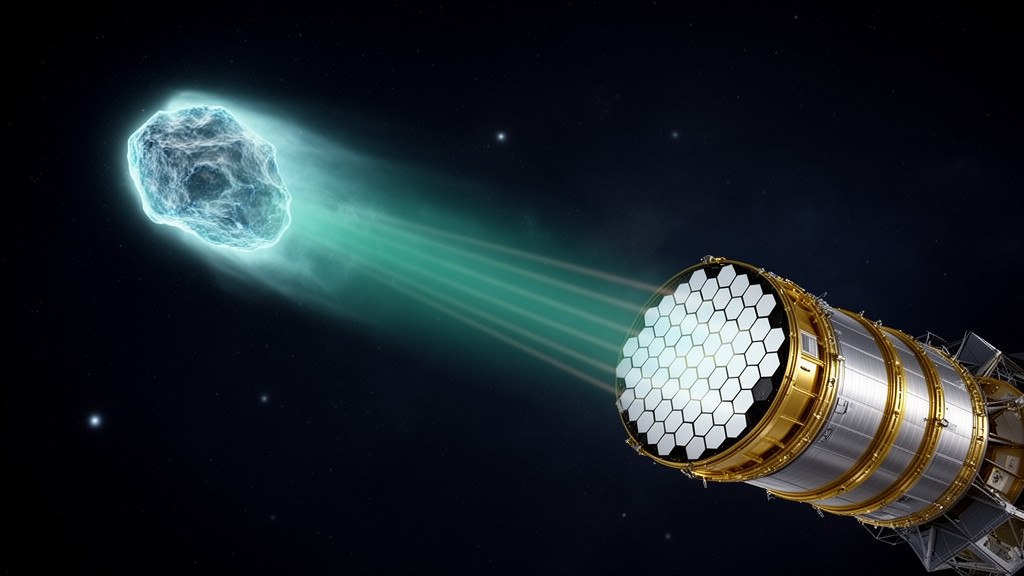
The interstellar object 3I/ATLAS has delivered one of the most striking chemical measurements yet made of material from another planetary system. Using the James Webb Space Telescope, astronomers have detected deuterated methane in its coma and found that the deuterium-to-hydrogen (D/H) ratio of its methane is (3.18 ± 0.30)%, a value higher than any methane measurement made anywhere in the Solar System.

It also represents an exceedingly rare detection of deuterated organic molecules in an interstellar object, offering a direct chemical glimpse into the conditions under which ices formed around the object’s parent star.

The measured methane D/H ratio is a factor of 13 ± 2 higher than the value measured in comet 67P/Churyumov–Gerasimenko by the Rosetta spacecraft, the only other comet for which CH3D has been detected. That comparison makes 3I/ATLAS an outlier even among comets, with a methane D/H ratio higher than any measured in the Solar System.

Interestingly, the comparison between 3I/ATLAS and 67P/Churyumov–Gerasimenko shows a familiar pattern. Both objects display a higher degree of methane deuteration than water deuteration, a trend also seen in other Solar System bodies and in the nearby interstellar medium, where deuteration in organic molecules exceeds that of water by up to an order of magnitude.

While the methane D/H ratio remains observationally unconstrained in extrasolar sources to date, the enriched value measured in 3I/ATLAS resembles those measured in methanol and formaldehyde towards pre- and protostellar environments, regions where new stars and planets are still taking shape.

The research team, led by Nathan X. Roth and including Martin Cordiner, Stefanie Milam and colleagues across multiple institutions, interprets the elevated methane D/H ratio as consistent with the hypothesis that the object’s ices formed in a cold, low-metallicity interstellar or protostellar environment under a high cosmic ray irradiation rate.

Because interstellar objects are interlopers from other planetary systems, their volatile compositions provide a rare opportunity to sample planet-forming material from beyond the Solar System without waiting for a spacecraft mission.

The measurement also highlights the power of the James Webb Space Telescope for interstellar object science.

As 3I/ATLAS continues its journey through and out of the Solar System, the enriched methane D/H ratio now stands as a chemical record of its birthplace: a cold, irradiated, metal-poor environment in which deuterium was woven into organic ice far more heavily than in the comets of our own Solar System.

Subject of Research: Deuterium enrichment in methane measured in the coma of interstellar object 3I/ATLAS

Article Title: An enriched methane D/H ratio in the interstellar object 3I/ATLAS

Article References: Roth, N. X., Cordiner, M., Milam, S., Villanueva, G., Charnley, S., Biver, N., Bockelée-Morvan, D., Bodewits, D., Crovisier, J., Drozdovskaya, M. N., Farnocchia, D., Furuya, K., Kelley, M. S. P., Micheli, M., Noonan, J. W., Opitom, C., Schwamb, M. E., & Thomas, C. A. (2026). An enriched methane D/H ratio in the interstellar object 3I/ATLAS. Nature Astronomy. https://doi.org/10.1038/s41550-026-03002-5

Image Credits: AI Generated

DOI: 10.1038/s41550-026-03002-5

Keywords: 3I/ATLAS, interstellar object, James Webb Space Telescope, methane, deuterium, D/H ratio, comet 67P, Rosetta, astrochemistry, protostellar environments, cosmic rays, Nature Astronomy

Cite Scienmag News

Grant Pearson. (October 28, 2026). JWST finds methane in interstellar object 3I/ATLAS is unusually rich in deuterium. Scienmag. https://scienmag.com/jwst-finds-methane-in-interstellar-object-3i-atlas-is-unusually-rich-in-deuterium/

Grant Pearson. "JWST finds methane in interstellar object 3I/ATLAS is unusually rich in deuterium." Scienmag, 28 October 2026, https://scienmag.com/jwst-finds-methane-in-interstellar-object-3i-atlas-is-unusually-rich-in-deuterium/. Accessed 31 October 2026.

Grant Pearson. "JWST finds methane in interstellar object 3I/ATLAS is unusually rich in deuterium." Scienmag. October 28, 2026. https://scienmag.com/jwst-finds-methane-in-interstellar-object-3i-atlas-is-unusually-rich-in-deuterium/
Tags: 3I/ATLASastrochemistrychemical signatures of ices around parent starscomet 67Pcomparison of D/H ratios in Solar System and interstellar objectscosmic raysD/H ratiodeuterated methane in spacedeuteriumdeuterium-to-hydrogen ratio in organic moleculesimplications for planetary system formationinterstellar chemistry andinterstellar objectinterstellar object 3I/ATLAS chemical compositioninterstellar objectsJames Webb Space TelescopeJames Webb Space Telescope methane detectionmethanemethane deuteration in comets and interstellar mediummethane isotopic ratios in spaceNature Astronomyorganic molecules in interstellar objectsprotostellar environmentsRosetta
Share26Tweet16
Previous Post

Carbon tax thresholds could steer China–Europe shipping toward the Arctic Northeast Passage

Next Post

Two Distinct Mineralized Skarn Types Uncovered in Nigeria’s Tsauni Metagranitoids

Related Posts

Physicists Pin Down the Hidden Voltage Source Behind Geomagnetically Induced Currents
Space

Physicists Pin Down the Hidden Voltage Source Behind Geomagnetically Induced Currents

October 30, 2026
Moon’s mightiest mountain revealed as a three-sided pyramid taller than Everest’s base-to-peak height
Space

Moon’s mightiest mountain revealed as a three-sided pyramid taller than Everest’s base-to-peak height

October 30, 2026
CubeSat Deorbit Method Targets Re-Entry Longitude by Accounting for Earth’s Rotation
Space

CubeSat Deorbit Method Targets Re-Entry Longitude by Accounting for Earth’s Rotation

October 30, 2026
SETI Institute Adds Three Artists-in-Residence Probing Life, Intelligence and Consciousness
Space

SETI Institute Adds Three Artists-in-Residence Probing Life, Intelligence and Consciousness

October 30, 2026
Genetic Algorithm Tracks Relay of Three Dissipation Channels in Warm Higgs Inflation
Space

Genetic Algorithm Tracks Relay of Three Dissipation Channels in Warm Higgs Inflation

October 30, 2026
Tidal forces may have concentrated deep lunar heat near the core-mantle boundary, model suggests
Space

Tidal forces may have concentrated deep lunar heat near the core-mantle boundary, model suggests

October 30, 2026
Next Post
Two Distinct Mineralized Skarn Types Uncovered in Nigeria’s Tsauni Metagranitoids

Two Distinct Mineralized Skarn Types Uncovered in Nigeria's Tsauni Metagranitoids

  • Mothers who receive childcare support from maternal grandparents show more optimized

    Mothers who receive childcare support from maternal grandparents show more parental warmth, finds NTU Singapore study

    27656 shares
    Share 11059 Tweet 6912
  • University of Seville Breaks 120-Year-Old Mystery, Revises a Key Einstein Concept

    1061 shares
    Share 424 Tweet 265
  • Bee body mass, pathogens and local climate influence heat tolerance

    682 shares
    Share 273 Tweet 171
  • Researchers record first-ever images and data of a shark experiencing a boat strike

    546 shares
    Share 218 Tweet 137
  • Groundbreaking Clinical Trial Reveals Lubiprostone Enhances Kidney Function

    531 shares
    Share 212 Tweet 133
Science

Embark on a thrilling journey of discovery with Scienmag.com—your ultimate source for cutting-edge breakthroughs. Immerse yourself in a world where curiosity knows no limits and tomorrow’s possibilities become today’s reality!

RECENT NEWS

  • Trademarks Meet Patents in New Method to Spot Technology Opportunities
  • Reddit self-declarations offer auditable labels for demographic inference
  • Scots pine needles map trace element pollution in Polish industrial town
  • Dual-blockchain scheme secures vehicle handovers without pre-shared keys

Categories

  • Agriculture
  • Anthropology
  • Archaeology
  • Athmospheric
  • Biology
  • Biotechnology
  • Blog
  • Bussines
  • Cancer
  • Chemistry
  • Climate
  • Earth Science
  • Editorial Policy
  • Marine
  • Mathematics
  • Medicine
  • Pediatry
  • Policy
  • Psychology & Psychiatry
  • Science Education
  • Science News
  • Social Science
  • Space
  • Technology and Engineering

Subscribe to Blog via Email

Enter your email address to subscribe to this blog and receive notifications of new posts by email.

Join 5,150 other subscribers

© 2025 Scienmag - Science Magazine

Welcome Back!

Login to your account below

Forgotten Password?

Retrieve your password

Please enter your username or email address to reset your password.

Log In
No Result
View All Result
  • HOME
  • SCIENCE NEWS
  • CONTACT US

© 2025 Scienmag - Science Magazine

Discover more from Science

Subscribe now to keep reading and get access to the full archive.

Continue reading