


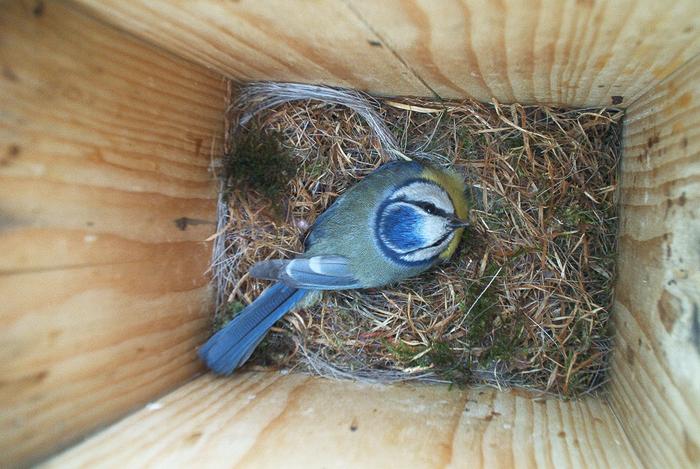
Young male blue tits are less successful in fathering offspring outside their breeding pair, not because of a lack of experience, but because they are outcompeted by older males, Bart Kempenaers and colleagues from the Max Planck Institute for Biological Intelligence in Germany report in a study publishing April 16th in the open-access journal PLOS Biology.

Credit: Kaspar Delhey, MPIBI (CC-BY 4.0,
Young male blue tits are less successful in fathering offspring outside their breeding pair, not because of a lack of experience, but because they are outcompeted by older males, Bart Kempenaers and colleagues from the Max Planck Institute for Biological Intelligence in Germany report in a study publishing April 16th in the open-access journal PLOS Biology.
Many birds form breeding pairs but will also mate and produce offspring outside of that pairing — known as “extra-pair” paternity. Inexperienced males in their first year of breeding are less likely to father extra-pair offspring than adult males, but it is unclear whether their poor performance is because of competition with older males, or because of a lack of skills or experience. Between 2007 and 2021, researchers studied the breeding behavior of a wild population of blue tits (Cyanistes caeruleus) living in nest boxes in a German forest, using radio-frequency identification technology, behavioral observations, and DNA testing. Then, in 2022, the team relocated almost all the adult males from the population. They compared the extra-pair breeding success of young males in this altered population with data from the previous 15 years. In the absence of competition from adult males, 33% of young males fathered at least one extra-pair offspring, compared to just 13% on average in years when adult males were present. Their extra-pair breeding success matched that of adult males in normal conditions.
These results suggest that young males’ failure to father extra-pair offspring is due to competition with adult males, rather than a lack of experience or maturity. Adult males may outcompete young males for a variety of reasons. They might fare better in fights over females, they might invest more energy in extra-pair mating, females may find them more attractive, or a combination of these factors might be at play, the authors say.
The authors add, “Our study indicates that the generally observed low extra-pair siring success of first-year males is due to competition with older males. This age effect is thus mediated by the social environment, at least in the blue tit.”
#####
In your coverage, please use this URL to provide access to the freely available paper in PLOS Biology:
Citation: Schlicht E, Gilsenan C, Santema P, Türk A, Wittenzellner A, Kempenaers B (2024) Removal of older males increases extra-pair siring success of yearling males. PLoS Biol 22(4): e3002584.
Author Countries: Germany, United Kingdom
Funding: This work was supported by the Max Planck Society (to BK). All authors received a salary from the Max Planck Society. The funder had no role in study design, data collection and analysis, decision to publish, or preparation of the manuscript.
Journal
PLoS Biology
Method of Research
Experimental study
Subject of Research
Animals
COI Statement
Competing interests: The authors have declared that no competing interests exist.
Cite Scienmag News
Drew Townsend. (April 16, 2024). Older males out-compete young males when it comes to extra-marital breeding. Scienmag. https://scienmag.com/older-males-out-compete-young-males-when-it-comes-to-extra-marital-breeding/
Drew Townsend. "Older males out-compete young males when it comes to extra-marital breeding." Scienmag, 16 April 2024, https://scienmag.com/older-males-out-compete-young-males-when-it-comes-to-extra-marital-breeding/. Accessed 4 September 2026.
Drew Townsend. "Older males out-compete young males when it comes to extra-marital breeding." Scienmag. April 16, 2024. https://scienmag.com/older-males-out-compete-young-males-when-it-comes-to-extra-marital-breeding/

