Friday, October 30, 2026
Science
No Result
View All Result
  • Login
  • HOME
  • SCIENCE NEWS
  • CONTACT US
  • HOME
  • SCIENCE NEWS
  • CONTACT US
No Result
View All Result
Scienmag
No Result
View All Result
Home Science News Biology

Alx4 keeps its limb-building role even as its expression shifts across amniotes

October 28, 2026
in Biology
Juliet Wilcox
By Juliet Wilcox Scienmag Editorial Profile - Human Genetics
Reading Time: 2 mins read
0
Alx4 keeps its limb-building role even as its expression shifts across amniotes

Alx4 keeps its limb-building role even as its expression shifts across amniotes

65
SHARES
587
VIEWS
Share on FacebookShare on Twitter
ADVERTISEMENT

A gene that helps build limbs has kept its protein function remarkably stable across millions of years of amniote evolution, even as the places where it is switched on in the developing limb have changed, according to a new open-access study published in Developmental Biology Advances on 27 September 2026.

The research, led by Ziqiu Jia, Shibin Bai, Shanshan Li and colleagues with senior author Zhe Wang, focused on Alx4, an Aristaless-like homeobox gene that is required for vertebrate limb development. Morphological diversification among amniote limbs is widely thought to arise through evolutionary changes in developmental gene regulation, yet whether divergent gene expression is accompanied by divergence in developmental function has remained unclear. The team set out to test that question directly.

Comparative expression analysis showed that Alx4 exhibits divergent spatial expression patterns in chicken and mouse limb buds, meaning the gene is active in different regions of the early limb in the two species.

In contrast, when the researchers examined evolutionary sequence conservation across 51 amniote species, they found the coding sequence to be strongly conserved. Key functional domains were completely conserved, and the analysis revealed pervasive purifying selection, indicating that evolution has consistently removed mutations that would alter the protein.

To probe function, the team carried out cross-species gain-of-function assays in chicken embryos. Chicken, mouse and human Alx4 orthologs induced highly similar limb phenotypes, characterized mainly by skeletal shortening and, less frequently, by tibial widening, syndactyly and ectopic sesamoid-like cartilage.

Transcriptomic profiling further identified shared downstream responses involving extracellular matrix organization, focal adhesion, Wnt signaling and skeletal development, suggesting that the different orthologs act through overlapping molecular pathways.

The authors conclude that Alx4 retains a conserved developmental function despite divergence in limb bud expression. This suggests that differences in Alx4 regulation may contribute to variation in limb development, whereas changes in Alx4 protein function are less likely to explain the observed evolutionary differences.

The study is being shared early to provide faster access to peer-reviewed, accepted research; it is citable and carries a permanent DOI, and this version is subject to further edits before the final Version of Record replaces it.

For evolutionary developmental biology, the finding adds a concrete example of a pattern long suspected in the field: regulatory changes, rather than alterations in the protein itself, may underlie much of the diversity in how amniote limbs take shape.

Subject of Research: Evolutionary conservation and divergence of the Alx4 gene in amniote limb development

Article Title: Divergent expression and conserved function of Alx4 for limb development in amniotes

Article References: Jia, Z., Bai, S., Li, S., Tang, Y., Li, X., Zhang, J., Irwin, D. M., Zhang, S., & Wang, Z. (2026). Divergent expression and conserved function of Alx4 for limb development in amniotes. Developmental Biology Advances. https://doi.org/10.1186/s13227-026-00275-9

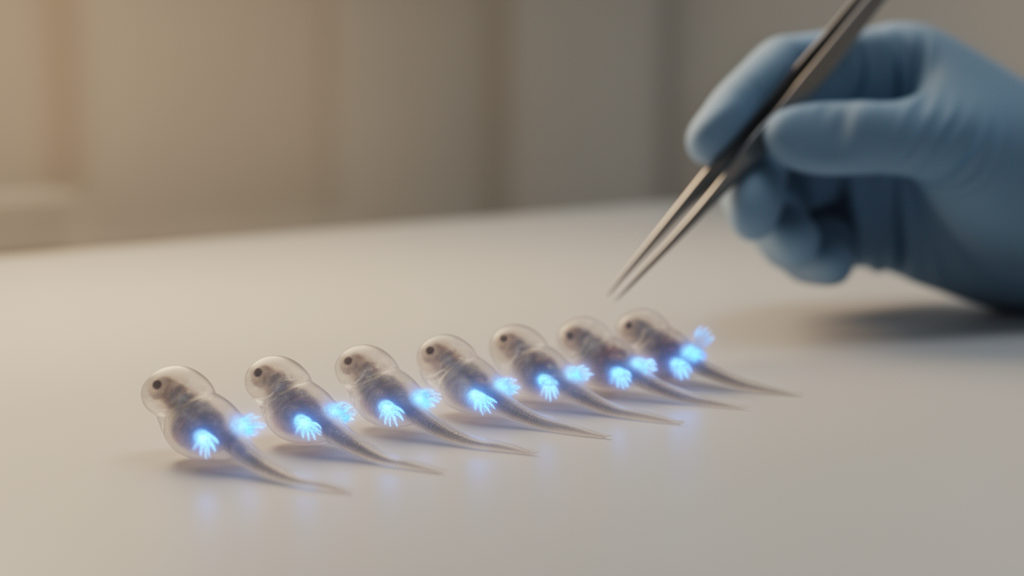
Image Credits: AI Generated

DOI: 10.1186/s13227-026-00275-9

Keywords: Alx4, limb development, amniotes, gene regulation, chicken embryos, mouse, purifying selection, transcriptomics, Wnt signaling, evolutionary developmental biology, homeobox gene, skeletal development

Cite Scienmag News

Juliet Wilcox. (October 28, 2026). Alx4 keeps its limb-building role even as its expression shifts across amniotes. Scienmag. https://scienmag.com/alx4-keeps-its-limb-building-role-even-as-its-expression-shifts-across-amniotes/


Juliet Wilcox. "Alx4 keeps its limb-building role even as its expression shifts across amniotes." Scienmag, 28 October 2026, https://scienmag.com/alx4-keeps-its-limb-building-role-even-as-its-expression-shifts-across-amniotes/. Accessed 30 October 2026.

Juliet Wilcox. "Alx4 keeps its limb-building role even as its expression shifts across amniotes." Scienmag. October 28, 2026. https://scienmag.com/alx4-keeps-its-limb-building-role-even-as-its-expression-shifts-across-amniotes/

Tags: Alx4Alx4 gene functionamniote limb developmentamnioteschicken embryoscomparative genomics in amniotesdevelopmental gene expression divergenceevolutionary conservation of developmental genesevolutionary developmental biologyevolutionary stability of protein functionGene regulationgene regulation in limb morphogenesishomeobox genehomeobox genes in limb formationlimb developmentmorphological diversification in limbsmousepurifying selectionpurifying selection in gene evolutionskeletal developmentspatial gene expression patternsTranscriptomicsvertebrate limb evolutionWnt signaling
Share26Tweet16
Previous Post

Iron-Chromium Atom Pairs Boost Catalyst Activity and Durability for Fuel Cells

Next Post

Flavoromics maps the volatile ticking clock of a stored wine cap mushroom

Related Posts

Microbial Sources and Stress Shape the Hidden Endophytes of an Invasive Plant
Biology

Microbial Sources and Stress Shape the Hidden Endophytes of an Invasive Plant

October 30, 2026
Firebreaks Leave Lasting Scars in Grasslands While Wildfire Heals Fast
Biology

Firebreaks Leave Lasting Scars in Grasslands While Wildfire Heals Fast

October 30, 2026
Hidden Peptides in Non-Coding RNAs Reshape Cardiovascular Biology
Biology

Hidden Peptides in Non-Coding RNAs Reshape Cardiovascular Biology

October 30, 2026
Phage K Holin’s C-Terminal Region Shapes Antibacterial Activity, Study Finds
Biotechnology

Phage K Holin’s C-Terminal Region Shapes Antibacterial Activity, Study Finds

October 30, 2026
Computational screen flags five natural compounds that bind a tuberculosis virulence enzyme
Chemistry

Computational screen flags five natural compounds that bind a tuberculosis virulence enzyme

October 30, 2026
Antifungal liver injury study pinpoints KDR as shared hepatotoxicity target
Biology

Antifungal liver injury study pinpoints KDR as shared hepatotoxicity target

October 30, 2026
Next Post
Flavoromics maps the volatile ticking clock of a stored wine cap mushroom

Flavoromics maps the volatile ticking clock of a stored wine cap mushroom

  • Mothers who receive childcare support from maternal grandparents show more optimized

    Mothers who receive childcare support from maternal grandparents show more parental warmth, finds NTU Singapore study

    27656 shares
    Share 11059 Tweet 6912
  • University of Seville Breaks 120-Year-Old Mystery, Revises a Key Einstein Concept

    1061 shares
    Share 424 Tweet 265
  • Bee body mass, pathogens and local climate influence heat tolerance

    682 shares
    Share 273 Tweet 171
  • Researchers record first-ever images and data of a shark experiencing a boat strike

    546 shares
    Share 218 Tweet 137
  • Groundbreaking Clinical Trial Reveals Lubiprostone Enhances Kidney Function

    531 shares
    Share 212 Tweet 133
Science

Embark on a thrilling journey of discovery with Scienmag.com—your ultimate source for cutting-edge breakthroughs. Immerse yourself in a world where curiosity knows no limits and tomorrow’s possibilities become today’s reality!

RECENT NEWS

  • Microbial Sources and Stress Shape the Hidden Endophytes of an Invasive Plant
  • Firebreaks Leave Lasting Scars in Grasslands While Wildfire Heals Fast
  • Regularisation and voluntary return reproduce precarity for irregularised migrants in Spain and the UK
  • ZNF207 shields glutamine transporter ASCT2 from degradation to fuel liver cancer growth

Categories

  • Agriculture
  • Anthropology
  • Archaeology
  • Athmospheric
  • Biology
  • Biotechnology
  • Blog
  • Bussines
  • Cancer
  • Chemistry
  • Climate
  • Earth Science
  • Editorial Policy
  • Marine
  • Mathematics
  • Medicine
  • Pediatry
  • Policy
  • Psychology & Psychiatry
  • Science Education
  • Science News
  • Social Science
  • Space
  • Technology and Engineering

Subscribe to Blog via Email

Enter your email address to subscribe to this blog and receive notifications of new posts by email.

Join 5,151 other subscribers

© 2025 Scienmag - Science Magazine

Welcome Back!

Login to your account below

Forgotten Password?

Retrieve your password

Please enter your username or email address to reset your password.

Log In
No Result
View All Result
  • HOME
  • SCIENCE NEWS
  • CONTACT US

© 2025 Scienmag - Science Magazine

Discover more from Science

Subscribe now to keep reading and get access to the full archive.

Continue reading