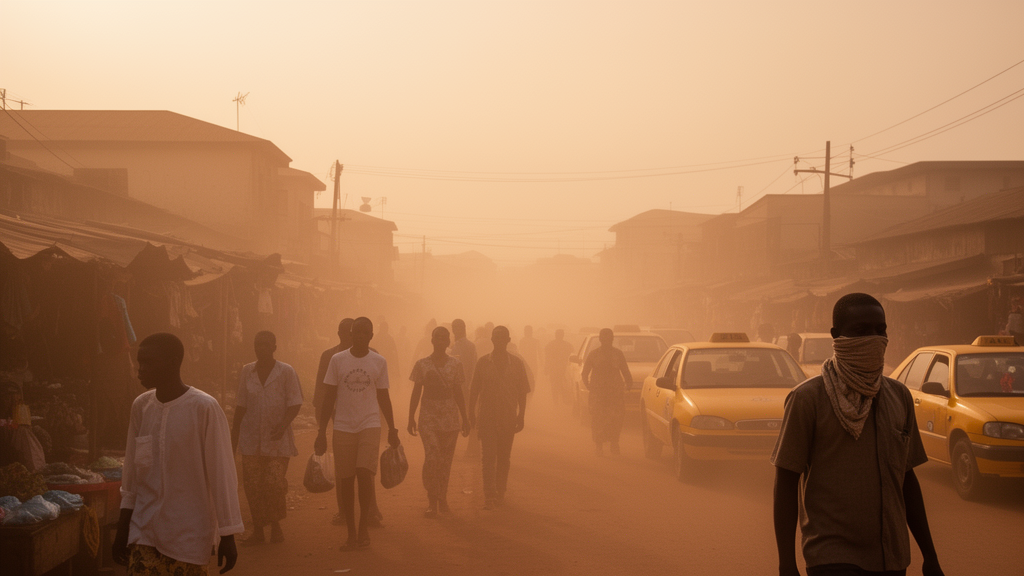
Researchers who spent a full dry season sampling the air at two very different Ghanaian locations have found that fine inhalable particles carry concentrations of chromium and nickel far above United States regulatory thresholds, and that the way people live and work at each site leaves a distinct chemical fingerprint in the dust they breathe. The study, published in the Asian Journal of Atmospheric Environment, compared a busy highway intersection at Winneba with a coastal fish-smoking community at Apam, both in Ghana’s Central Region, and concluded that exposure to the toxic elements embedded in airborne particles poses moderate to significant potential cancer risks, particularly for adults.
The team, led by Francis Attiogbe and Godfred Safo-Adu, collected particulate matter with aerodynamic diameters of 10 micrometres or less, known as PM10, using a Gent sampler fitted with a Gast pump and a stacked filter unit. Sampling ran three times per week from November 2022 to March 2023, with each session lasting 24 hours, and the instruments were mounted two metres above the ground and operated at flow rates of 16 to 17 litres per minute. In total, 86 samples underpinned the analysis. The filters were analysed for elemental composition with a silver-anode X-ray tube spectrometer, while black carbon was quantified with a smoke stain reflectometer.
The headline concentrations are striking. Average chromium levels reached 77 nanograms per cubic metre at the Winneba Highway Intersection and 310 nanograms per cubic metre at the Apam Fish-smoking Community. Nickel averaged 210 nanograms per cubic metre at Winneba and 470 nanograms per cubic metre at Apam. All four figures exceeded the threshold limits set by the US Environmental Protection Agency. By contrast, daily mean concentrations of arsenic and lead stayed below both US EPA and European Union limits, and manganese remained below the World Health Organization guideline of 150 nanograms per cubic metre on average.
Overall particulate levels also breached health-based guidelines. The mean 24-hour PM10 concentrations were 80 micrograms per cubic metre at Apam and 71 micrograms per cubic metre at Winneba, both above the WHO permissible limit of 45 micrograms per cubic metre. Black carbon peaked at 11 micrograms per cubic metre across the sites, with averages of 5.3 micrograms per cubic metre at Winneba and 4.4 at Apam, levels the authors attribute to heavy vehicle traffic and biomass burning. The researchers note that comparable dry-season measurements in Enugu State, Nigeria, and Conakry, Guinea, were even higher, at 205.07 and 431.19 micrograms per cubic metre respectively, owing to massive road-dust resuspension and diesel traffic.
Timing mattered. December through February, which coincides with the Harmattan, recorded the highest PM10 levels, with January peaking at Apam and February at Winneba. During these months the Harmattan wind carries Saharan dust across West Africa, and the authors argue that a combination of long-range dust transport, intensified local emissions and atmospheric conditions that trap pollutants near the ground explains the elevated readings. The monthly average Air Quality Index values for December to February ranged from 63 to 94, falling within the US EPA’s moderate band, which implies that sensitive groups such as children, the elderly and pregnant women should avoid prolonged outdoor exposure. November and March, by contrast, showed good air quality, with AQI values between 32 and 48 and mean PM10 below the WHO limit.
The chemical profile differed sharply between the two sites. At Apam, magnesium and sodium dominated, with magnesium averaging 14,000 nanograms per cubic metre, the highest of any element measured there, while silicon topped the list at Winneba at 12,000 nanograms per cubic metre. Crustal elements such as iron, silicon, aluminium, calcium and sodium prevailed overall. Sodium and chlorine, major components of marine aerosols, were abundant at both locations, and the measured chlorine-to-sodium ratios of 0.75 at Winneba and 0.72 at Apam fell well below the benchmark of 1.8 that indicates fresh sea salt, suggesting the marine aerosols at both sites were aged and had reacted with acidic pollutants in the air.
To trace where the particles came from, the team applied three complementary tools: Pearson correlation analysis, an enrichment factor model referenced to iron and average upper continental crust composition, and principal component analysis. Enrichment factors showed that titanium, calcium, aluminium, sodium, magnesium, iron, manganese and silicon were non-enriched, pointing to crustal origins, while chlorine, cobalt, nickel, copper, zinc and bromine were highly enriched at Winneba, marking them as anthropogenic. At Apam, zinc, lead, bromine, copper, nickel, sulphur, chlorine and chromium were highly enriched. Strong correlations among aluminium, iron, titanium, silicon and calcium indicated windblown soil, and sulphur and potassium were tightly linked at both sites, a pattern typical of diesel and other combustion sources.
The principal component analysis resolved the sources into four factors at each site. At Winneba, the first component, accounting for 67.4 percent of the variance, combined sea salt, fugitive dust from soil and roads, and a suite of trace elements; the second pointed to vehicle exhaust; the third to brake and tyre wear; and the fourth, dominated by zinc, to minor industrial activities such as the small-scale vehicle painting, metal welding, corn milling and paper milling operations located near the interchange. At Apam, the leading component was attributed to sea salt, the second to soil dust mixed with biomass burning, the third to brake and tyre wear, and the fourth, loaded with lead and arsenic, to vehicle exhaust. The authors acknowledge an inconsistency in their results: the enrichment factor model assigned chromium and nickel at Apam to anthropogenic emissions, while the PCA grouped them with sea salt, likely because strong coastal sea-spray pulses masked weaker anthropogenic signals in the statistical analysis.
The health risk assessment, which followed the US EPA framework under a residential exposure scenario with 24-hour daily exposure, 350 exposure days per year, six-year exposure durations for children and 24 years for adults, produced sobering results. Hazard quotients for arsenic, hexavalent chromium, copper, zinc and lead were below the safety threshold of one for both age groups at both sites, indicating negligible non-cancer risks. But nickel inhalation posed non-cancer risks, with hazard quotients of 14.9 to 32.3, and cobalt at Winneba sat just above the threshold at 1.01. The combined hazard index exceeded one at both locations, signalling significant overall non-carcinogenic risk. For hexavalent chromium, estimated by assuming a one-to-six ratio with trivalent chromium, the calculated cancer risk for adults at Apam crossed into the significant range, above 10 to the power of minus four, while total cancer risks at Winneba, between 1.57 and 6.2 times 10 to the minus five, fell in the moderate band. Adults fared worse than children across the board, which the authors attribute to greater cumulative exposure over longer lifetimes.
The study has clear limitations that the authors themselves enumerate. It covered only one fish-smoking community and one highway intersection in Ghana’s Central Region, the sampling period was short, background PM10 levels were not measured, and gases such as ozone, sulphur oxides and nitrogen oxides were outside its scope. The risk model treats all individuals as equally susceptible and, by the authors’ own account, may understate actual exposure. Even so, the work is presented as the first direct comparison of elemental particulate pollution between a wood-burning neighbourhood and a highway crossroads in Ghana, and it fills a gap in a region where long-term air quality monitoring infrastructure remains scarce. The team’s recommendations are practical: cleaner fuels, sustainable transport, better-ventilated and properly maintained fish-smoking kilns, and adoption of the Food and Agriculture Organization’s Thiaroye Processing Technology kilns, which are designed to cut particulate emissions and protect the health of the people who use them.
Subject of Research: Elemental composition, sources and health risks of dry-season PM10 pollution at a Ghanaian highway intersection and a fish-smoking community
Article Title: Elemental characterisation, potential sources and health risk assessment of ambient PM10 in urban Ghana during the dry season
Article References: Attiogbe, F., Safo-Adu, G., Ofosu, F. G., Sam, A., Gyampo, O., & Ahiamadjie, H. (2026). Elemental characterisation, potential sources and health risk assessment of ambient PM10 in urban Ghana during the dry season. Asian Journal of Atmospheric Environment, 20(1), Article 16. https://doi.org/10.1007/s44273-026-00096-1
Image Credits: AI Generated
DOI: 10.1007/s44273-026-00096-1
Keywords: PM10, air pollution, Ghana, heavy metals, chromium, nickel, black carbon, Harmattan, biomass burning, fish smoking, cancer risk, source apportionment
Cite Scienmag News
Russell Cooper. (October 28, 2026). Toxic Chromium and Nickel Soar in Ghana’s Dry Season Air, Study Finds. Scienmag. https://scienmag.com/toxic-chromium-and-nickel-soar-in-ghanas-dry-season-air-study-finds/
Russell Cooper. "Toxic Chromium and Nickel Soar in Ghana’s Dry Season Air, Study Finds." Scienmag, 28 October 2026, https://scienmag.com/toxic-chromium-and-nickel-soar-in-ghanas-dry-season-air-study-finds/. Accessed 28 October 2026.
Russell Cooper. "Toxic Chromium and Nickel Soar in Ghana’s Dry Season Air, Study Finds." Scienmag. October 28, 2026. https://scienmag.com/toxic-chromium-and-nickel-soar-in-ghanas-dry-season-air-study-finds/