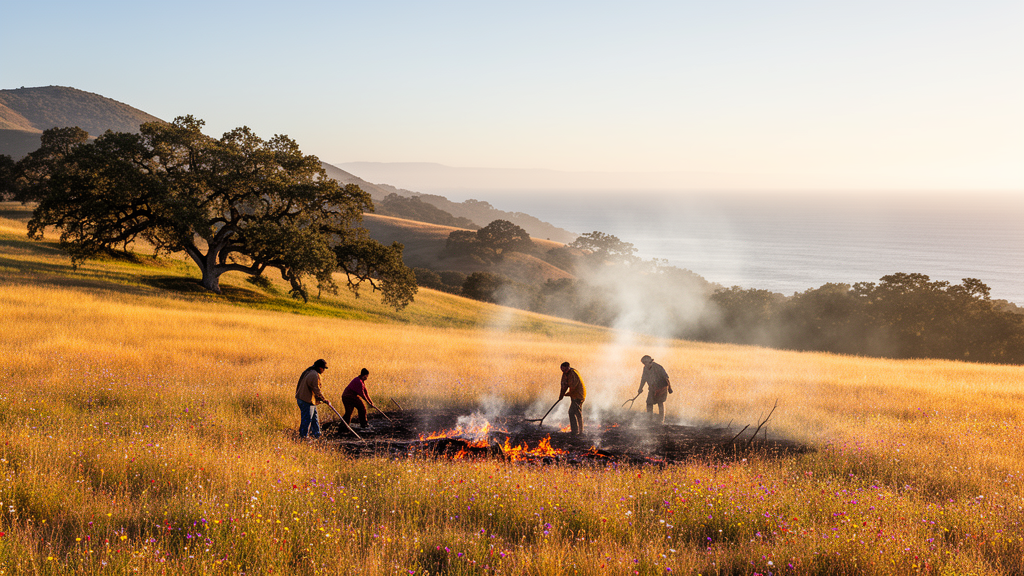
A sweeping review of fire-scarred tree rings, wetland sediment cores, ancient soil samples and archaeological excavations concludes that Indigenous communities along the Central California Coast deliberately burned coastal prairies for at least 1,300 years, beginning around 700 to 800 CE and continuing into historic times. The synthesis, published in the journal Fire Ecology, argues that the region’s once-extensive grasslands could not have persisted under lightning-ignited fires alone, because natural ignition in the area is simply too rare to sustain prairie ecosystems that begin converting to shrubland within a few years without fire.
The paper, authored by Kent Lightfoot, Peter Nelson and Scott Stephens, examines a review area stretching from Fort Ross to Santa Cruz, including San Francisco Bay, the homeland of Kashia Pomo, Southern Pomo, Coast Miwok and Costanoan peoples. The authors set out to address a long-running debate: how much of the precolonial fire regime was driven by humans rather than lightning. Distinguishing the two is notoriously difficult, since human-set fires may have mimicked natural regimes or left only subtle signals in ecological records. The researchers therefore generated explicit expectations for each scenario, predicting fire return intervals of roughly 50 to 100 years or more for lightning-dominated regimes, and intervals of 1 to 10 years for sustained cultural burning.
The case for human ignition rests partly on how rarely lightning strikes the Central California Coast. Using lightning data from 1985 to 2000, the authors note that this region recorded the lowest strike frequency in California, at fewer than three strikes per 100 square kilometers per year, and only about 1.2 to 1.7 percent of strikes actually ignited fires. Estimated lightning fire return intervals of 50 to 100 years or more fall far short of what coastal prairies require. Field studies cited in the review indicate that shrubs and conifers can begin invading open grasslands within just 3 to 5 years, and that fire intervals of roughly 2 to 10 years are needed to keep woody vegetation from converting prairies into scrub and forest.
Colonial eyewitness accounts provide a vivid snapshot of the practice at the moment of contact. Russian visitors at Colony Ross, established in 1812 in Kashia Pomo country, described Indigenous people burning meadows to increase their fertility, and in 1818 an observer aboard the Kamchatka recorded fires burning through the night after harvest of a wild rye-like grain, noting that burning the stubble made the next year’s crop bigger and more flavorful. Spanish expedition records from 1769 to 1775, analyzed in detail by the archaeologist Rob Cuthrell, describe extensively burned grassland corridors roughly 1 to 5 kilometers wide along the coast and bay shore, with burned patches of several square kilometers forcing expeditions to search for unburned pasture for their livestock.
The dendroecological evidence comes from fire scars preserved in the annual rings of old-growth coast redwood and Douglas-fir stumps left by industrial logging. Across nine studies in the review area, most sites yielded fire return intervals of 4 to 16 years in the earliest periods analyzed, with a few sites showing intervals of 22 to 50 years. Most researchers concluded that this frequency was too high to be explained by lightning alone, particularly during the Little Ice Age, when cooler and wetter conditions would have suppressed natural ignition. The authors caution that small, low-intensity surface fires may leave no scar at all, making these figures conservative estimates of actual fire frequency.
Sediment cores from seven wetlands with well-documented radiocarbon chronologies told a complementary story. Charcoal accumulation rates indicate that frequent burning was established across much of the coast by 3500 to 2000 years ago, and pollen records show grassland ecosystems maintained within a patchwork of scrublands, woodlands and forests. The studies also confirmed that climate mattered: fire activity varied with temperature and moisture, and no clear trends emerged for the Medieval Climatic Anomaly or the Little Ice Age. But in several areas, sustained periods of frequent, relatively low-intensity fires over multiple centuries were correlated with grassland and fire-follower plants, a pattern the authors say warrants further study.
The eco-archaeological evidence is perhaps the most striking. At seven excavated residential settlements, flotation of sediment samples recovered abundant seeds from grassland plants, with grasses by far the most common, alongside panicled bulrush, coast tarweed, clover, composites, bedstraw, wild cucumber, goosefoot and phacelias. Hazelnut, a species that responds well to frequent fire and is now nearly absent from the region, was the primary nut food recovered at Santa Cruz coast sites. Charcoal analysis showed that people burned fuel from fire-adapted species, including coast redwood and California lilac, a fire-enabled shrub whose seeds germinate en masse after burns, while Douglas-fir saplings, which suffer mortality rates above 90 percent in low-intensity fires, and coyote brush were strikingly scarce in the archaeological record.
Phytolith analysis, which detects microscopic silica bodies produced by grasses, provided independent confirmation of long-lived grasslands. Soil samples near the settlements contained 0.5 to 4 percent phytoliths by dry weight, well above the roughly 0.3 percent threshold that indicates sustained grassland vegetation spanning hundreds of years or more. Comparable results at Fort Ross and Salt Point State Parks showed grasslands once dominated coastal terraces that are now covered by shrublands and forests, with bishop pine encroaching into former prairie only 22 to 123 years ago and Douglas-fir about 50 to 70 years ago, after the suppression of Indigenous burning.
The authors argue that the most compelling evidence for cultural burning comes from the Little Ice Age, between roughly 1200 and 1850 CE, when cool, wet conditions would have made lightning fires rare and long fire intervals expected. Identifying human ignition during the warmer, drier Medieval Climatic Anomaly is harder, though the authors suggest that even if lightning fires increased, they likely remained too infrequent to sustain prairies. There are also hints of much earlier burning: an uptick in regional fire activity at 3500 to 2000 years ago, intensified fire activity around 6500 years ago at one site, and seed assemblages from Tolay Valley that may extend back 6000 or more years, though the authors stress that more corroborating evidence is needed.
The review carries pointed implications for a state now confronting catastrophic wildfires and perilously high fuel loads after more than a century of fire suppression. California’s native grasslands have collapsed to an estimated 1 to 2 percent of their former extent, and the authors attribute much of that loss to colonial bans on Indigenous burning, first imposed by Spanish and Russian settlers more than 200 years ago, and later to American fire suppression policies. Tribes across California are now working to revitalize cultural burning in partnership with state and federal agencies, and the authors argue that acknowledging the centuries-long Indigenous role in shaping the state’s environments should be central to how California manages its fire future.
Subject of Research: Indigenous cultural burning and its role in sustaining coastal prairie ecosystems on the precolonial Central California Coast
Article Title: Indigenous cultural burning on the Central California Coast in precolonial times
Article References: Lightfoot, K. G., Nelson, P. A., & Stephens, S. L. (2026). Indigenous cultural burning on the Central California Coast in precolonial times. Fire Ecology, 22(1), Article 163. https://doi.org/10.1186/s42408-026-00590-5
Image Credits: AI Generated
DOI: 10.1186/s42408-026-00590-5
Keywords: cultural burning, Indigenous stewardship, coastal prairies, Central California Coast, fire ecology, dendroecology, palynology, phytoliths, eco-archaeology, fire return intervals, fire suppression, Late Holocene
Cite Scienmag News
Gavin Prescott. (October 28, 2026). Indigenous Burning Sustained California Coastal Prairies for Over 1,300 Years, Review Finds. Scienmag. https://scienmag.com/indigenous-burning-sustained-california-coastal-prairies-for-over-1300-years-review-finds/
Gavin Prescott. "Indigenous Burning Sustained California Coastal Prairies for Over 1,300 Years, Review Finds." Scienmag, 28 October 2026, https://scienmag.com/indigenous-burning-sustained-california-coastal-prairies-for-over-1300-years-review-finds/. Accessed 28 October 2026.
Gavin Prescott. "Indigenous Burning Sustained California Coastal Prairies for Over 1,300 Years, Review Finds." Scienmag. October 28, 2026. https://scienmag.com/indigenous-burning-sustained-california-coastal-prairies-for-over-1300-years-review-finds/