A trove of satellite observations collected nearly half a century ago has been brought back from oblivion. Scientists report that they have located and recovered the data record of the Special Sensor H (SSH), an instrument that flew aboard four early Defense Meteorological Satellite Program (DMSP) block-5D1 satellites, designated F-1 through F-4, between 1976 and 1980. The record had been unavailable in recent decades until the present investigation, and its recovery opens a rare window onto the state of the atmosphere in the late 1970s.
The rescued observations span March 1977 to February 1980, a period the researchers describe as an important segment of the global climate record, coinciding with the acceleration of ozone layer depletion. According to the team, whose work appears in Frontiers in Remote Sensing, the accuracy of climate reanalyses is limited by observation availability, and this is especially true for satellite soundings before 1979, when operational polar-orbiting satellites became more prevalent.
SSH was a pioneering instrument for its time. It carried eight thermal infrared channels, one of which was sensitive to ozone while the others were primarily sensitive to atmospheric temperature and the surface. In addition, it featured eight far-infrared channels sensitive to water vapor. The far-infrared region of the electromagnetic spectrum has not been much monitored since SSH flew, and it is now under renewed interest thanks to the recent PREFIRE mission and the upcoming ESA FORUM mission.
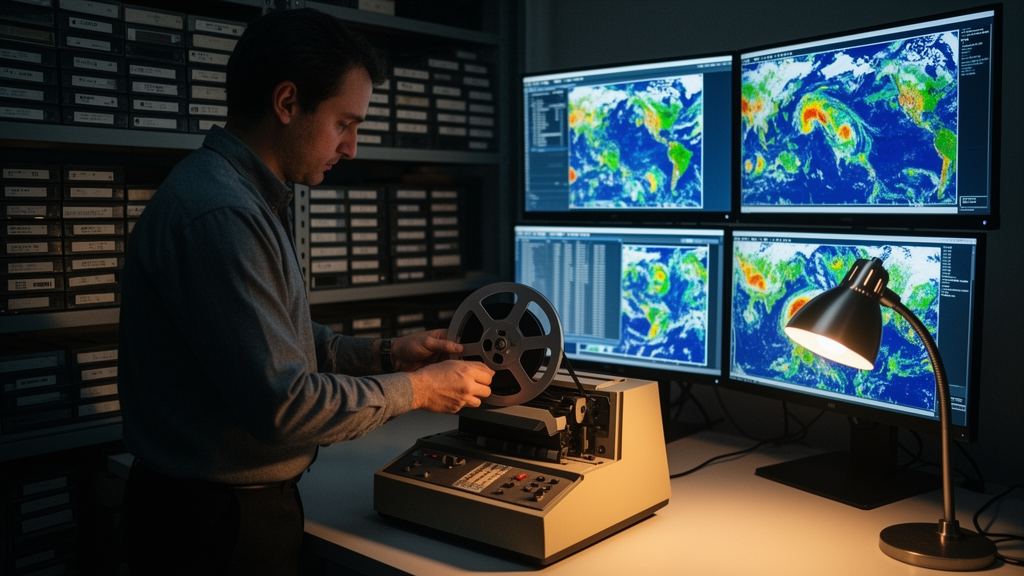
Recovering the data was no simple matter of reading old files. The paper presents the methodology used to retrieve the observations from the original tapes, a process that required both locating the physical media and devising ways to interpret what was stored on them.
Assessing decades-old measurements demanded careful validation. The researchers evaluated the rescued observations using radiance simulations and by drawing comparisons with the High-resolution Infrared Radiation Sounder, a contemporary instrument flying on NOAA satellites at the time. These cross-checks provided a way to gauge whether the recovered SSH record behaved as expected.
To test the scientific value of the rescued data, the team conducted an Observing System Experiment using an early, lower-resolution version of the data assimilation system being prepared for the upcoming ERA6 reanalysis. Several configuration trials were run, deliberately designed to separate the impact of the far-infrared channels from that of the other channels.
The results point to a clear conclusion: assimilating all available channels sensitive to temperature, ozone, and water vapor, including those in the far infrared, yields the largest impact in improving the analyses and forecasts. In other words, the full complement of SSH channels, rather than any subset, delivered the greatest benefit to reanalysis quality.
They performed radiance simulations of SI-1, a hyperspectral sounder mounted on the Soviet satellite Meteor-29 in 1979. When SSH observations were assimilated, the simulations represented the SI-1 measurements better, which the authors say confirms the positive impact of SSH on reanalysis quality.
Beyond the specific findings, the study highlights the enduring value of data rescue. Records once thought lost can still contribute to modern climate science, filling gaps in the observational record precisely where reanalyses are weakest. As new missions revisit the far-infrared spectrum that SSH explored decades ago, the recovered archive offers both a historical baseline and a demonstration that even pioneering instruments from the 1970s can still sharpen our picture of the changing atmosphere.
Subject of Research: Rescue and reanalysis assimilation of the 1970s DMSP Special Sensor H satellite sounding record
Article Title: DMSP special sensor H (SSH) data rescue and assimilation in reanalysis
Article References: Poli, P., Hanschmann, T., John, V. O., Bell, W., Ribas, R., Schepers, D., Schulz, J., Vidot, J., Lalande, J.-M., Johnson, J. E., Zamkoff, E. B., Esfandiari, A. E., Gerasimov, I. V., Al-Jazrawi, A. F., Standfuss, C., & Klonecki, A. (2026). DMSP special sensor H (SSH) data rescue and assimilation in reanalysis. Frontiers in Remote Sensing, 7, Article 1945649. https://doi.org/10.3389/frsen.2026.1945649
Image Credits: AI Generated
DOI: 10.3389/frsen.2026.1945649
Keywords: data rescue, satellite sounding, Special Sensor H, DMSP, far infrared, reanalysis, radiative transfer, data assimilation, ozone, climate record, ERA6, PREFIRE
Cite Scienmag News
Violet Maxwell. (October 28, 2026). Lost 1970s satellite data rescued to sharpen climate reanalyses. Scienmag. https://scienmag.com/lost-1970s-satellite-data-rescued-to-sharpen-climate-reanalyses/
Violet Maxwell. "Lost 1970s satellite data rescued to sharpen climate reanalyses." Scienmag, 28 October 2026, https://scienmag.com/lost-1970s-satellite-data-rescued-to-sharpen-climate-reanalyses/. Accessed 29 October 2026.
Violet Maxwell. "Lost 1970s satellite data rescued to sharpen climate reanalyses." Scienmag. October 28, 2026. https://scienmag.com/lost-1970s-satellite-data-rescued-to-sharpen-climate-reanalyses/