A low-cost inertial sensor paired with a stacked ensemble of machine learning models can track the movement of a sliding soil block in laboratory flume experiments more faithfully than a traditional physics-based integration method, according to a new study published in the journal Geoenvironmental Disasters. The framework, called X-SEL, achieved the lowest average root mean square error across three experimental datasets and reproduced smooth, continuous displacement curves that the classical trapezoidal integration approach could not match.
The research, led by Shubham Kumar, Mirothali Chand, Kala Venkata Uday and Varun Dutt, addresses a persistent problem in landslide early-warning systems: predicting how far and how fast soil will move before and during failure. Physics-based approaches estimate displacement by integrating acceleration readings from accelerometers, often using MEMS devices. While theoretically sound, this double integration is notoriously fragile. Sensor noise and drift accumulate over successive integration steps, producing unstable and abrupt displacement estimates, particularly during the transitional phases when soil sliding accelerates non-linearly.
Machine learning offers an alternative. Instead of integrating raw signals, models learn a direct mapping from instantaneous sensor measurements to labelled displacement values, so errors do not compound through repeated numerical processing. Yet the authors caution that machine learning performance depends heavily on dataset properties such as sample size, noise levels and feature correlations, and no single algorithm wins in every situation. Stacked ensemble learning, which combines predictions from multiple heterogeneous models through a meta-learner, is intended to trade off the biases and variances of individual learners, though it does not guarantee superiority over the best single model on any given dataset.
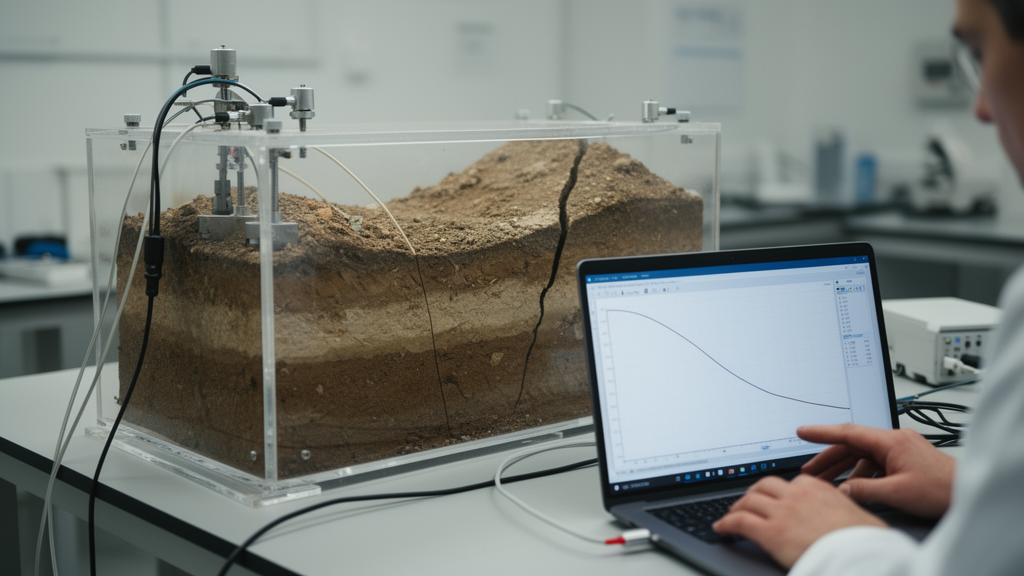
To test these ideas, the team built a wooden flume test bed measuring 91 by 42 by 10 centimetres with an adjustable slope. A compacted soil wedge of 30 by 42 by 7 centimetres, prepared at optimum moisture content and maximum dry density, was subjected to artificial rainfall from a sprinkler system. Infiltration reduced friction between the soil and the wooden surface until sliding occurred. The soil itself, sourced from the Kamand valley region near the IIT Mandi campus in Himachal Pradesh, India, was classified as silty sand under the Unified Soil Classification System, containing 65 percent sand, 32 percent silt and 3 percent clay, with an internal friction angle of 33 degrees and negligible cohesion.
Two sensing systems recorded the experiments. An MPU-6050 inertial measurement unit captured triaxial accelerations and angular velocities at a sampling rate of roughly 10.98 hertz, while a custom-made extensometer using a precision potentiometer provided independent ground-truth displacement measurements, calibrated at a ratio of 1 centimetre to 4.8 millivolts. Because actual sliding lasted only three to five seconds within hour-long experiments, the researchers constructed event-focused datasets. Case I covered 350 seconds with 3,978 data points including both non-sliding and sliding states, while Cases II and III each lasted 25 seconds with around 300 data points focused on sliding, differing in correlation structure and statistical properties.
The X-SEL architecture stacks seven base learners: linear regression, support vector regression, decision tree, random forest, gradient boosting, k-nearest neighbours and XGBoost. An XGBoost meta-learner then combines their out-of-fold predictions, generated through five-fold cross-validation to prevent information leakage. Data were split 80:20 using a time-preserving method so that the progression of displacement was retained during training. Performance was evaluated with root mean square error, mean absolute error and mean absolute percentage error, and the framework was benchmarked against a trapezoidal-rule integration of z-axis acceleration, deliberately kept simple and transparent without drift correction or filtering, to serve as a reproducible physics baseline.
The results revealed a nuanced picture. In Case I, the largest and most structured dataset, XGBoost alone performed best on the test set with an RMSE of 0.3086, with X-SEL nearly identical at 0.3088, suggesting that a strong individual learner already captures most of the underlying structure when data are abundant. In Cases II and III, the smaller datasets with pronounced local patterns, k-nearest neighbours took the lead with test RMSE values of 0.2469 and 0.2346 respectively, while X-SEL remained close behind at 0.2603 and 0.2451. Across all three cases, X-SEL recorded the lowest average RMSE, at 0.2714, compared with the benchmark models, indicating that its principal strength lies in consistency across heterogeneous dataset conditions rather than in dominating every individual case.
The trapezoidal method fared far worse. In Case I it produced a test RMSE of 24.848, failing to track the rapid transition from stability to failure, and in the other cases it generated stiff, step-like curves that missed the smooth nonlinear progression of displacement, even though it could roughly approximate the timing of movement onset. The authors attribute this to the threshold-based integration approach, which suppresses small accelerations but cannot respond to gradual nonlinear deformation, and to the accumulation of measurement errors inherent in double integration, a problem that worsens with inexpensive inertial sensors.
Interpretability analysis using SHAP values, a game-theoretic technique that quantifies each feature’s contribution to predictions, was applied at two levels. At the meta level, the ensemble learned to weight its most competent base learners in each case, relying heavily on tree-based models in Case I and on the k-nearest neighbours learner in Case III. At the feature level, triaxial acceleration components consistently contributed more to displacement prediction than gyroscopic features, which carried minimal weight in most cases. Interestingly, accelerations along axes other than the primary sliding direction often dominated, a pattern the authors explain through the MPU-6050’s measurement characteristics: early tilting of the soil block redistributes gravity components across all axes, making these signals sensitive statistical indicators of instability onset.
The authors emphasise that the work is a laboratory-scale proof of concept, not a deployable field system. The experiments used homogeneous soil, fixed flume geometry and a single sensor location, and the event-window datasets assume prior knowledge of failure intervals that would not exist in operational monitoring. The models also provide only deterministic point estimates without uncertainty quantification, a significant gap for safety-critical applications. Future work, they write, will focus on field-scale validation, transfer learning to bridge the domain shift from laboratory to natural slopes, probabilistic methods such as conformal prediction and Bayesian ensembles, and user-friendly deployment tools. Even so, the combination of inexpensive MEMS sensing with adaptive ensemble learning offers a promising, cost-effective foundation for future sensor-based landslide monitoring and early-warning research.
Subject of Research: Machine learning prediction of soil sliding displacement from inertial sensor data in laboratory flume experiments
Article Title: X-SEL: a stacked ensemble learning architecture for forecasting soil slide displacement in flume simulations
Article References: Kumar, S., Chand, M., Uday, K. V., & Dutt, V. (2026). X-SEL: a stacked ensemble learning architecture for forecasting soil slide displacement in flume simulations. Geoenvironmental Disasters, 13(1), Article 54. https://doi.org/10.1186/s40677-026-00400-9
Image Credits: AI Generated
DOI: 10.1186/s40677-026-00400-9
Keywords: landslide early warning, machine learning, stacked ensemble learning, XGBoost, MEMS sensors, soil displacement, flume experiments, SHAP interpretability, trapezoidal integration, geohazards, proof of concept, X-SEL
Cite Scienmag News
Teresa Odom. (October 29, 2026). Machine Learning Outperforms Physics Method in Predicting Lab Soil Slide Displacement. Scienmag. https://scienmag.com/machine-learning-outperforms-physics-method-in-predicting-lab-soil-slide-displacement/
Teresa Odom. "Machine Learning Outperforms Physics Method in Predicting Lab Soil Slide Displacement." Scienmag, 29 October 2026, https://scienmag.com/machine-learning-outperforms-physics-method-in-predicting-lab-soil-slide-displacement/. Accessed 29 October 2026.
Teresa Odom. "Machine Learning Outperforms Physics Method in Predicting Lab Soil Slide Displacement." Scienmag. October 29, 2026. https://scienmag.com/machine-learning-outperforms-physics-method-in-predicting-lab-soil-slide-displacement/