Thursday, October 29, 2026
Science
No Result
View All Result
  • Login
  • HOME
  • SCIENCE NEWS
  • CONTACT US
  • HOME
  • SCIENCE NEWS
  • CONTACT US
No Result
View All Result
Scienmag
No Result
View All Result
Home Science News Athmospheric

Warsaw’s Winter Air Quality Improved Markedly Over the Past Decade

October 29, 2026
in Athmospheric, Earth Science
Russell Cooper
By Russell Cooper Scienmag Editorial Profile - Environmental Pollution
Reading Time: 2 mins read
0
Warsaw’s Winter Air Quality Improved Markedly Over the Past Decade

Warsaw's Winter Air Quality Improved Markedly Over the Past Decade

65
SHARES
587
VIEWS
Share on FacebookShare on Twitter
ADVERTISEMENT

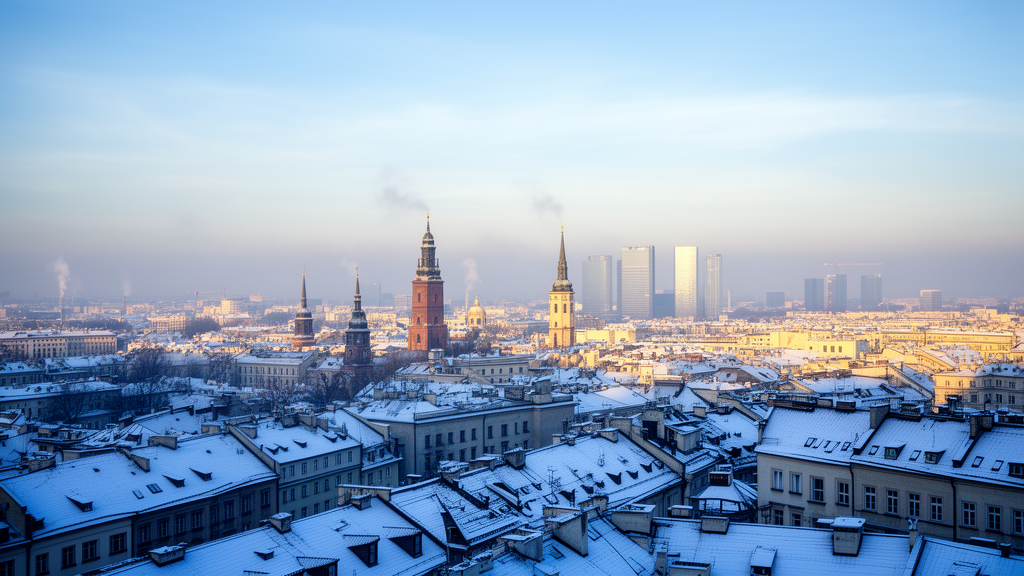
Winter air pollution in Warsaw has improved substantially over the past decade, according to an analysis of hourly measurements from nine CIEP monitoring stations covering 2016 to 2025. The study, which also drew on meteorological observations from the Okecie IMGW station, boundary layer heights from ERA5, and HYSPLIT backward trajectories, focused on PM10, PM2.5, NO2, and O3, with particular attention to black smog episodes. The findings indicate that both emission controls and atmospheric conditions contributed to cleaner winter air in Poland’s capital.

The scale of the improvement is evident in the frequency of good or very good conditions under Polish air quality index thresholds. For PM2.5, such conditions rose from 10 to 12 percent of hours in 2016–2018 to 30 to 32 percent in 2023–2025. For PM10, the share increased from 16 to 24 percent to 43 to 45 percent over the same period. NO2 also declined: very good conditions increased from 66 percent in urban areas and 88 percent in suburban areas to 84 percent and 95 percent, respectively.

Smog episodes occurred under a characteristic set of conditions. They were associated with low temperatures, averaging −3.3 °C, weak winds of up to 5 m/s, strong temperature inversions, and high humidity, with air masses arriving from local, northern, or western origins. The analysis quantified how strongly meteorology shapes pollution levels: PMx concentrations fell about 4 to 8 fold from the lowest temperature bin (−21 to −16 °C) to the 9–14 °C bin, dropped 4 to 6 fold as winds strengthened from 0–1 to 8–12 m/s, and decreased 7 to 11 fold as the boundary layer deepened from 0–100 to 1500–2500 m. In contrast, O3 increased under deeper boundary layers and cleaner air masses.

Crucially, the researchers compared pollution levels under similar meteorological conditions to separate genuine emission changes from weather-driven variability. Those comparisons confirmed a genuine downward trend in PM2.5, which the authors attribute to emission reductions from residential heating, stricter policies, and better alignment with EU standards. The results indicate that winter air quality in Warsaw has improved due to both emission control and favorable atmospheric conditions, with regional transport modulating urban pollution. The study is an open-access research article published in Aerosol and Air Quality Research, based on a decade of observational data from a single metropolitan area.

Subject of Research: Wintertime air quality trends and smog episodes in Warsaw, Poland, from 2016 to 2025

Article Title: Improvement in wintertime air quality in urban and suburban areas of Warsaw within 2016–2025

Article References: Szczepanik, D. M., Deptuła, K., Kłapiński, S., Rakowska, J., Maciejewska, K., Czaplicka, M., & Stachlewska, I. S. (2026). Improvement in wintertime air quality in urban and suburban areas of Warsaw within 2016–2025. Aerosol and Air Quality Research. https://doi.org/10.1007/s44408-026-00173-8

Image Credits: AI Generated

DOI: 10.1007/s44408-026-00173-8

Keywords: air quality, PM2.5, PM10, NO2, smog, Warsaw, boundary layer, meteorology, emission reductions, black smog, HYSPLIT, ERA5

Cite Scienmag News

Russell Cooper. (October 29, 2026). Warsaw’s Winter Air Quality Improved Markedly Over the Past Decade. Scienmag. https://scienmag.com/warsaws-winter-air-quality-improved-markedly-over-the-past-decade/

Russell Cooper. "Warsaw’s Winter Air Quality Improved Markedly Over the Past Decade." Scienmag, 29 October 2026, https://scienmag.com/warsaws-winter-air-quality-improved-markedly-over-the-past-decade/. Accessed 29 October 2026.

Russell Cooper. "Warsaw’s Winter Air Quality Improved Markedly Over the Past Decade." Scienmag. October 29, 2026. https://scienmag.com/warsaws-winter-air-quality-improved-markedly-over-the-past-decade/


Tags: air pollution reduction in Warsawair qualityair quality index thresholds in Polandatmospheric conditions affecting urban smogbackward trajectory analysis of smog episodesblack smogblack smog episodes in Warsawboundary layerboundary layer height influence on pollutionemission reductionsERA5HYSPLITimpact of emission controls on Warsaw airlong-term air quality monitoring in Polandmeteorological factors in winter air pollutionmeteorologyNO2NO2 and O3 air quality changesPM10PM2.5PM2.5 and PM10 trend analysissmogWarsawWarsaw winter air quality improvement
Share26Tweet16
Previous Post

Fungal Enzyme Study Reveals Stereochemistry Limits Cytochalasan Biocatalyst Versatility

Next Post

Minocycline Prescribing Patterns and Tolerability Mapped Across Indian Outpatient Records

Related Posts

Fluoride in Bedrock Groundwater Poses Hidden Health Risks in Northeast China Basin
Earth Science

Fluoride in Bedrock Groundwater Poses Hidden Health Risks in Northeast China Basin

October 29, 2026
Graph theory meets expert weighting to reroute Vellore’s waste trucks
Earth Science

Graph theory meets expert weighting to reroute Vellore’s waste trucks

October 29, 2026
Faults Shaped the Massive 1998 Mission Peak Landslide in California
Earth Science

Faults Shaped the Massive 1998 Mission Peak Landslide in California

October 29, 2026
New Open-Access Journal Geohazards & Remediation Launches to Tackle Rising Global Geohazard Losses
Earth Science

New Open-Access Journal Geohazards & Remediation Launches to Tackle Rising Global Geohazard Losses

October 29, 2026
China’s Water Resilience and Green Development Are Rising Together, Study Finds
Earth Science

China’s Water Resilience and Green Development Are Rising Together, Study Finds

October 29, 2026
When Volcanoes Fall Quiet, Scientists Say It Is Time to Talk
Earth Science

When Volcanoes Fall Quiet, Scientists Say It Is Time to Talk

October 29, 2026
Next Post
Minocycline Prescribing Patterns and Tolerability Mapped Across Indian Outpatient Records

Minocycline Prescribing Patterns and Tolerability Mapped Across Indian Outpatient Records

  • Mothers who receive childcare support from maternal grandparents show more optimized

    Mothers who receive childcare support from maternal grandparents show more parental warmth, finds NTU Singapore study

    27656 shares
    Share 11059 Tweet 6912
  • University of Seville Breaks 120-Year-Old Mystery, Revises a Key Einstein Concept

    1061 shares
    Share 424 Tweet 265
  • Bee body mass, pathogens and local climate influence heat tolerance

    682 shares
    Share 273 Tweet 171
  • Researchers record first-ever images and data of a shark experiencing a boat strike

    546 shares
    Share 218 Tweet 137
  • Groundbreaking Clinical Trial Reveals Lubiprostone Enhances Kidney Function

    531 shares
    Share 212 Tweet 133
Science

Embark on a thrilling journey of discovery with Scienmag.com—your ultimate source for cutting-edge breakthroughs. Immerse yourself in a world where curiosity knows no limits and tomorrow’s possibilities become today’s reality!

RECENT NEWS

  • Olive Bark Beetle Discovered in Czech Republic Raises Fears of a Central European Spread
  • Teachers’ beliefs about models linked to how they assess modeling in science
  • Older Adults with Type 1 Diabetes Aim Stricter Than Their Doctors
  • Machine Learning Maps Flash Drought Drivers Across the Yellow River Basin

Categories

  • Agriculture
  • Anthropology
  • Archaeology
  • Athmospheric
  • Biology
  • Biotechnology
  • Blog
  • Bussines
  • Cancer
  • Chemistry
  • Climate
  • Earth Science
  • Editorial Policy
  • Marine
  • Mathematics
  • Medicine
  • Pediatry
  • Policy
  • Psychology & Psychiatry
  • Science Education
  • Science News
  • Social Science
  • Space
  • Technology and Engineering

Subscribe to Blog via Email

Enter your email address to subscribe to this blog and receive notifications of new posts by email.

Join 5,151 other subscribers

© 2025 Scienmag - Science Magazine

Welcome Back!

Login to your account below

Forgotten Password?

Retrieve your password

Please enter your username or email address to reset your password.

Log In
No Result
View All Result
  • HOME
  • SCIENCE NEWS
  • CONTACT US

© 2025 Scienmag - Science Magazine

Discover more from Science

Subscribe now to keep reading and get access to the full archive.

Continue reading