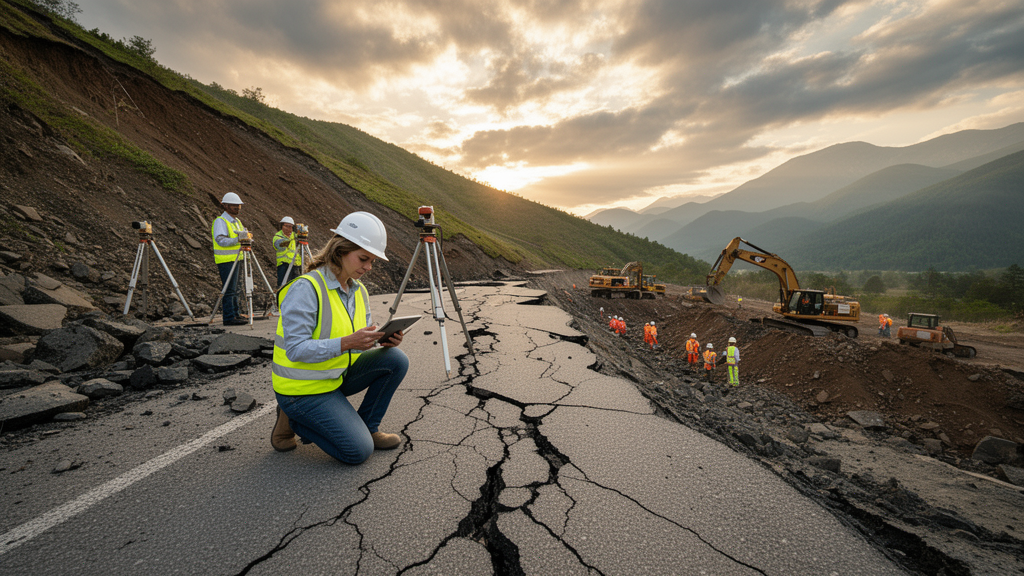
A new international, open-access journal dedicated to geohazards has launched with its first editorial, published on 12 March 2026 as Volume 1, article number 1 of Geohazards & Remediation.
The launch comes against a backdrop of mounting losses. According to United Nations statistics cited in the editorial, direct losses caused by global disasters amount to approximately 202 billion US dollars annually, while indirect losses reach as high as 2.3 trillion US dollars. The editors write that as climate extremes intensify and human activities reshape the Earth’s surface at an unprecedented scale, geohazards are becoming more frequent, complex, and devastating, with events of unique characteristics that have never happened in the historical record continuing to emerge and cause significant damage.
Geohazards & Remediation was founded by Higher Education Press, and the team of editors is led by Tongji University. The editorial states that the journal’s objective is to promote a comprehensive improvement in the ability to predict, mitigate, resist, and reduce geohazards, while advancing global geohazard research and leading technological innovation. The editors frame the current moment as one presenting researchers and engineers with unprecedented new challenges and opportunities, arguing that the need for robust, interdisciplinary, and globally collaborative research on geohazards has never been more urgent.
The journal’s stated scope covers core scientific and technological issues across several areas: geohazard mechanisms, prevention and control measures, monitoring and early warning, risk assessment, emergency response, and post-disaster recovery. The editorial emphasizes a concept of multi-disciplinary cross-integration in running the journal, positioning it as a venue where work spanning different geohazard types and methods can be exchanged on a single platform.
In terms of article formats, GR encourages submissions of Research Articles, Review Articles, Case Reports, and Perspectives. The editors state that the journal particularly seeks research showcasing innovative discoveries that open up new directions in the field, as well as cutting-edge work on emerging geohazards such as cluster and cascading geohazards. Approaches highlighted include advanced theoretical, experimental, and field-based methods, alongside artificial intelligence (AI) techniques.
Beyond academic exchange, the editorial describes an ambition of full-chain coverage from academic research to engineering applications. The journal, according to the editors, takes into account both theoretical frontier and practical value, aiming to provide not only an academic exchange platform for researchers but also implementable technical solutions for engineers and technicians working on geohazard problems in practice.
On publishing logistics, the editorial states that GR is committed to providing a fair, fast, and transparent review process, and that accepted papers will be published by Higher Education Press and Springer. In the pre-launch period, the journal will not charge any publication fees and will waive open access fees, lowering the cost barrier for authors during the journal’s establishment phase. The journal is fully open access, and the inaugural editorial is available to all readers.
The editors close by expressing appreciation for community support and inviting contributions to understanding and mitigating geohazards, stating that they look forward to communicating and working with researchers through the journal to make the world a safer and better place, with updates to follow through the journal’s official website. As an inaugural editorial, the piece announces the journal’s mission, scope, and policies rather than presenting new research findings; its quantitative claims about disaster losses are attributed to United Nations statistics as cited by the editors.
Subject of Research: Launch of the open-access journal Geohazards & Remediation for geohazard mechanisms, monitoring, risk assessment, and remediation research
Article Title: A new journal, a safer future
Article References: Huang, Y., & Casagli, N. (2026). A new journal, a safer future. Geohazards & Remediation, 1(1), Article 1. https://doi.org/10.1007/s44517-026-00001-1
Image Credits: AI Generated
DOI: 10.1007/s44517-026-00001-1
Keywords: Geohazards & Remediation, geohazards, landslides, earthquakes, debris flows, ground subsidence, glacial collapses, open access, risk assessment, early warning, disaster losses, artificial intelligence
Cite Scienmag News
Violet Maxwell. (October 29, 2026). New Open-Access Journal Geohazards & Remediation Launches to Tackle Rising Global Geohazard Losses. Scienmag. https://scienmag.com/new-open-access-journal-geohazards-remediation-launches-to-tackle-rising-global-geohazard-losses/
Violet Maxwell. "New Open-Access Journal Geohazards & Remediation Launches to Tackle Rising Global Geohazard Losses." Scienmag, 29 October 2026, https://scienmag.com/new-open-access-journal-geohazards-remediation-launches-to-tackle-rising-global-geohazard-losses/. Accessed 4 November 2026.
Violet Maxwell. "New Open-Access Journal Geohazards & Remediation Launches to Tackle Rising Global Geohazard Losses." Scienmag. October 29, 2026. https://scienmag.com/new-open-access-journal-geohazards-remediation-launches-to-tackle-rising-global-geohazard-losses/