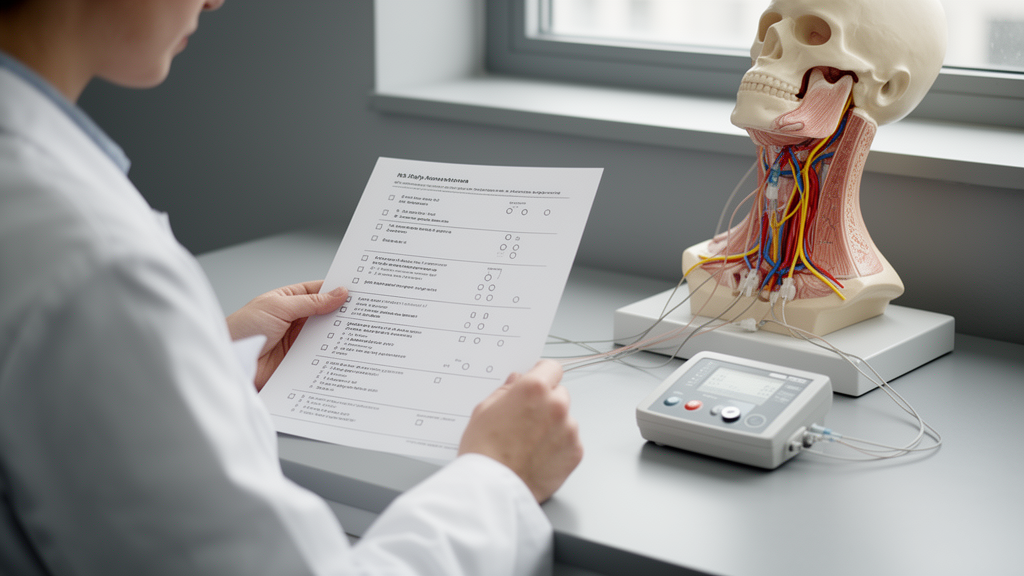
Transcutaneous auricular vagus nerve stimulation, or taVNS, has become one of the most widely explored non-invasive neuromodulation techniques in neuroscience research, attracting interest for its potential neural mechanisms and therapeutic applications. Yet despite its reputation as a safe procedure, the way researchers record and report side effects has remained strikingly inconsistent across the field. A new methodological study now addresses that gap with a dedicated instrument designed to bring order to adverse event documentation.
Researchers at the University of Oldenburg and the Evangelisches Krankenhaus Oldenburg developed the taVNS Adverse Events Questionnaire, or taVNS-AEQ, through a multistage process that included item generation, cognitive pretesting, pilot testing and translation into several languages.
The foundation of the questionnaire was a targeted literature review of taVNS studies. The search initially identified 203 records, of which 71 studies met the predefined eligibility criteria and were included in the review. Among these 71 studies, only 39 provided semi-structured adverse event data, a figure that illustrates just how uneven safety reporting has been in this literature. From the included studies, a total of 539 individual adverse event symptoms were reported as absolute counts across 19 studies, complemented by symptom data assessed using Likert scales in 20 studies. These findings were categorized and used to inform the generation of questionnaire items.
Based on the literature findings, the team built a semi-structured questionnaire intended to capture both the frequency and the character of side effects that participants may experience during or after stimulation. Because taVNS involves stimulating the auricular branch of the vagus nerve through the skin of the ear, the range of possible sensations and after-effects is broad, and unstructured reporting makes it difficult to compare results between laboratories, devices and stimulation protocols.
To evaluate the instrument, the researchers carried out cognitive pretesting, in which potential respondents were asked to work through the draft items and explain their interpretations, followed by pilot testing in a randomized crossover study comparing active and sham taVNS. The crossover design meant that each participant experienced both real and sham stimulation under controlled conditions, allowing the questionnaire to be exercised in a realistic research setting rather than only on paper.
In that real-sham crossover study with 29 participants, the most frequently reported adverse events were tingling, fatigue and changes in concentration. Without standardized procedures for assessment and documentation, it is difficult to determine how common particular symptoms truly are or how they relate to stimulation parameters.
The questionnaire performed well in feasibility testing, and after revisions the team finalized version 3.0, which was translated into four languages. The final instrument includes four participant items and seven personnel items, along with recommendations for documenting stimulation parameters.
The authors position the taVNS-AEQ as a newly developed semi-structured approach that could enhance the quality and comparability of future taVNS studies. As a preliminary evaluation, the work establishes the instrument’s feasibility rather than demonstrating its performance at scale, and widespread adoption will depend on whether research groups integrate it into their protocols. Still, for a field in which fewer than half of eligible studies provided structured safety data, a shared, multilingual assessment tool represents a concrete step toward making the safety profile of this popular neuromodulation technique measurable in a consistent way.
Subject of Research: Development and feasibility testing of a standardized adverse events questionnaire for transcutaneous auricular vagus nerve stimulation research
Article Title: Development and feasibility testing of the taVNS adverse events questionnaire: a multistage methodological study
Article References: Meier-Bartelt, K., Schmidt, L. M., Bömmer, T., & Witt, K. (2026). Development and feasibility testing of the taVNS adverse events questionnaire: a multistage methodological study. Frontiers in Neuroscience, 20, 1974496. https://doi.org/10.3389/fnins.2026.1974496
Image Credits: AI Generated
DOI: 10.3389/fnins.2026.1974496
Keywords: taVNS, vagus nerve stimulation, adverse events, questionnaire development, systematic review, neuromodulation, safety reporting, crossover study, research methods, Frontiers in Neuroscience, Development, feasibility
Cite Scienmag News
Cassandra Pierce. (October 28, 2026). New Questionnaire Brings Structure to Vagus Nerve Stimulation Safety Reporting. Scienmag. https://scienmag.com/new-questionnaire-brings-structure-to-vagus-nerve-stimulation-safety-reporting/
Cassandra Pierce. "New Questionnaire Brings Structure to Vagus Nerve Stimulation Safety Reporting." Scienmag, 28 October 2026, https://scienmag.com/new-questionnaire-brings-structure-to-vagus-nerve-stimulation-safety-reporting/. Accessed 28 October 2026.
Cassandra Pierce. "New Questionnaire Brings Structure to Vagus Nerve Stimulation Safety Reporting." Scienmag. October 28, 2026. https://scienmag.com/new-questionnaire-brings-structure-to-vagus-nerve-stimulation-safety-reporting/