Friday, October 30, 2026
Science
No Result
View All Result
  • Login
  • HOME
  • SCIENCE NEWS
  • CONTACT US
  • HOME
  • SCIENCE NEWS
  • CONTACT US
No Result
View All Result
Scienmag
No Result
View All Result
Home Science News Marine

Bacteria split into distinct water and sediment communities in South Africa’s Knysna Estuary

October 28, 2026
in Marine
Violet Maxwell
By Violet Maxwell Scienmag Editorial Profile - Natural Hazards
Reading Time: 3 mins read
0
Bacteria split into distinct water and sediment communities in South Africa’s Knysna Estuary

Bacteria split into distinct water and sediment communities in South Africa's Knysna Estuary

65
SHARES
587
VIEWS
Share on FacebookShare on Twitter
ADVERTISEMENT

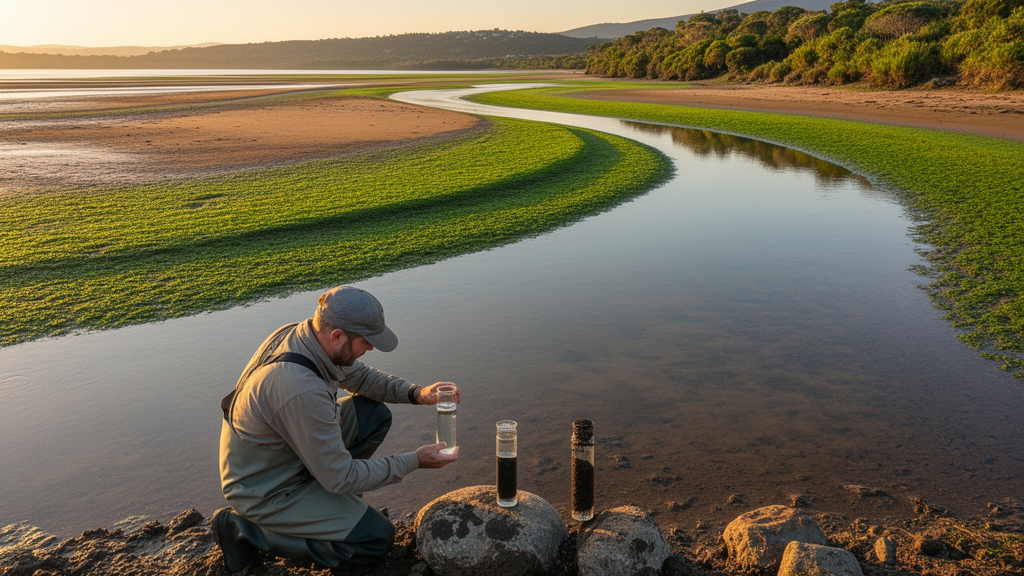
Researchers from North-West University in Potchefstroom, South Africa, have mapped how bacterial communities divide between the water and sediments of the Knysna Estuary, finding that the two habitats host clearly separated microbial populations shaped by salinity, pH, nutrients and trace metals. The study, published as an original research article in Frontiers in Marine Science, combined DNA metabarcoding of the 16S rRNA gene with elemental profiling by inductively coupled plasma mass spectrometry.

The survey identified 18 bacterial phyla across the estuary, with Proteobacteria dominating both sample types. This phylum accounted for 52.33 percent of sequences in water samples and 40.67 percent in sediments. At broader taxonomic levels the two habitats overlapped, but when the researchers examined family and genus ranks, a clear segregation emerged, with distinct bacterial taxa unique to each sampling type.

Diversity measurements reinforced that picture. The team observed significant differences between water and sediment in both Shannon and Simpson alpha diversity as well as in beta diversity. Together, these results indicate a partitioning of bacterial communities between the two habitats, with sediments acting as a richer and more compositionally heterogeneous microbial reservoir than the overlying water column.

To understand what drives this separation, the researchers turned to multivariate statistics. Redundancy analysis and species response curves revealed that gradients in salinity and pH, together with the distribution of nutrients and trace metals, were primarily associated with variation in bacterial communities in both habitats. The genus Synechococcus displayed particularly strong sensitivity to these environmental conditions.

The two communities also differed in how they responded to environmental fluctuation. Bacterial communities in the water exhibited wider ecological tolerances, a pattern the authors link to the constantly changing conditions of an estuary, where oceanic and riverine waters mix. Sediment communities, by contrast, were more specialised and more strongly associated with local geochemistry.

That sediment specialisation showed up in specific chemical associations. Sediment bacterial communities were particularly tied to the concentrations of metals including cobalt, lead and nickel, along with nutrients such as phosphorus and calcium, and various ions. This tighter coupling to local chemistry suggests the seafloor acts as a geochemically structured microbial habitat in its own right.

The Knysna Estuary, like estuaries generally, supports diverse biological communities and a range of socioeconomic activities, and its waters are defined by the mixing of oceanic and riverine inputs. The authors note that increasing anthropogenic pressures have led to widespread habitat degradation and nutrient pollution, with nearly half of South Africa’s estuaries currently affected. Bacterial communities play important roles in the ecological and geochemical processes that such systems depend on.

By pairing genetic sequencing with direct chemical measurement, the study offers a template for understanding how microbial assemblages respond to different biogeochemical conditions in a dynamic estuarine system. The authors describe their work as establishing a baseline for future research in the Knysna Estuary, one that could inform targeted monitoring and intervention practices as pressures on South Africa’s estuaries continue to grow.

Subject of Research: Bacterial community structure and its relationship to geochemical gradients in the water and sediments of the Knysna Estuary, South Africa

Article Title: Bacterial partitioning across water and sediment geochemical gradients in the Knysna estuary, South Africa

Article References: Fourie, M., Bezuidenhout, J. J., Lekota, K. E., & Bergh, E. W. (2026). Bacterial partitioning across water and sediment geochemical gradients in the Knysna estuary, South Africa. Frontiers in Marine Science, 13, Article 1971632. https://doi.org/10.3389/fmars.2026.1971632

Image Credits: AI Generated

DOI: 10.3389/fmars.2026.1971632

Keywords: Knysna Estuary, bacterial communities, 16S rRNA metabarcoding, sediment microbiology, Proteobacteria, trace metals, salinity gradient, estuarine ecology, Synechococcus, South Africa, biogeochemistry, microbial diversity

Cite Scienmag News

Violet Maxwell. (October 28, 2026). Bacteria split into distinct water and sediment communities in South Africa’s Knysna Estuary. Scienmag. https://scienmag.com/bacteria-split-into-distinct-water-and-sediment-communities-in-south-africas-knysna-estuary/

Violet Maxwell. "Bacteria split into distinct water and sediment communities in South Africa’s Knysna Estuary." Scienmag, 28 October 2026, https://scienmag.com/bacteria-split-into-distinct-water-and-sediment-communities-in-south-africas-knysna-estuary/. Accessed 30 October 2026.

Violet Maxwell. "Bacteria split into distinct water and sediment communities in South Africa’s Knysna Estuary." Scienmag. October 28, 2026. https://scienmag.com/bacteria-split-into-distinct-water-and-sediment-communities-in-south-africas-knysna-estuary/
Tags: 16S rRNA metabarcodingbacteria in estuary water and sedimentsbacterial communitiesbeta and alpha diversity in microbial populationsbiogeochemistryDNA metabarcoding of 16S rRNA geneelemental profiling of estuarine sedimentsenvironmental factors shaping bacterial community structureestuarine ecologyinfluence of salinity and pH on bacteriaKnysna Estuarymarine microbial communitiesmicrobial diversitymicrobial diversity in estuariesmicrobial ecology of South African estuariesmicrobial habitat segregation in estuariesProteobacteriaProteobacteria dominance in estuarine environmentssalinity gradientsediment microbiologySouth AfricaSynechococcustrace metalstrace metals and microbial communities
Share26Tweet16
Previous Post

Fire Severity Drives Nonlinear Shifts in Subalpine Forest Soil Carbon

Next Post

ECG data and early radiology reports add little to ICU mortality prediction from structured records

Related Posts

Farmland acts as both carbon source and sink along China’s coasts
Marine

Farmland acts as both carbon source and sink along China’s coasts

October 30, 2026
Bee glue for fish farms: propolis shows promise as a natural immunostimulant and antimicrobial
Marine

Bee glue for fish farms: propolis shows promise as a natural immunostimulant and antimicrobial

October 30, 2026
Degraded Mangroves of Batan Still Shelter Endangered Species and Sustain Coastal Livelihoods
Marine

Degraded Mangroves of Batan Still Shelter Endangered Species and Sustain Coastal Livelihoods

October 30, 2026
Prebiotic, Probiotic, and Organic Acid Blend Modulates Tilapia Physiology Without Boosting Growth
Marine

Prebiotic, Probiotic, and Organic Acid Blend Modulates Tilapia Physiology Without Boosting Growth

October 30, 2026
New Wavelet Method Sharpens Detection of Sperm Whale Echolocation Clicks
Marine

New Wavelet Method Sharpens Detection of Sperm Whale Echolocation Clicks

October 30, 2026
Sterile Sea Lettuce Cultivation Cuts Marine Fouling on Structures
Marine

Sterile Sea Lettuce Cultivation Cuts Marine Fouling on Structures

October 30, 2026
Next Post
ECG data and early radiology reports add little to ICU mortality prediction from structured records

ECG data and early radiology reports add little to ICU mortality prediction from structured records

  • Mothers who receive childcare support from maternal grandparents show more optimized

    Mothers who receive childcare support from maternal grandparents show more parental warmth, finds NTU Singapore study

    27656 shares
    Share 11059 Tweet 6912
  • University of Seville Breaks 120-Year-Old Mystery, Revises a Key Einstein Concept

    1061 shares
    Share 424 Tweet 265
  • Bee body mass, pathogens and local climate influence heat tolerance

    682 shares
    Share 273 Tweet 171
  • Researchers record first-ever images and data of a shark experiencing a boat strike

    546 shares
    Share 218 Tweet 137
  • Groundbreaking Clinical Trial Reveals Lubiprostone Enhances Kidney Function

    531 shares
    Share 212 Tweet 133
Science

Embark on a thrilling journey of discovery with Scienmag.com—your ultimate source for cutting-edge breakthroughs. Immerse yourself in a world where curiosity knows no limits and tomorrow’s possibilities become today’s reality!

RECENT NEWS

  • Scientists map plan to test Raman spectroscopy for real-time glioma diagnosis
  • Inflammatory stimulation reshapes microglial vesicle miRNA cargo and modestly alters recipient cells
  • Cascaded Flatness Control Steers Six-Degree Stratospheric Airships
  • Slovenia Rewrites Its Curriculum to Teach Evolution Earlier and More Completely

Categories

  • Agriculture
  • Anthropology
  • Archaeology
  • Athmospheric
  • Biology
  • Biotechnology
  • Blog
  • Bussines
  • Cancer
  • Chemistry
  • Climate
  • Earth Science
  • Editorial Policy
  • Marine
  • Mathematics
  • Medicine
  • Pediatry
  • Policy
  • Psychology & Psychiatry
  • Science Education
  • Science News
  • Social Science
  • Space
  • Technology and Engineering

Subscribe to Blog via Email

Enter your email address to subscribe to this blog and receive notifications of new posts by email.

Join 5,151 other subscribers

© 2025 Scienmag - Science Magazine

Welcome Back!

Login to your account below

Forgotten Password?

Retrieve your password

Please enter your username or email address to reset your password.

Log In
No Result
View All Result
  • HOME
  • SCIENCE NEWS
  • CONTACT US

© 2025 Scienmag - Science Magazine

Discover more from Science

Subscribe now to keep reading and get access to the full archive.

Continue reading