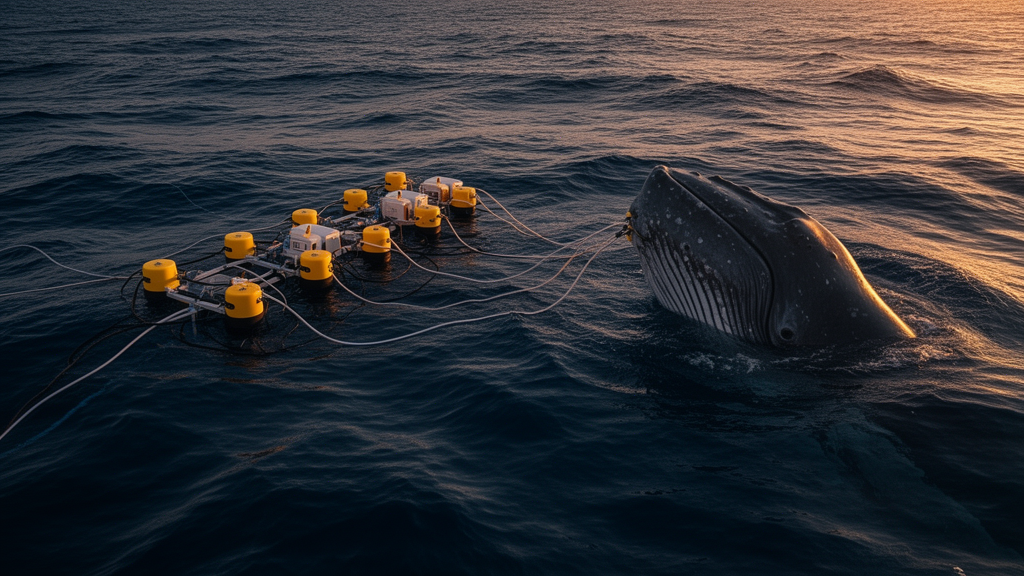
Sperm whales hunt in darkness, relying on powerful, broadband echolocation clicks to find prey in the deep ocean. A new study proposes a wavelet-based method designed to do exactly that, identifying regions of interest in audio recordings that contain sperm whale clicks while suppressing unwanted signals.
The approach, developed by researchers at the University of Zagreb, the University of Haifa and Project CETI, exploits the impulsive character of sperm whale clicks. The team designed a wavelet kernel to match a Gabor function representing a model of a sperm whale click. When a recorded signal is reconstructed using this wavelet, the output produces high peaks primarily in regions containing genuine clicks, while ambient noise and transient noise sources are suppressed. This matching-filter logic means the method responds strongly to signals shaped like the target click and largely ignores everything else.
To benchmark performance, the authors compared their method against two established alternatives: the Teager–Kaiser energy operator, a commonly used reference technique for detecting impulsive signals, and an existing wavelet-based sperm whale click detection method. The evaluation used a large dataset of manually annotated sperm whale clicks recorded near Dominica Island and the Bahamas, giving the comparison a substantial, ground-truthed foundation across two distinct Atlantic field sites.
The reported result is a favorable trade-off between true and false detection rates. By suppressing transient noise at the detection stage, the new kernel aims to reduce the false positives that have long challenged automated monitoring of these deep-diving predators.
The work, published as an original research article in Frontiers in Marine Science, addresses a practical bottleneck for long-term whale conservation. Because sperm whale clicks are powerful and distinctive, they are well suited to passive monitoring, but transient noise sources in the ocean can mimic their impulsive structure. The authors note that all claims in the article are solely those of the authors and do not necessarily represent their affiliated organizations or the publisher.
Subject of Research: A wavelet-based signal processing method for detecting sperm whale echolocation clicks in passive acoustic monitoring data.
Article Title: A wavelet kernel design for the detection of sperm whale echolocation clicks
Article References: Jahanshahi Zeitouni, M., Mišković, N., & Diamant, R. (2026). A wavelet kernel design for the detection of sperm whale echolocation clicks. Frontiers in Marine Science, 13, Article 1903330. https://doi.org/10.3389/fmars.2026.1903330
Image Credits: AI Generated
DOI: 10.3389/fmars.2026.1903330
Keywords: sperm whales, echolocation, passive acoustic monitoring, wavelet transform, click detection, noise suppression, Gabor function, Teager-Kaiser energy operator, Dominica, Bahamas, marine megafauna, wavelet
Cite Scienmag News
Violet Maxwell. (October 30, 2026). New Wavelet Method Sharpens Detection of Sperm Whale Echolocation Clicks. Scienmag. https://scienmag.com/new-wavelet-method-sharpens-detection-of-sperm-whale-echolocation-clicks/
Violet Maxwell. "New Wavelet Method Sharpens Detection of Sperm Whale Echolocation Clicks." Scienmag, 30 October 2026, https://scienmag.com/new-wavelet-method-sharpens-detection-of-sperm-whale-echolocation-clicks/. Accessed 30 October 2026.
Violet Maxwell. "New Wavelet Method Sharpens Detection of Sperm Whale Echolocation Clicks." Scienmag. October 30, 2026. https://scienmag.com/new-wavelet-method-sharpens-detection-of-sperm-whale-echolocation-clicks/