
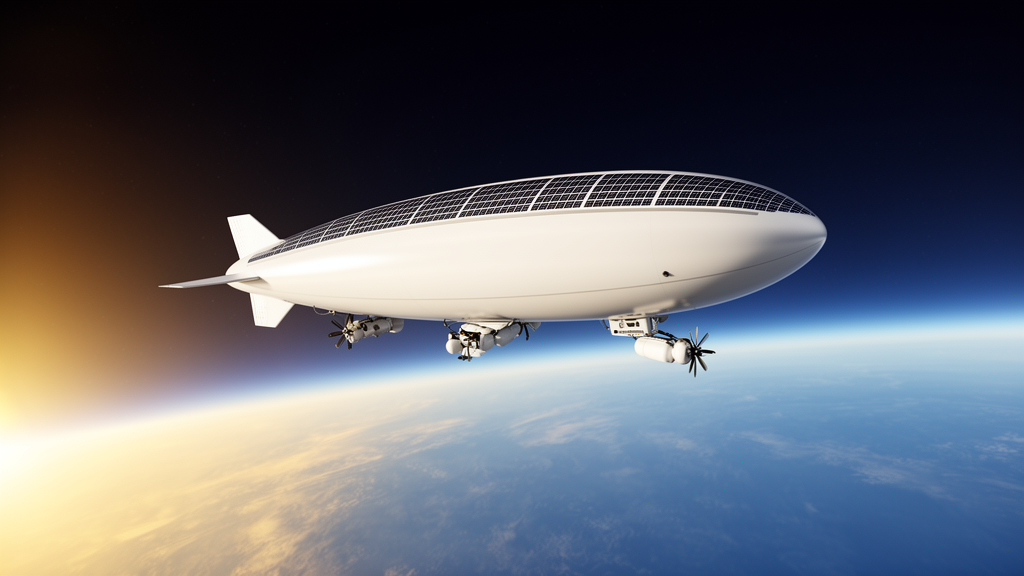
A six-degree-of-freedom stratospheric airship is a demanding machine to fly. It drifts through the thin air between 20 and 30 kilometers of altitude, held aloft by a light lifting gas such as helium, and its motion couples position, attitude, linear and angular velocities in a strongly nonlinear way. A team led by G. Rigatos, with colleagues including P. Siano, Z. Gao, J. Franch, L. Dala, J. O. Limaverde-Filho and K. Ouahada, now reports a control method that tackles this problem without reshaping the vehicle’s equations of motion. Writing in Discover Robotics, they describe a flatness-based controller arranged in successive loops, and they back the design with a Lyapunov stability proof and a battery of simulation tests.
The appeal of stratospheric airships is practical. With accumulated solar power they can remain operational for long periods, and recent designs are aimed at environmental monitoring, weather forecasting, long-distance communication systems and defense missions. Their advantages include vertical take-off and landing, low flight costs and the ability to stay fully functional over long durations. When flown in formations they can support detailed geo-surveillance and wireless communication data retransmission, which makes precise positioning and stability of individual vehicles a matter of formation-wide consequence. All of this depends on a controller that can hold the airship’s center of gravity on a commanded flight path while disturbances push it around.
The mathematical obstacle is the vehicle’s model. The airship’s motion is described by a joint kinematic and dynamic model that uses a body-fixed reference frame and an earth-fixed inertial frame, linked through rotation matrices built from the Euler angles. The state vector gathers the inertial position, the Euler angles, the body-frame linear velocities and the body-frame angular rates, twelve variables in all. The dynamics include aerodynamic forces and torques, buoyancy, gravity, the offset of the center of gravity, moments and products of inertia, and disturbance forces. Earlier nonlinear approaches, including sliding-mode, backstepping, adaptive and H-infinity control, have addressed this plant, but the authors note that many global linearization techniques demand changes of state variables and transformations of the model into canonical forms, producing elongated formulas and inverse transformations that can run into singularity issues.
The new method rests on differential flatness, a property of certain nonlinear systems in which all state variables and control inputs can be written as differential functions of a subset of the states, the flat outputs, and those flat outputs are not tied together by any homogeneous differential relation. The authors formulate the airship’s flight-path tracking problem in an earth-fixed frame and show that the integrated kinematic-dynamic model is differentially flat, with the position and orientation states serving as the flat output. From the flat output and its derivatives, the remaining states and the actual control inputs follow algebraically, which is what makes trajectory planning and feedback design tractable for this vehicle.
The key structural move is a split into two chained subsystems. The first subsystem carries the six position and attitude states, and treats the six velocity states as its virtual control inputs. The second subsystem carries the velocity states and receives the real control inputs, the forces and torques that the airship’s actuators actually produce. Each subsystem, viewed on its own, is also differentially flat, so each can be controlled by inverting its dynamics in the manner familiar from input-output linearized systems. At every time step, the state vector of the subsequent subsystem becomes the virtual control input for the preceding one, and equivalently the virtual control input of the preceding subsystem becomes the setpoint for the subsequent one. The real control input is computed from the last subsystem by inverting its dynamics, and it implicitly carries the virtual control inputs of all preceding loops, with stabilizing effects that trace backwards through the chain.
Stability is not left to intuition. For each subsystem the feedback law inverts the subsystem dynamics and subtracts a diagonal gain matrix multiplied by the tracking error between the actual states and their setpoints. Substituting these laws into the subsystem equations shows that each tracking error obeys a first-order linear error dynamics that converges to zero as time grows without bound. The authors then define a Lyapunov function as half the sum of the squared errors of both subsystems and show that its time derivative is negative definite, vanishing only when every tracking error is zero. They go further and demonstrate exponential convergence: with the smallest diagonal gain element denoted as a minimum gain, the Lyapunov function is bounded by an exponentially decaying envelope, which establishes global exponential stability for the closed-loop system.
What distinguishes this design from classical flatness-based control is what it avoids. Because the control problem is solved on the initial nonlinear model, no diffeomorphisms or complicated state-space transformations are needed, and the computed control inputs are applied directly to the original dynamics. Selecting stabilizing feedback gains reduces to assigning positive values to the diagonal elements of the gain matrices of the individual loops, and the setpoint definition problem is handled by an iterative procedure: setpoints are first defined freely for the states that coincide with the flat outputs, and setpoints for the remaining velocity states follow from the differential relations connecting them to those flat outputs. The authors also position the method relative to backstepping, arguing that it applies to a wider class of systems than those in strict-feedback form and is simpler because it feeds back only the tracking error.
The evidence presented is simulation, not flight test. Using indicative parameters for the airship, including a mass of 9400 kilograms, moments of inertia on the order of millions of kilogram-square-meter units, a center-of-gravity offset of half a meter and an air density of 0.088, the team ran eight setpoint tracking cases. Across all test cases the reported plots show the twelve state variables converging quickly to their reference setpoints, the tracking errors converging to zero, moderate variations of the six control inputs, and the airship’s center of gravity following the reference flight path. Three tables accompany the figures, quantifying tracking accuracy in the disturbance-free case, robustness to parametric changes in the model with a change in one parameter up to sixty percent, and the speed of convergence of the state variables to their setpoints.
The authors argue the approach is computationally efficient and characterized by particularly easy parametrization, and they claim it can be applied to a large class of Euler-Lagrange systems beyond airships. The claims about tracking precision and robustness rest on the simulated scenarios and the tabulated metrics, and the stability proof assumes the model structure and the positive diagonal gains; how the controller performs on a physical airship in real stratospheric conditions remains for future work to demonstrate. Still, the combination is notable: a provably globally exponentially stable controller for a strongly nonlinear aerial vehicle, one that plans trajectories and computes actuator commands from the flat outputs without ever rewriting the vehicle’s equations into a canonical linear form. For a class of vehicles whose missions depend on holding station and formation at the edge of the atmosphere, a control architecture that is simple to tune and mathematically grounded could matter as much as the airframe itself.
Subject of Research: Flatness-based multi-loop control and stability analysis for a six-degree-of-freedom autonomous stratospheric airship
Article Title: Flatness-based control in successive loops for the 6-DOF autonomous stratospheric airship
Article References: Rigatos, G., Siano, P., Gao, Z., Franch, J., Dala, L., Limaverde-Filho, J. O., & Ouahada, K. (2026). Flatness-based control in successive loops for the 6-DOF autonomous stratospheric airship. Discover Robotics, 2(1), Article 16. https://doi.org/10.1007/s44430-026-00029-1
Image Credits: AI Generated
DOI: 10.1007/s44430-026-00029-1
Keywords: stratospheric airship, differential flatness, nonlinear control, Lyapunov stability, flight-path tracking, autonomous aerial vehicles, cascaded subsystems, input-output linearization, simulation study, Discover Robotics, 6-DOF control, feedback gain tuning
Cite Scienmag News
Denise Maddox. (October 30, 2026). Cascaded Flatness Control Steers Six-Degree Stratospheric Airships. Scienmag. https://scienmag.com/cascaded-flatness-control-steers-six-degree-stratospheric-airships/
Denise Maddox. "Cascaded Flatness Control Steers Six-Degree Stratospheric Airships." Scienmag, 30 October 2026, https://scienmag.com/cascaded-flatness-control-steers-six-degree-stratospheric-airships/. Accessed 4 November 2026.
Denise Maddox. "Cascaded Flatness Control Steers Six-Degree Stratospheric Airships." Scienmag. October 30, 2026. https://scienmag.com/cascaded-flatness-control-steers-six-degree-stratospheric-airships/