Physicists have laid out a detailed strategy for the very first experiments at a forthcoming light source that could reshape how ultrafast x-ray science is done. In a Perspective article published in Discover Physics, Emiliano Principi of the National Laboratory of Frascati in Italy analyzes which classes of experiments could best exploit the characteristics of the EuPRAXIA@SPARC_LAB facility, set to become the first soft x-ray free-electron laser driven by plasma wakefield acceleration, during its initial operational phase. The author argues that the transformative potential of this new light source, and its role within the photon science community, will depend directly on the experimental strategy adopted in its early years.
Plasma-acceleration technology offers a route to drastically reduce the size and cost of x-ray free-electron lasers, potentially enabling a broad diffusion of such facilities worldwide and a scientific impact comparable to, or even exceeding, that associated with the advent of third-generation synchrotron radiation sources three decades ago. However, substantial advances in plasma-acceleration technique are still required before these compact sources can compete with conventional free-electron lasers, which rely on high-quality relativistic electron bunches with low energy spread and high repetition rates. The EuPRAXIA project aims to operate the first soft x-ray free-electron laser driven by a compact plasma wakefield acceleration module at the National Laboratory of Frascati in Italy by 2031.
According to the article, the success of the project hinges on a twofold goal: demonstrating the feasibility of a plasma-acceleration-based soft x-ray free-electron laser, and establishing a novel, sustainable and cost-effective paradigm for a user facility dedicated to advanced ultrafast x-ray science. The author considers the second objective the more critical of the two. A plasma-based soft x-ray free-electron laser, he warns, risks being a purely technological exercise if it does not deliver an experimental impact comparable to that of conventional facilities based on low-gradient accelerating structures. Ensuring scientific relevance alongside reduced installation and operational costs is described as the ultimate challenge for driving the global expansion of ultrafast x-ray science.
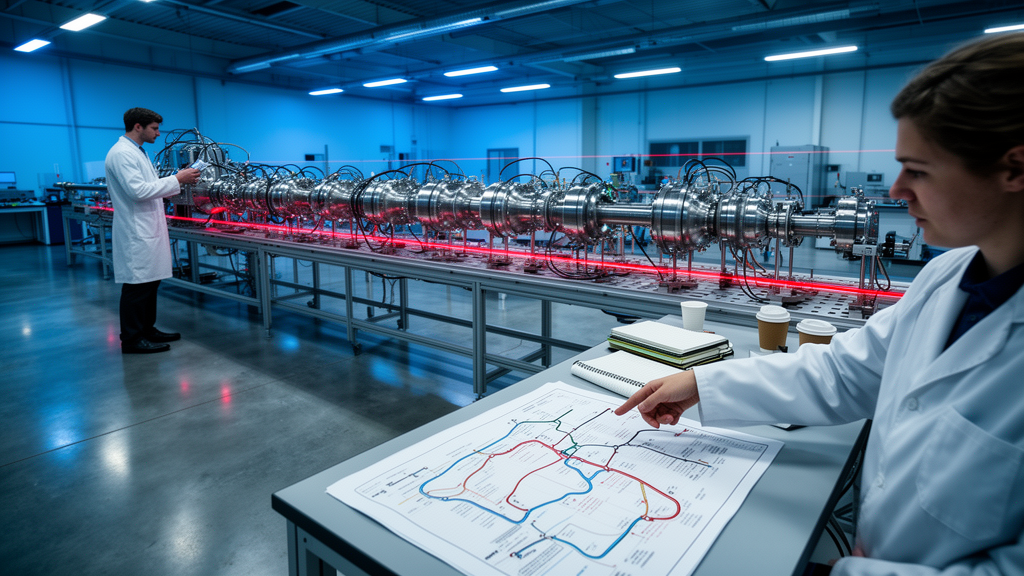
The technical design of the source is ambitious. The EuPRAXIA@SPARC_LAB free-electron laser is designed as a self-amplified spontaneous emission source, driven by relativistic electron bunches with a kinetic energy of 1 GeV. This energy is achieved by injecting a double electron bunch, a 200 pC driver and a 30 pC witness, into a 60 cm plasma module. The bunches are pre-accelerated to 550 MeV by an X-band linear accelerator, and within the nitrogen capillary of the plasma module the wakefield generated by the driver bunch provides the additional acceleration to the witness bunch, which is then used to generate the free-electron laser radiation.
In its initial operational phase, the source will deliver photons in the 3.2 to 5.2 nm spectral range to the AQUA beamline, giving access to the region known as the Water Window. Successive developments envisage delivering electrons with energies of 0.72 GeV and 1.25 GeV, thereby extending the accessible spectral range to the 2 to 10 nm region. The emitted radiation is expected to feature a spectral bandwidth of a few electronvolts, a pulse duration shorter than 10 femtoseconds, and a pulse energy between 10 and 20 microjoules, corresponding to about 10^11 photons per pulse. The repetition rate will be 100 Hz, though inherent instabilities will likely affect both the central wavelength and profile of the spectrum, as well as beam pointing, with the average photon energy expected to undergo a shot-to-shot jitter of a few percent.
To balance these operational challenges with experimental feasibility during early commissioning, the roadmap proposes a deliberately minimalist approach. Experimental setups should avoid complex instrumentation and elaborate signal detection schemes, so that experimental uncertainties are effectively isolated to the performance of the free-electron laser source itself. A radical simplification on the photon transport side is to omit a photon-hungry time-delay compensated monochromator, the device normally required to preserve the native femtosecond duration of a pulse when monochromatizing the beam. Instead, the facility would operate in pink-beam mode, using the full spectral content and intensity of the generated pulses. The article estimates that downstream of such a monochromator, photons per pulse would fall to the order of 10^8, and the combination of photon energy jitter and stochastic spectral profiles would cause excessive intensity fluctuations and a severe attenuation of the average soft x-ray flux, ultimately undermining the source’s scientific impact.
Foregoing the monochromator narrows the feasible experiments to those less demanding on spectral purity but able to exploit the source’s femtosecond pulse duration. The natural focus, therefore, is time-resolved studies of ultrafast dynamics in matter, using pump-probe schemes that combine the free-electron laser with an auxiliary ultrafast source. Because uncertainty in temporal synchronization is the primary factor limiting experimental resolution, the article identifies developing a robust jitter compensation approach for soft x-ray pulses shorter than 10 femtoseconds as both a challenge and a priority. Sample delivery is also simplified by concentrating early experiments on solid-state specimens: sub-micrometric sample foils grant access to a transmission geometry that is straightforward to implement and intrinsically less sensitive to beam-pointing instabilities, provided the targets are spatially homogeneous.
The first proposed experimental class is ultrafast electron diffraction on high-energy-density materials. In this scheme the free-electron laser acts as a single-shot non-resonant thermal pump, heating various materials via isochoric excitation: the pulse triggers a femtosecond-scale response in the electronic subsystem, followed by energy transfer to the lattice on sub-picosecond and picosecond timescales. Because the excitation is non-resonant, the broad bandwidth and shot-to-shot spectral instabilities do not significantly affect the sample response, so the full integrated intensity of the spectrum can be exploited. The soft x-ray radiation is strongly absorbed by condensed matter, penetrating up to hundreds of nanometers into the bulk, and absorption occurs primarily through linear single-photon processes even at elevated fluences, enabling precise determination of the deposited energy density. With 10^11 photons per pulse, samples can be excited to temperatures of several electronvolts under single-shot exposure, generating pressures in the Mbar range, regimes of interest for high-energy-density physics, warm dense matter, astrophysics and aerospace technology.
The structural probe would be a non-relativistic sub-picosecond electron bunch, generated by combining a 100 keV electron gun with a compact radio-frequency cavity that compresses the bunch via velocity bunching. Bunches with a charge of 10 femtocoulombs, sufficient for single-shot diffraction imaging, can be compressed below 500 femtoseconds, potentially reaching durations of about 50 femtoseconds. This scheme was successfully implemented at the FERMI free-electron laser, where time-resolved ultrafast electron diffraction measurements were carried out on nanometric gold foils and CVD diamond slabs exposed to intense single shots at a 25 nm wavelength, enabling observation of the ultrafast decrease in Bragg diffraction peak intensity associated with FEL-driven melting, followed in single-crystal gold by periodic recrystallization of the liquid phase activated by a sub-THz acoustic mode. Because materials exposed to intense radiation are rapidly destroyed, a single-shot approach is mandatory, which relaxes the requirement for high repetition rates and eases constraints on the plasma accelerating module. FEL-induced lattice dynamics typically occur on picosecond timescales, partially relaxing the need for sub-100 femtosecond jitter compensation, though achieving shot-to-shot transverse overlap between the electron probe and the pump within a focal region of a few tens of micrometers remains a major technical challenge.
The second proposed class uses the source as a femtosecond soft x-ray probe in time-resolved x-ray absorption spectroscopy, relying on the polychromatic beam through a technique called ghost spectroscopy. Here the spectrum upstream of the sample, recorded shot-by-shot by a spectrometer, is correlated with the integrated intensity measured downstream by a bucket detector, and the sample’s spectral transmission is retrieved by regularized inversion of the resulting linear system. The accessible spectral range includes the carbon K-edge at about 285 eV, with the potential to reach the nitrogen and oxygen K-edges at about 410 and 543 eV through a modest upgrade. Employing state-of-the-art timing tools, a residual arrival-time jitter below 20 femtoseconds could be targeted, and operating at 100 Hz, a complete time-resolved XANES scan over a 100 picosecond window at the silicon L2,3-edge could be collected within one hour using about 25 to 30 delays on a non-uniform temporal grid. The author emphasizes that these two schemes, rarely adopted at conventional facilities, would define a distinctive experimental portfolio that minimizes direct competition with other x-ray free-electron lasers and high-harmonic generation tabletop sources, while representing only the first steps of a broader range of innovative solutions as the source matures.
Subject of Research: Strategic planning of pilot experiments at the first plasma wakefield acceleration-driven soft x-ray free-electron laser facility
Article Title: A roadmap for strategic pilot experiments at the first plasma-driven x-ray FEL
Article References: Principi, E. (2026). A roadmap for strategic pilot experiments at the first plasma-driven x-ray FEL. Discover Physics, 2(1), Article 12. https://doi.org/10.1007/s44418-026-00013-z
Image Credits: AI Generated
DOI: 10.1007/s44418-026-00013-z
Keywords: EuPRAXIA@SPARC_LAB, plasma wakefield acceleration, x-ray free-electron laser, ultrafast electron diffraction, ghost spectroscopy, time-resolved XANES, pump-probe experiments, SASE FEL, water window, high-energy-density physics, warm dense matter, soft x-ray science
Cite Scienmag News
Katie Riggs. (October 28, 2026). Roadmap charts first experiments for world’s first plasma-driven x-ray laser. Scienmag. https://scienmag.com/roadmap-charts-first-experiments-for-worlds-first-plasma-driven-x-ray-laser/
Katie Riggs. "Roadmap charts first experiments for world’s first plasma-driven x-ray laser." Scienmag, 28 October 2026, https://scienmag.com/roadmap-charts-first-experiments-for-worlds-first-plasma-driven-x-ray-laser/. Accessed 28 October 2026.
Katie Riggs. "Roadmap charts first experiments for world’s first plasma-driven x-ray laser." Scienmag. October 28, 2026. https://scienmag.com/roadmap-charts-first-experiments-for-worlds-first-plasma-driven-x-ray-laser/