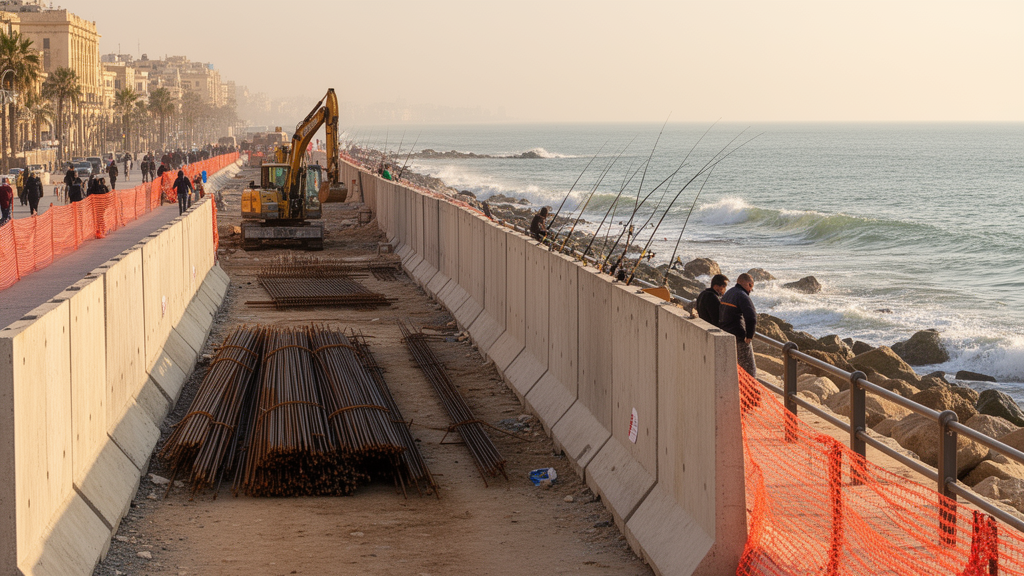
A comparative study of two adjacent stretches of Alexandria’s Corniche in Egypt has found that ongoing waterfront construction is associated with sharply lower user satisfaction, restricted access, and a thinner mix of public activities than a nearby construction-free promenade. The research, published in the journal City, Territory and Architecture, compared the Sidi Gaber promenade, where large-scale building works have been under way since 2018, with the Cleopatra promenade, which has remained largely free of new construction.
The study, conducted by Nourshek Mostafa Sultan and Abdelaziz Farouk Mohamed, used a mixed-methods comparative case study design. The researchers collected structured surveys from approximately 200 waterfront users, roughly 100 at each site, alongside field observations, behavioral mapping, spatial analysis, and photographic documentation. Surveys were administered in April 2024, while behavioral observations took place on two Fridays and two Saturdays in 2023, spanning morning, afternoon, and evening periods.
The quantitative contrast between the sites was stark. At Sidi Gaber, 82 percent of respondents reported restricted access caused by construction fencing, and 65 percent said ongoing redevelopment had reduced visual openness to the sea. Mean satisfaction with comfort and accessibility was 2.8 out of 5 at Sidi Gaber, compared with 4.1 out of 5 at Cleopatra. Perceived safety was also rated lower at the construction site, 2.1 versus 3.2. Behavioral observations showed that pedestrian density at Cleopatra during peak afternoon periods between 3:00 and 6:00 pm was approximately 40 percent higher than at Sidi Gaber.
The two promenades also differed in the diversity of activities they supported. Informal recreational practices such as fishing and street vending were reported by 45 percent of respondents at Cleopatra but only 15 percent at Sidi Gaber. Cleopatra continued to host strolling, sightseeing, informal sports, and family gatherings along an open, visually unobstructed shoreline, while Sidi Gaber’s use pattern shifted toward commercially oriented activities associated with private clubs, restaurants, and entertainment venues such as the Italian Circus and Jewel Park. Environmental comfort diverged as well: nearly 70 percent of Sidi Gaber respondents expressed dissatisfaction with the availability of shaded seating and green space, compared with 30 percent at Cleopatra.
The authors frame these differences through five indicators of public space quality drawn from the waterfront literature: publicness, accessibility, inclusivity, activity diversity, and place attachment. On their reading, publicness was the most strongly affected dimension at Sidi Gaber, where fencing and construction barriers transformed a traditionally open promenade into a more regulated environment. The segment, roughly 940 meters long, has been constrained to narrow, fenced pedestrian pavements, with public access to open views and flexible social space notably restricted. Cleopatra’s studied segment, about 640 meters long, retains open access and unobstructed sea views, though it lacks intentional design, adequate amenities, and formal infrastructure such as shelters and lighting.
The statistical analysis supported the observational findings in part. The researchers report that significant differences at the 95 percent confidence level emerged for several indicators, including frequency of use, perceived comfort, and activity diversity. Within-site analyses of demographic variables produced a more mixed picture. At Sidi Gaber, most activities showed no significant gender or relationship-status differences, with shopping through waterfront bazaars the main exception in the chi-square analyses, and swimming the only activity differing significantly across age groups in the ANOVA. At Cleopatra, sitting and relaxing differed by relationship status, and walking varied with visit frequency, while age showed no significant association with any activity. The authors caution that small and unequal subgroup sizes, and the conservative Scheffé post hoc test, likely limited the detection of subtler differences.
Context matters for interpreting these findings. A 2023 status report cited in the study found that only 46 percent of the 20-kilometer Corniche maintains visually open access to the sea, with 54 percent obstructed by commercial establishments, private clubs, elevated platforms, and fencing. Sidi Gaber has undergone significant construction and infrastructure development since 2018, and the paper links this to altered spatial configurations, restricted access, and changing patterns of public use. The authors argue that waterfront redevelopment can significantly reduce the social and spatial quality of public waterfronts when accessibility, permeability, and continuity are compromised, and they situate Alexandria within broader debates on gentrification, privatization, and coastal resilience in Mediterranean port cities.
The study’s limitations are explicitly acknowledged. The comparative design contrasts two adjacent sites rather than tracking the same location before and after construction, which constrains causal interpretation of the observed differences. The overall sample size, particularly when disaggregated into demographic and temporal subgroups, reduced statistical power, and not all comparisons reached significance. Some post hoc tests could not be conducted because certain subgroups contained fewer than two participants. The survey sample at both sites was predominantly female, single, and composed of Alexandrian residents aged predominantly in their twenties, which may limit generalizability. The authors call for longitudinal research with larger samples to assess post-implementation outcomes and broader socioeconomic impacts over time.
Building on the findings, the researchers developed a design proposal for the Cleopatra promenade as a demonstration of a user-centered regeneration strategy. The proposal, derived from survey suggestions, interviews, and behavioral observations, includes shaded seating areas, a human-scale lighting strategy aimed at safety concerns raised particularly by female users, continuous cycling lanes, dedicated fishing platforms and organized kiosks to preserve informal practices, accessible public toilets, and preserved sea-view corridors. The design also features an open-air theatre with stepped seating, play and fitness zones, a sea pool enclosed with steel barriers, and entrances oriented toward fishermen and boat rental. The authors note that its success would depend on effective implementation, long-term maintenance, and sustained community engagement.
For policy, the study concludes that Alexandria’s current transformation model at Sidi Gaber risks creating consumption-driven enclaves that alienate local users, and it recommends shifting from fragmented, market-led interventions toward integrated, user-centered waterfront policy. Proposed measures include institutionalizing view-corridor protection and public permeability in urban design codes, regulating commercialization, investing in climate-responsive public infrastructure, and embedding participatory planning mechanisms. The authors propose a phased timeline: low-cost tactical interventions such as ramps, shaded seating, and defined walkways in the short term; codified access standards and continuous pedestrian and cycling networks in the medium term; and adaptive coastal defenses with nature-based solutions in the long term, all while preserving physical and visual access to the sea. They argue that successful waterfront regeneration should be judged not by the scale of physical investment alone but by its ability to sustain publicness, accessibility, inclusivity, activity diversity, and place attachment.
Subject of Research: Comparative study of how construction-led redevelopment affects public access, satisfaction, and activity on two Alexandria waterfront promenades
Article Title: Construction-led waterfront transformation and public life: comparing Sidi Gaber and Cleopatra promenades on Alexandria’s Corniche, Egypt
Article References: Sultan, N. M., & Mohamed, A. F. (2026). Construction-led waterfront transformation and public life: comparing Sidi Gaber and Cleopatra promenades on Alexandria’s Corniche, Egypt. City, Territory and Architecture, 13(1), Article 28. https://doi.org/10.1186/s40410-026-00323-w
Image Credits: AI Generated
DOI: 10.1186/s40410-026-00323-w
Keywords: Alexandria, Corniche, waterfront redevelopment, public space, urban transformation, Sidi Gaber, Cleopatra promenade, user satisfaction, pedestrian access, Right to the City, Mediterranean cities, behavioral mapping
Cite Scienmag News
Denise Maddox. (October 28, 2026). Construction on Alexandria’s Corniche cuts public access and waterfront life. Scienmag. https://scienmag.com/construction-on-alexandrias-corniche-cuts-public-access-and-waterfront-life/
Denise Maddox. "Construction on Alexandria’s Corniche cuts public access and waterfront life." Scienmag, 28 October 2026, https://scienmag.com/construction-on-alexandrias-corniche-cuts-public-access-and-waterfront-life/. Accessed 28 October 2026.
Denise Maddox. "Construction on Alexandria’s Corniche cuts public access and waterfront life." Scienmag. October 28, 2026. https://scienmag.com/construction-on-alexandrias-corniche-cuts-public-access-and-waterfront-life/