


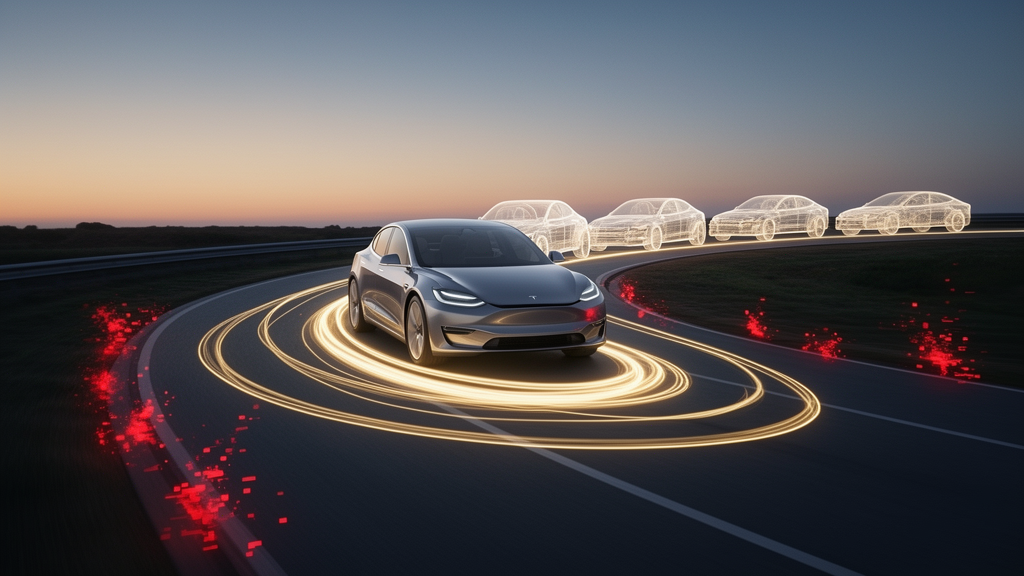
Intelligent connected vehicles that must navigate dense urban traffic face a tangle of hazards: cars cutting in, pedestrians stepping off curbs, sudden obstacles, and communication links that lag or drop. A new study published in Discover Internet of Things on 21 October 2026 proposes a control framework that combines distributed imitation learning with adversarial path tracking, and reports substantial gains in simulated path tracking accuracy, decision stability, and robustness under disturbance. The work, led by Licheng Bao, was conducted entirely in a joint simulation environment, so its performance figures describe model behavior in software rather than on real roads.
The core idea is to treat each intelligent connected vehicle as a distributed learning agent. Instead of a single vehicle learning from its own limited expert demonstrations, multiple vehicles act as learning nodes that collect local perception data and expert driving trajectories, then exchange intermediate features, behavioral samples, or model parameters through vehicle-to-everything communication. An edge coordination node aggregates experience and updates models, allowing vehicles to jointly optimize driving policies while preserving local environmental characteristics. The authors emphasize that this is a genuine multi-agent collaborative learning mechanism, not merely distributed data collection, and that the shared knowledge is intended to improve generalization across different traffic densities and interaction scenarios.
Building the framework starts with data. The system collects vehicle coordinates, speed, heading angle, and acceleration, along with information about surrounding vehicles, pedestrians, road signs, and hazards from cameras, LiDAR, millimeter-wave radar, and inertial measurement units. Multi-source heterogeneous data fusion merges camera images, radar point clouds, vehicle status, and environmental semantics into a unified state representation. An expert driving behavior enhancement mechanism then filters collected trajectories according to safety indicators such as collision avoidance, lane stability, and smooth control, removing low-quality samples, and expands typical behaviors like following, obstacle avoidance, and lane changing by generating varied interaction conditions, including changes in surrounding vehicle density, obstacle positions, and target speeds.
On top of this dataset sits a spatio-temporal interaction feature learning network built on a multi-head attention mechanism. The feature encoder uses a two-layer Transformer architecture with an embedding dimension of 128, four attention heads, and a feed-forward network dimension of 256, designed to model the dynamic correlations among vehicles, pedestrians, and obstacle targets. The action decoder pairs a policy network with a value network in an actor-critic structure: the policy branch maps environment states through fully connected layers to steering and acceleration commands, while the value branch estimates long-term rewards. Layer normalization, residual connections, and ReLU activations are applied to stabilize feature representation and training.
The adversarial component is what distinguishes the approach from conventional imitation learning. During training, perturbation vectors are injected into the environmental state input before feature encoding, simulating non-ideal conditions such as communication delay that makes vehicle position and velocity information outdated, perception noise that corrupts object states, and dynamic obstacle disturbances that alter expected interaction trajectories. The perturbation intensity is bounded by a maximum disturbance factor set to 0.05 in the experiments. A motion smoothing constraint penalizes abrupt changes in control commands, and a combined robust optimization objective integrates path tracking error, policy loss, and the smoothing term. Training proceeds in a hybrid fashion: expert demonstrations first constrain the initial policy, then interaction-based optimization with environmental feedback refines it, with imitation-related objectives weighted more heavily early in training.
Testing took place on a CARLA-SUMO co-simulation platform, where CARLA handled vehicle dynamics, sensor data generation, and perception while SUMO managed traffic flow and multi-vehicle interaction. The researchers generated 50,000 trajectory samples covering vehicle following, lane changing, obstacle avoidance, and emergency braking, split 8:2 into training and testing sets. Evaluation used 120 dynamic traffic test scenarios across four types: intersection interaction, cooperative lane changing, dense vehicle following, and obstacle avoidance, with traffic density from 20 to 100 vehicles per kilometer and speeds from 0 to 15 meters per second. Comparisons were made against Proximal Policy Optimization, Deep Deterministic Policy Gradient, and traditional Behavior Cloning, all trained and tested on the same data, scenarios, and metrics, with five repetitions per experiment.
The reported results favor the proposed model across the board. Its path tracking error stabilized at around 0.16 meters after 120 training epochs, compared with 0.35 meters for PPO, 0.37 meters for DDPG, and 0.36 meters for Behavior Cloning, and it dropped below 0.30 meters after roughly 30 epochs while the baselines stayed above 0.45 meters. In the comprehensive performance table, the proposed method achieved a path tracking error of 0.18 meters, 47.1 percent lower than PPO and 65.4 percent lower than Behavior Cloning, an average lateral offset of 0.12 meters, a collision rate of 2.8 percent, a task completion rate of 96.4 percent, and a stability control rate of 92.6 percent. Average decision response time was 48.6 milliseconds, coordinated traffic efficiency reached 81.7 percent, and the comprehensive robustness score was 0.93.
Robustness testing added communication delays of 20 to 120 milliseconds, zero-mean Gaussian noise with variance 0.01 injected into perception inputs, random trajectory interference, and false environmental information. Under a traffic density of 120 vehicles per kilometer, the proposed model maintained passage efficiency around 82 percent while Behavior Cloning fell to about 65 percent, and its collision rate stayed below 3 percent against nearly 10 percent for Behavior Cloning. In simulation analysis, the model recorded an average lane-changing time of 4.21 seconds, about 26.7 percent shorter than Behavior Cloning, a minimum safe distance of 4.86 meters, only 6.4 emergency braking events compared with 17.8 for Behavior Cloning, a trajectory recovery time of 1.63 seconds, speed fluctuation of 0.87 meters per second, and a control smoothness score of 0.91. Ablation experiments supported the design: removing the distributed imitation learning module raised path tracking error to 0.31 meters, removing adversarial perturbation training dropped the robustness score from 0.93 to 0.86, and removing the action smoothing constraint increased collisions and reduced stable control performance.
The authors frame the work as an AIoT-oriented collaborative control solution, positioning connected vehicles as mobile edge nodes within a broader ecosystem of heterogeneous sensing, V2X communication, and edge intelligence. They argue the framework improves the utilization efficiency of distributed vehicle data and the reliability of connected-device cooperation under dynamic traffic conditions. From an Internet of Things perspective, the study illustrates how multi-agent learning architectures might exploit the connectivity that defines intelligent transportation systems, turning the communication network itself into part of the learning infrastructure rather than merely a conduit for raw sensor streams.
Important caveats remain. The experiments were conducted exclusively in joint simulation, and the authors state plainly that real-world vehicle deployment validation has not yet been fully conducted. They acknowledge that differences between simulated and real traffic environments may persist, including sensor uncertainty, communication instability, and driver behavior diversity, even though the simulation scenarios were calibrated against realistic traffic characteristics. Future work, they write, will incorporate public real-world driving datasets and actual vehicle-road test platforms to evaluate cross-domain generalization and practical deployment capability, potentially combined with edge computing deployments and vehicle-road coordination communication systems. Until such validation is complete, the reported error rates, collision rates, and robustness scores should be read as simulation benchmarks demonstrating the potential of combining distributed imitation with adversarial training, not as evidence of performance on physical roads.
Subject of Research: Distributed imitation learning and adversarial path tracking control for intelligent connected vehicles in dynamic traffic interaction scenarios
Article Title: Distributed imitation learning and adversarial path tracking strategies for intelligent connected vehicles oriented to dynamic interaction scenarios
Article References: Bao, L. (2026). Distributed imitation learning and adversarial path tracking strategies for intelligent connected vehicles oriented to dynamic interaction scenarios. Discover Internet of Things, 6(1), Article 223. https://doi.org/10.1007/s43926-026-00532-2
Image Credits: AI Generated
DOI: 10.1007/s43926-026-00532-2
Keywords: intelligent connected vehicles, distributed imitation learning, adversarial training, path tracking, autonomous driving, V2X communication, actor-critic, CARLA-SUMO simulation, multi-head attention, robustness, collaborative driving, edge intelligence
Cite Scienmag News
Denise Maddox. (October 28, 2026). Simulated connected vehicles learn robust path tracking through imitation and adversarial training. Scienmag. https://scienmag.com/simulated-connected-vehicles-learn-robust-path-tracking-through-imitation-and-adversarial-training/
Denise Maddox. "Simulated connected vehicles learn robust path tracking through imitation and adversarial training." Scienmag, 28 October 2026, https://scienmag.com/simulated-connected-vehicles-learn-robust-path-tracking-through-imitation-and-adversarial-training/. Accessed 1 November 2026.
Denise Maddox. "Simulated connected vehicles learn robust path tracking through imitation and adversarial training." Scienmag. October 28, 2026. https://scienmag.com/simulated-connected-vehicles-learn-robust-path-tracking-through-imitation-and-adversarial-training/









