Feed is the single largest expense in African catfish farming, and researchers in Benin have now tested how far a locally grown legume can push down that bill without hurting the fish. In a six-week feeding trial at the National University of Agriculture, a team replaced soybean seed meal with roasted velvet bean (Mucuna pruriens) seed meal in the diets of Clarias gariepinus fingerlings and measured growth, feed use, survival, blood parameters and cost. The verdict was nuanced: at 20% inclusion, velvet bean performed almost as well as soybean and was cheaper, but at 40% inclusion the diet performed poorly on nearly every measure.
The study, published in Aquaculture Science and Management, was conducted at the Research Unit on Aquaculture and Fisheries Management in Adjohoun, Ouémé Department, in southern Benin. The authors set out to test whether Mucuna pruriens seed meal could partially substitute soybean (Glycine max) seed meal in catfish diets without adversely affecting growth performance, basic health status or feed cost. The motivation is economic as much as biological: feed expenses account for roughly 70% of production costs in catfish farming, and fishmeal alone, a crucial but costly protein source, represents 40 to 60% of those costs. Soybean meal is a proven plant protein substitute, but high human demand for soy pushes its price and invites the search for alternatives.
Velvet bean has an attractive profile for this role. It is an underutilised legume that is rarely eaten by people, thrives in nutrient-deficient soils, and offers a protein content and essential amino acid profile comparable to soybean. The catch is that Mucuna seeds contain antinutritional factors, including lectins, tannins and L-DOPA, which can impair digestibility and nutrient absorption. The researchers therefore roasted the seeds in hot sand at 150 to 160 degrees Celsius, sifted out the sand and burnt grains, and ground them into powder before incorporating the meal into extruded experimental diets.
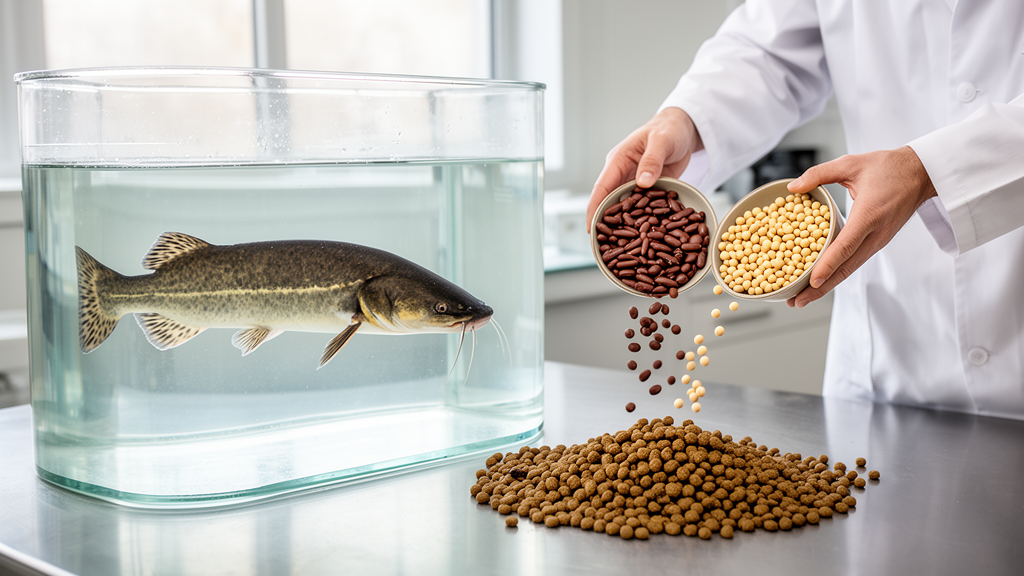
Three hundred fingerlings with an average initial weight of 7.78 plus or minus 0.12 grams were randomly allocated to five treatments, each replicated three times in separate tanks with 20 fish per tank. Four isocaloric, isoproteic diets were formulated: DSSM20 with 20% soybean seed meal, DMSM20 with 20% Mucuna seed meal, DSSM40 with 40% soybean seed meal, and DMSM40 with 40% Mucuna seed meal. The fifth diet, DCCF0, was an imported commercial feed (Gouessant) with about 44% crude protein, serving as the control. Fish were fed to apparent satiety three times daily, at 7 am, 1 pm and 6 pm, for six weeks, around 45 days. Water quality was monitored three times daily and stayed within suitable ranges: average temperature between 27.01 and 27.18 degrees Celsius, pH between 6.81 and 6.90, and dissolved oxygen between 6.75 and 6.80 milligrams per litre.
The commercial control feed produced the best growth overall. Final tank biomass reached 1564.00 grams for DCCF0, with no significant difference from DSSM20 (1405.00 grams) or DSSM40 (1390.66 grams). In stark contrast, DMSM40, the 40% Mucuna diet, produced a final biomass of only 154.66 grams. Daily tank biomass ranged from 14.74 grams for DMSM40 to 31.31 grams for DCCF0, and biomass gain ranged from 663.33 grams to 1409.00 grams across the same pair of treatments. Specific growth rate varied significantly between 4.08% and 5.13% per day, with the control diet highest and DMSM40 lowest. Notably, there was no significant difference in specific growth rate among DCCF0 (5.13% per day), DSSM20 (4.89% per day) and DSSM40 (4.88% per day).
Feed utilisation told the same story. Feed conversion ratio ranged from 1.07 for the control to 2.57 for DMSM40, and feed efficiency ranged from 0.93 for DCCF0 to 0.39 for DMSM40, with no significant difference between the control and DSSM20 (0.86). The protein efficiency ratio ranged from 0.99 for DMSM40 to 2.06 for DCCF0, again with no significant difference between DCCF0 and DSSM20. Survival also differed significantly among treatments: it ranged from 83.33% for DMSM40 to 100% for DCCF0, with no significant difference between the control and DSSM20. No mortality was recorded in the DSSM20, DSSM40 or control groups, while the 20% Mucuna diet recorded 96.66% survival. The authors attribute the low survival and poor growth at 40% Mucuna to the higher concentration of antinutritional factors in that diet, noting that the absence of direct analyses of tannins and L-DOPA in their experimental diets means this explanation rests on the literature rather than their own measurements.
The haematological profile mirrored the growth results. Haemoglobin ranged from 3.83 grams per decilitre in the DMSM40 group to 10.83 grams per decilitre in the control, with DMSM40 significantly lower than all other treatments. Packed cell volume ranged from 14.00% in the 40% Mucuna group to 32.00% in the control, and red blood cell counts ranged from 4.70 to 8.50, with DMSM40 again significantly lower than the other groups. The authors interpret these reductions in haemoglobin, packed cell volume and red blood cells in the 40% Mucuna group as indicating anaemia, which they link to the presence of toxic and antinutritional elements in the diet and to low feed intake associated with poor acceptance of the 40% Mucuna feed. White blood cell counts showed the opposite pattern, ranging from 11.66 in the DSSM20 group to 18.66 in DMSM40, an elevation the authors suggest may indicate a defensive response to microbes or a decline in immune function under inadequate nutrition.
The economic analysis offered the clearest case for the moderate inclusion level. The economic conversion ratio, calculated as feed conversion multiplied by feed cost using local market prices and an exchange rate of 600 CFA francs to one US dollar, ranged from 1.72 for DSSM20 to 3.21 for DMSM40, with no significant differences among the control, DSSM40 and DMSM40. The DSSM20 and DMSM20 diets showed the most favourable production costs for catfish in this study. The authors conclude that using 20% and 40% soybean seed meal and 20% and 40% Mucuna seed meal is less costly than the imported control feed, even though the commercial feed delivered the best zootechnical performance.
Why did 40% Mucuna fail where 20% succeeded? The authors point to several converging factors. Chemical analysis showed a slight nutritional advantage for soybean over Mucuna seed meal, with about 5% more protein and 10% more lipid, while Mucuna contained roughly 22% more carbohydrate. Raising the inclusion level to 40% therefore widened the gap in protein and lipid content between the two diets, and diets richer in protein and lipid are likely to support better zootechnical performance. The pre-treatment method is also implicated: roasting alone may not be sufficient to make Mucuna’s nutrients fully bioavailable, and the authors note that meaningful use of Mucuna in aquaculture feeds requires pre-treatment beyond roasting if significant amounts are to be included. They also acknowledge that their result differs from earlier work reporting favourable performance at 50% Mucuna inclusion in catfish diets, a discrepancy they attribute to differences in species and diet.
The study’s conclusion is deliberately modest. Based on the findings, the authors suggest that Mucuna pruriens could be used at up to 20% in practical diets for C. gariepinus, provided adequate thermal pre-treatment is applied. From both economic and haematological perspectives, the treatments containing 20% soybean seed meal, 40% soybean seed meal and 20% Mucuna seed meal yielded the best results, combining lower feed cost with strong haematological values. The trial was short, conducted in outdoor tanks with fingerlings, and did not analyse antinutritional factors directly in the diets, so the findings describe a specific six-week fingerling rearing scenario rather than a general recommendation for grow-out production. Still, for a region where fish is the most accessible and widely consumed source of animal protein, and where imported feed weighs heavily on farm budgets, the message is practical: a locally grown, little-used legume can shoulder part of the soybean burden in catfish feed, but only up to a point, and crossing that point carries measurable costs in growth, survival and fish health.
Subject of Research: Substituting velvet bean seed meal for soybean meal in African catfish aquaculture feeds
Article Title: Zootechnical performance, haematological profile, and economic analysis of Clarias gariepinus (Burchell, 1822) fed with Velvet bean (Mucuna pruriens) seed meal as a substitute for soybean (Glycine max) seed meal
Article References: Vodounnou, J. V., Iko, R., Luthada-Raswiswi, R., Mama, D., Niass, F., & Micha, J.-C. (2026). Zootechnical performance, haematological profile, and economic analysis of Clarias gariepinus (Burchell, 1822) fed with Velvet bean (Mucuna pruriens) seed meal as a substitute for soybean (Glycine max) seed meal. Aquaculture Science and Management, 3(1), Article 18. https://doi.org/10.1186/s44365-026-00046-6
Image Credits: AI Generated
DOI: 10.1186/s44365-026-00046-6
Keywords: aquaculture, African catfish, Clarias gariepinus, velvet bean, Mucuna pruriens, soybean meal, fish feed, feed conversion ratio, haematology, Benin, feed economics, antinutritional factors
Cite Scienmag News
Alan Morgan. (October 28, 2026). Velvet Bean Can Replace Some Soybean in Catfish Feed, but Only at Low Levels. Scienmag. https://scienmag.com/velvet-bean-can-replace-some-soybean-in-catfish-feed-but-only-at-low-levels/
Alan Morgan. "Velvet Bean Can Replace Some Soybean in Catfish Feed, but Only at Low Levels." Scienmag, 28 October 2026, https://scienmag.com/velvet-bean-can-replace-some-soybean-in-catfish-feed-but-only-at-low-levels/. Accessed 28 October 2026.
Alan Morgan. "Velvet Bean Can Replace Some Soybean in Catfish Feed, but Only at Low Levels." Scienmag. October 28, 2026. https://scienmag.com/velvet-bean-can-replace-some-soybean-in-catfish-feed-but-only-at-low-levels/