Hydrogen is often billed as the clean fuel of the future, but the way most of it is made today is anything but clean. Industrial hydrogen still comes overwhelmingly from steam methane reforming and coal gasification, processes that run at harsh temperatures and release substantial carbon dioxide. Electrochemical water splitting offers a greener route, yet it carries its own penalty: although the theoretical cell voltage is only 1.23 volts, sluggish oxygen evolution kinetics at the anode push practical operation above 1.5 volts, eroding energy efficiency. A research team reporting in the journal Carbon Neutrality now describes a layered electrode design that sidesteps the oxygen problem altogether by oxidizing methanol instead, and does so with a catalyst pairing that outperforms platinum-based systems in a full operating cell.
The study, published on 10 October 2026 as an open-access original article, was led by Minwook Jeong, Dayoeng Gang and Minsu Gu along with colleagues including Yonghoon Lee, Dong-Gyu Lee, Dae Han Sung and Jisoo Kim. Their strategy replaces the kinetically unfavorable oxygen evolution reaction with the methanol oxidation reaction, or MOR, which has a lower oxidation potential, faster kinetics and an inexpensive, abundant feedstock. The catch is that such an approach demands electrocatalysts that are not only highly active and durable but also architecturally engineered so that both electrons and reactants can move efficiently through the electrode.
The researchers built their electrodes using electrostatic layer-by-layer assembly, a dip-and-rinse technique that deposits one nanoscale sheet at a time with precise control over thickness and composition. Negatively charged MXene nanosheets, a family of two-dimensional transition metal carbides, were alternated with positively charged palladium nanoparticles stabilized by DMAP ligands. Zeta-potential measurements confirmed the electrostatic pairing, with the MXene dispersion at minus 35.5 millivolts and the palladium particles at plus 35.0 millivolts. Quartz crystal microbalance tracking showed each MXene layer added about 5.72 micrograms per square centimeter and each palladium layer about 2.84 micrograms, while surface profilometry recorded film thicknesses of 50.5, 52.9, 68.7 and 107.4 nanometers for films of 5, 10, 15 and 20 bilayers respectively.
The choice of MXene over the graphene oxide used in the team’s earlier multilayer electrodes was deliberate. Graphene oxide disperses well and stabilizes nanoparticles, but its intrinsically low conductivity limits electrochemical performance. MXene, by contrast, combines metallic conductivity, tunable layered architecture and hydrophilic surface terminations. In methanol oxidation tests conducted by cyclic voltammetry in nitrogen-saturated 0.1 M potassium hydroxide containing 1.0 M methanol, the anodic current density climbed steadily with bilayer number up to 15 bilayers, where the electrode delivered a peak current density of 9.38 milliamperes per square centimeter. That figure is more than three times the maximum previously reported for graphene-oxide-supported palladium multilayers at 6 bilayers, and comparisons with previously reported palladium-based electrocatalysts placed the MXene-supported system among the competitive performers.
Importantly, the team did not attribute the gains simply to better chemistry. When the current was normalized to the palladium mass measured by quartz crystal microbalance, the mass activity was highest at a single bilayer and declined progressively as the film thickened. In other words, the intrinsic per-site activity of palladium did not improve with more layers; the rising geometric current density came from a larger amount of electrochemically accessible palladium within the conductive MXene framework. Beyond 15 bilayers, diffusion constraints in the thicker film began to bite, and both current density and electrochemical surface area fell at 20 bilayers. Tafel analysis reinforced this picture: the slopes, ranging from 206.9 to 463.2 millivolts per decade across 1 to 20 bilayers, are large enough that the authors caution they reflect film resistance and mass-transport limitations as much as intrinsic charge-transfer kinetics.
Control experiments clarified who was doing the catalytic work. A (MXene/PEI)15 electrode, in which inert polyethyleneimine replaced the palladium nanoparticles, showed an anodic peak only in the first cyclic voltammetry scan, in electrolyte with or without methanol, indicating that the initial oxidation came from the MXene itself rather than from methanol. Once oxidized, MXene no longer acted as a catalytic site for the methanol oxidation reaction, functioning instead as a conductive support and electron transport mediator. Durability was respectable if not record-setting: the multilayer electrode retained 74.4 percent of its initial current density after 100 cycles, and a five-hour chronoamperometry test at 0.2 volts settled into a stable current of roughly 0.014 to 0.016 milliamperes after an initial decay. Post-test electron microscopy showed some localized particle aggregation but no large-scale cracking or delamination.
Impedance and X-ray photoelectron spectroscopy added nuance to how the electrode evolves during operation. Charge-transfer resistance was lowest before cycling, at 1144 ohms, rose to 2093 ohms after full activation as intermediates accumulated and the MXene partially oxidized, then partially recovered to 1548 ohms after 100 cycles. Spectroscopically, the most striking change was in the titanium 2p spectra, where the characteristic titanium dioxide peak present before activation disappeared entirely after activation. The authors are careful here: they considered local electron flux through the MXene as a possible cause of partial surface reduction, but state that the XPS data alone cannot conclusively establish that mechanism. Four-point probe measurements showed conductivity dipping only slightly, from 1905.57 to 1741.87 kilosiemens per meter, about 91.4 percent retention, which argues against any conductivity enhancement during operation.
The hydrogen evolution side of the story proved more synergistic. Measured by linear sweep voltammetry in 0.1 M sulfuric acid, a medium chosen because the underlying ITO substrate’s reduction current overlaps the HER region in alkaline electrolyte, the (MXene/Pd) multilayers delivered current densities of minus 3.0 to minus 3.5 milliamperes per square centimeter, with current continuing to rise as bilayers accumulated because hydrogen evolution is less hampered by mass transport. Control electrodes disentangled the contributions: (PSS/Pd) films, built on insulating polystyrene sulfonate, managed only about minus 1.0 milliampere per square centimeter, while (MXene/PEI) films without palladium showed markedly lower activity still. Yet the combined (MXene/Pd) electrode outperformed the simple sum of those two controls, and MXene alone, drop-cast onto glassy carbon, showed measurable intrinsic hydrogen evolution activity with current features that may reflect hydrogen adsorption-desorption processes, though pseudocapacitive surface reactions cannot be excluded. In this reaction, unlike methanol oxidation, MXene contributes beyond its supporting role.
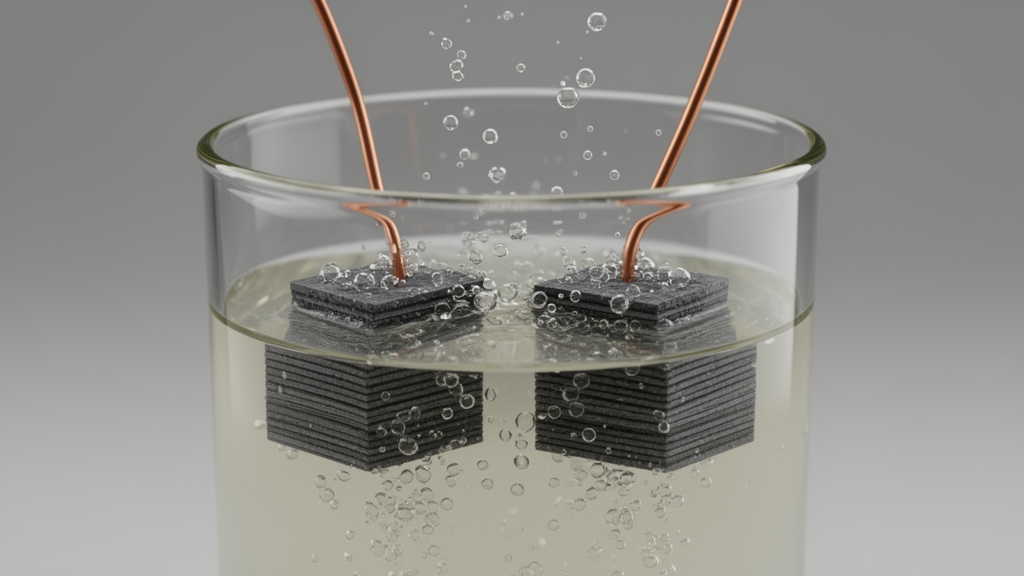
The decisive demonstration came in a two-electrode full cell coupling the two half-reactions. With the (MXene/Pd)15 film as the methanol-oxidizing anode, the cell reached a peak potential of 0.90 volts when paired with a platinum cathode and just 0.65 volts when the cathode was a fully assembled (MXene/Pd)20 film, both well below the 1.23-volt thermodynamic requirement of conventional water splitting. Notably, the all-MXene-palladium cell beat the platinum-based one on operating voltage, even though platinum still delivered higher current densities at high overpotentials; the hybrid electrode’s advantage lay in the low-overpotential region. Because methanol oxidation and hydrogen evolution occurred at spatially separated electrodes under opposite polarization, competition for active sites was minimized, and replacing the sluggish oxygen evolution reaction with methanol oxidation lowered the voltage needed for hydrogen production overall.
The authors present the work as a case for architecture-driven catalyst design rather than a hunt for a single miracle material. By leveraging electrostatic layer-by-layer assembly to control charge and mass transport at the nanoscale, and pairing palladium’s catalytic activity with MXene’s conductivity and, in hydrogen evolution, its own measurable adsorption activity, the electrodes achieved performance that neither component reached alone. The team frames the LbL-engineered hybrid platform as scalable and as a viable alternative to platinum-based catalysts for electrochemical reforming and clean energy applications, while the detailed stability, impedance and spectroscopy data make clear that the real-world behavior of these thin films, including intermediate buildup and partial MXene oxidation, remains an active frontier for the field.
Subject of Research: Layer-by-layer assembled MXene-palladium multilayer electrodes for coupled methanol oxidation and hydrogen evolution
Article Title: Bifunctional MXene-Pd multilayer electrodes enabling coupled electrochemical reforming and hydrogen evolution
Article References: Jeong, M., Gang, D., Lee, Y., Lee, D.-G., Sung, D. H., Kim, J., & Gu, M. (2026). Bifunctional MXene-Pd multilayer electrodes enabling coupled electrochemical reforming and hydrogen evolution. Carbon Neutrality, 5(1), Article 30. https://doi.org/10.1007/s43979-026-00184-9
Image Credits: AI Generated
DOI: 10.1007/s43979-026-00184-9
Keywords: hydrogen evolution, electrochemical reforming, MXene, palladium nanoparticles, layer-by-layer assembly, methanol oxidation reaction, electrocatalysis, water splitting, thin-film electrodes, clean energy, Ti3C2Tx, two-electrode cell
Cite Scienmag News
Denise Maddox. (October 28, 2026). Layered MXene-Palladium Electrodes Split Methanol to Make Hydrogen Cheaply. Scienmag. https://scienmag.com/layered-mxene-palladium-electrodes-split-methanol-to-make-hydrogen-cheaply/
Denise Maddox. "Layered MXene-Palladium Electrodes Split Methanol to Make Hydrogen Cheaply." Scienmag, 28 October 2026, https://scienmag.com/layered-mxene-palladium-electrodes-split-methanol-to-make-hydrogen-cheaply/. Accessed 28 October 2026.
Denise Maddox. "Layered MXene-Palladium Electrodes Split Methanol to Make Hydrogen Cheaply." Scienmag. October 28, 2026. https://scienmag.com/layered-mxene-palladium-electrodes-split-methanol-to-make-hydrogen-cheaply/