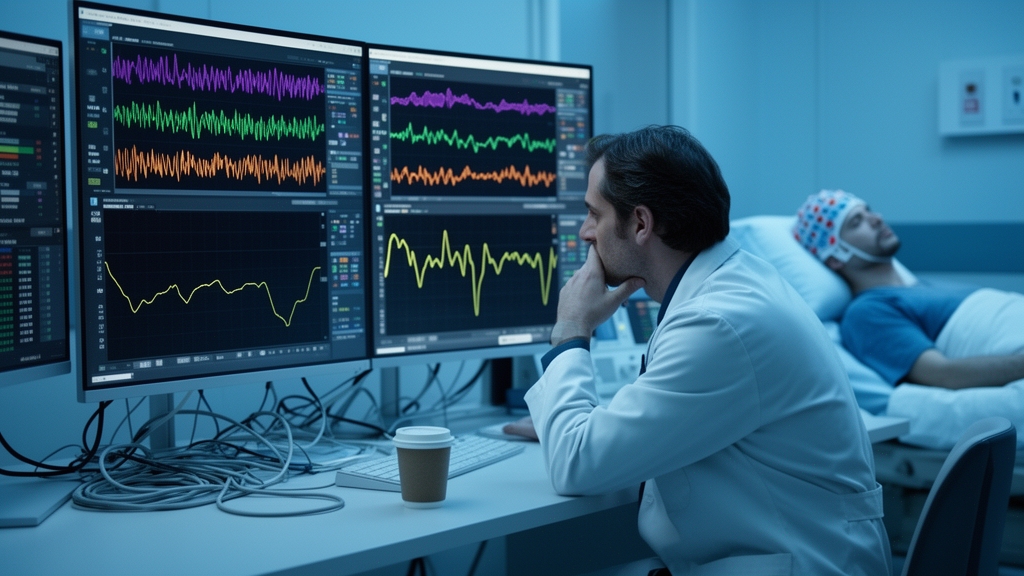
Self-supervised learning has become one of the most seductive promises in medical artificial intelligence: let a neural network teach itself from oceans of unlabelled data, then fine-tune it with the scarce expert annotations that hospitals can actually afford. A new proof-of-concept study puts that promise to an unusually honest test in the field of epileptic seizure detection, and the results are a masterclass in why headline accuracy numbers can hide clinically dangerous trade-offs. The researchers pre-trained a compact convolutional network on unlabelled electroencephalography (EEG) recordings using a contrastive objective, then compared it against an otherwise identical model trained from scratch on labelled data. On the surface, the two models were statistically indistinguishable. Beneath the surface, they behaved like two very different machines — one more sensitive, one more precise, each with its own characteristic way of failing when the recording conditions turned hostile.
The study, published in Discover Artificial Intelligence, used a publicly available derivative of the CHB-MIT Scalp EEG Database, a collection of long-term scalp recordings from 22 paediatric patients with intractable epilepsy, sampled at 256 hertz. The working dataset consisted of 11,233 EEG segments, each spanning roughly 6.26 seconds across 23 channels, with 1,434 segments labelled as active seizure (ictal) activity and 9,799 as interictal background — a class imbalance of 6.8 to 1. Because the Kaggle derivative stripped out patient identifiers, the team applied stratified random 60/20/20 splits, a decision they openly flag as a limitation: segments from the same patient could appear in both training and test sets, meaning the reported performance likely overestimates what a patient-independent system would achieve. The authors also documented strong temporal autocorrelation in the data, with consecutive segments sharing labels over long runs, compounding the leakage concern.
The self-supervised pipeline followed the SimCLR recipe. Each unlabelled EEG segment was transformed into two stochastic views — one corrupted with Gaussian noise at a fixed scale, the other circularly shifted in time by up to about 98 milliseconds — and an InfoNCE loss trained the encoder to recognise that both views came from the same underlying signal. The intuition is elegant: by forcing the network to see past these distortions, the pre-training stage bakes invariances into the learned representations before a single label is shown. The encoder was then fine-tuned end-to-end with class-weighted cross-entropy on the labelled split, using a StarNet-style one-dimensional convolutional backbone of roughly 0.6 million parameters. Crucially, the supervised baseline shared this exact backbone, so any behavioural difference between the two models could be attributed to the pre-training strategy alone rather than to architectural advantage.
On the held-out test set, the discrimination results were essentially a tie. The self-supervised model achieved an area under the receiver operating characteristic curve (AUROC) of 0.990, with a 95 percent bootstrap confidence interval of 0.985 to 0.994, while the supervised baseline reached 0.989 (0.983 to 0.994). The confidence intervals overlap almost completely, and the authors are careful to state that neither model is superior on discrimination. The area under the precision-recall curve told the same story: 0.940 for the self-supervised model versus 0.942 for the baseline. Had the evaluation stopped there — as most EEG studies do — the paper would have been one more entry in a crowded literature of near-identical AUROC figures. Instead, the researchers pushed into territory that clinical machine learning rarely visits: what happens at the actual decision threshold, how trustworthy are the probabilities, and how gracefully does each model degrade under realistic signal corruption.
The operating-point analysis is where the story sharpens. At the conventional threshold of 0.5, the self-supervised model detected seizures with a recall of 0.951, meaning it caught roughly 95 of every 100 true seizure segments, compared with 0.924 for the baseline. But that sensitivity came at a steep price in precision: 0.669 versus 0.839. In concrete terms, the self-supervised model generated approximately one false alarm for every two genuine seizure detections, while the baseline produced roughly one false alarm for every five. The confidence intervals for the precision gap did not overlap, confirming the difference is statistically supported; the recall advantage, by contrast, showed overlapping intervals and should be read as a directional trend. The clinical stakes are far from abstract. Alarm fatigue — the desensitisation of clinical staff to a flood of false positives — is among the most documented patient-safety concerns in intensive care and epilepsy monitoring units. A monitoring system that cries wolf twice as often could paradoxically make patients less safe, even while missing fewer seizures.
Calibration told a similar story of hidden divergence. Clinicians act on model confidence, not just on rankings, so a probability of 0.9 should mean roughly 90 percent of such predictions are correct. The supervised baseline delivered an expected calibration error (ECE) of 0.027 and a Brier score of 0.027, while the self-supervised model posted an ECE of 0.066 and a Brier score of 0.052 — with non-overlapping confidence intervals confirming the baseline is genuinely better calibrated. The authors trace this to the pre-training objective itself: InfoNCE optimises representational similarity, not probability reliability, and the geometry of the learned representation space can push fine-tuned probabilities away from their optimum. A lightweight fix — temperature scaling, a single learned scalar fitted on the validation set — improved both models modestly without altering AUROC or candidate rankings. The learned temperatures were 1.42 for the self-supervised model and 1.31 for the baseline. The authors note a caveat: on a class-imbalanced validation set, temperature scaling may be tuned primarily to the majority class, and asymmetric miscalibration would call for alternatives such as Platt scaling or isotonic regression.
The most original contribution is the robustness suite: eight physiology-aligned stressors, each applied at three severity levels, mirroring the corruption benchmarks that transformed evaluation standards in computer vision. The perturbations map onto real hardware and environmental failure modes — electrode dropout simulates lost leads and poor skin contact, baseline drift simulates electrode polarisation and slow head movements, sampling jitter simulates clock synchronisation differences between acquisition devices, and amplitude scaling simulates gain variation across amplifier generations. The results form a clean mechanistic pattern: wherever the self-supervised augmentations built invariance, the self-supervised model held up; wherever they did not, the supervised model prevailed. Under sampling jitter at 20 percent severity, the self-supervised model scored an AUROC of 0.968 against the baseline’s 0.960, a directional advantage with marginally overlapping confidence intervals that traces directly to the time-shift augmentation. Both models were essentially insensitive to burst noise.
The confirmed vulnerability is dramatic. Under strong low-frequency baseline drift at amplitude 0.40 — the kind of slow sinusoidal distortion produced by sweat artefacts and electrode polarisation — the self-supervised model dropped to an AUROC of 0.913 while the supervised baseline held at 0.970, a gap of 5.7 percentage points with completely non-overlapping confidence intervals. The explanation is refreshingly honest: neither Gaussian noise nor time shift teaches a network to ignore a drifting baseline, because drift is neither additive white noise nor a temporal translation. The augmentation views were chosen for direct hardware interpretability, borrowed largely from the computer vision contrastive learning literature, and they deliberately left spectral dynamics untouched. The authors point out that EEG’s discriminative power lives in physiological frequency bands — delta, theta, alpha, and beta — and that band-specific augmentations such as spectral masking would be natural extensions. They propose three concrete fixes: adding sinusoidal drift as an explicit augmentation view, including amplitude scaling and alternate referencing transforms, and propagating grouped channel dropout with band-limited masking.
The limitations deserve as much attention as the results. Beyond the subject leakage and temporal autocorrelation already noted, the study relies on a single dataset from a single acquisition site, with no device metadata available; the bootstrap resampling treats segments as independent draws, an assumption the leakage violates, so the reported confidence intervals are likely narrower than they should be. The evaluation covers a single backbone architecture, and the self-supervised encoder was pre-trained on the same 6,739 labelled-set segments it was later fine-tuned on — a within-dataset setup that limits the representation-learning advantage, which typically grows when the unlabelled pool is much larger than the labelled one. The authors frame everything as a controlled proof-of-concept, not a deployment benchmark, and their roadmap prioritises rebuilding the pipeline on the raw CHB-MIT recordings with patient-wise splits and a multi-architecture comparison including EEGNet and Transformer-based encoders.
What makes this study resonate beyond EEG is its methodological argument: discrimination metrics alone are no longer enough. By treating calibration, operating-point behaviour, and severity-controlled robustness as first-class evaluation goals, the researchers surfaced differences that a table of AUROC values would have buried entirely — a sensitivity-precision trade-off with direct alarm-fatigue consequences, a calibration deficit rooted in the pre-training objective, and a robustness profile that maps one-to-one onto augmentation design choices. The message for the field is both humbling and actionable. Self-supervised learning does not confer blanket resilience; it confers exactly the invariances you train for, and nothing else. For a clinical community weighing whether representation learning from unlabelled physiological signals is worth the investment, that is a far more useful finding than another near-tied AUROC — and a reminder that in medical AI, the perturbations you forgot to simulate are the ones that will find you first.
Subject of Research: Contrastive self-supervised learning for epileptic seizure detection from EEG with calibration and robustness evaluation
Article Title: Contrastive self-supervised learning for epileptic seizure detection from EEG with calibration and robustness evaluation under physiology-aligned perturbations
Article References: Al-Taie, M. Z., Hazzaa, F., & Qashou, A. (2026). Contrastive self-supervised learning for epileptic seizure detection from EEG with calibration and robustness evaluation under physiology-aligned perturbations. Discover Artificial Intelligence, 6(1), Article 943. https://doi.org/10.1007/s44163-026-02042-0
Image Credits: AI Generated
DOI: 10.1007/s44163-026-02042-0
Keywords: self-supervised learning, EEG, epilepsy, seizure detection, SimCLR, InfoNCE, calibration, robustness, baseline drift, alarm fatigue, CHB-MIT, temperature scaling
Cite Scienmag News
Denise Maddox. (October 28, 2026). Self-Supervised AI Learns to Detect Seizures, but Its Blind Spots Reveal a Deeper Truth About Robustness. Scienmag. https://scienmag.com/self-supervised-ai-learns-to-detect-seizures-but-its-blind-spots-reveal-a-deeper-truth-about-robustness/
Denise Maddox. "Self-Supervised AI Learns to Detect Seizures, but Its Blind Spots Reveal a Deeper Truth About Robustness." Scienmag, 28 October 2026, https://scienmag.com/self-supervised-ai-learns-to-detect-seizures-but-its-blind-spots-reveal-a-deeper-truth-about-robustness/. Accessed 29 October 2026.
Denise Maddox. "Self-Supervised AI Learns to Detect Seizures, but Its Blind Spots Reveal a Deeper Truth About Robustness." Scienmag. October 28, 2026. https://scienmag.com/self-supervised-ai-learns-to-detect-seizures-but-its-blind-spots-reveal-a-deeper-truth-about-robustness/