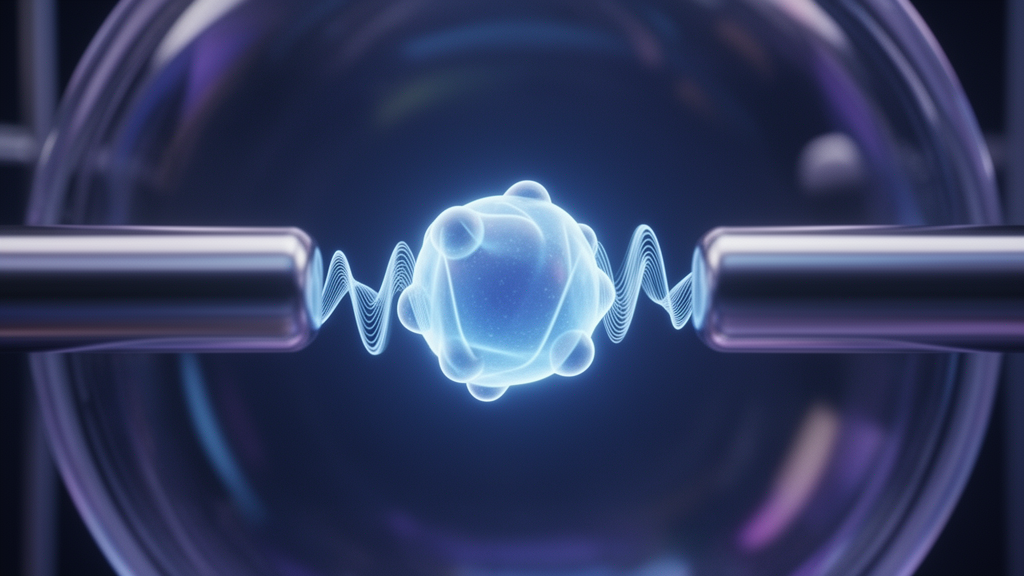
Conventional quantum error correction protocols typically require repeated syndrome measurements, real-time feedback or post-selection, and multiple physical qubits, all of which add technical complexity. A new experiment, published in Nature Physics, shows a way around that overhead. Researchers encoded a logical qubit in multiple internal spin states of a single trapped ion and corrected errors autonomously, using engineered couplings between spin and motion to drain away entropy without ever measuring the qubit itself.
By repeatedly applying their autonomous correction protocol, the team observed extension of the logical qubit’s lifetime beyond that benchmark, both under ordinary laboratory conditions and when low-frequency magnetic noise was deliberately injected into the system.
In the trapped-ion setup, that machinery is replaced by physics that happens on its own. Engineered spin–motion couplings transfer entropy introduced by errors into the motional modes of the ion, where it is dissipated through sympathetic cooling with a neighbouring ancilla ion.
Sympathetic cooling works like a built-in refrigerator for the quantum register. The ancilla ion, coupled to the same motional modes, carries away the energy and disorder that errors deposit, resetting the system without any measurement of the logical information.
The logical qubit itself lives in the multilevel structure of a single ion rather than in an entangled state spread across many qubits. That hardware-efficient encoding is the second half of the achievement: the experiment demonstrates that the rich internal level structure of trapped ions can serve as the substrate for quantum error correction with reduced overhead, instead of requiring large arrays of physical qubits for each protected qubit.
The demonstration held up under stress. The team observed lifetime extension not only in ambient laboratory conditions but also while injecting low-frequency magnetic noise, a realistic disturbance for trapped-ion hardware.
The researchers point to the broader implication: multilevel structure in trapped ions can support hardware-efficient quantum error correction and robust quantum memories with reduced overhead.
The work, led by Yi Li and colleagues with senior author Jiangfeng Du, appears in Nature Physics under the title ‘Beating the break-even point with autonomous quantum error correction’.
Subject of Research: Autonomous quantum error correction in a single trapped ion surpassing the break-even point for qubit lifetime
Article Title: Beating the break-even point with autonomous quantum error correction
Article References: Li, Y., Mei, Q., Jie, Q.-X., Cai, W., Li, Y., Liu, Z., Chen, Z.-J., Xie, Z., Cheng, X., Zhao, X., Luo, Z., Zhang, M., Zou, X.-B., Zou, C.-L., Lin, Y., & Du, J. (2026). Beating the break-even point with autonomous quantum error correction. Nature Physics. https://doi.org/10.1038/s41567-026-03486-y
Image Credits: AI Generated
DOI: 10.1038/s41567-026-03486-y
Keywords: quantum error correction, trapped ions, break-even point, logical qubit, sympathetic cooling, autonomous correction, quantum memory, spin-motion coupling, entropy dissipation, magnetic noise, Beating, break-even
Cite Scienmag News
Katie Riggs. (October 29, 2026). Trapped-ion qubit lives longer without measurement, beating break-even. Scienmag. https://scienmag.com/trapped-ion-qubit-lives-longer-without-measurement-beating-break-even/
Katie Riggs. "Trapped-ion qubit lives longer without measurement, beating break-even." Scienmag, 29 October 2026, https://scienmag.com/trapped-ion-qubit-lives-longer-without-measurement-beating-break-even/. Accessed 29 October 2026.
Katie Riggs. "Trapped-ion qubit lives longer without measurement, beating break-even." Scienmag. October 29, 2026. https://scienmag.com/trapped-ion-qubit-lives-longer-without-measurement-beating-break-even/