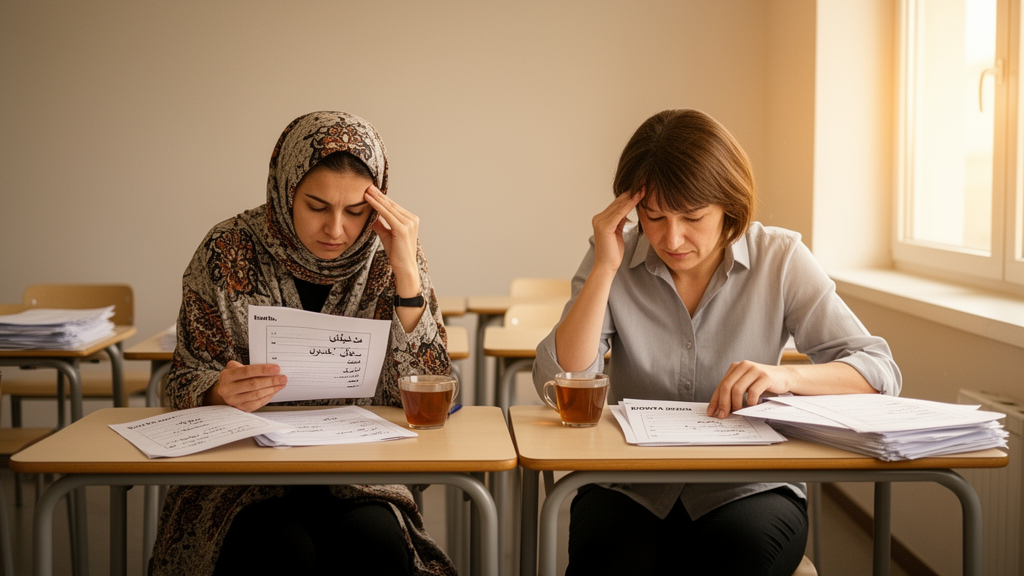
University English teachers in Iran and Poland describe strikingly similar pressures on the job, from unmanageable workloads to disruptive students, but the way they interpret those pressures and the strategies they use to survive them diverge sharply along cultural and institutional lines. That is the central finding of a qualitative comparative study published on 21 October 2026 in the Asian-Pacific Journal of Second and Foreign Language Education, which examined the lived experience of psychological distress among English as a foreign language teachers in the two countries.
Psychological distress, as the researchers define it in their review of the literature, is an unsettled mental state ranging from anxiety to depression, marked by emotional and physical symptoms, and it is well documented among university teachers. Prolonged occupational stress can manifest as work-related emotional fatigue and depressive symptoms, and prior research links sustained distress to disrupted sleep, psychosomatic illness, reduced job satisfaction and, in severe and unresolved cases, burnout. What has been missing, the authors argue, is in-depth qualitative inquiry into how the perception and emotional weight of these stressors differ across distinct cultural settings, since most existing work is quantitative and confined to single national contexts.
To address that gap, the team interviewed ten university-level EFL teachers, five in Iran and five in Poland, recruited through purposive maximum variation sampling. Participants were selected for diversity in teaching experience, which ranged from five to twenty-five years, in educational background, with all holding a PhD in EFL teaching or a related field, and in institution type, covering public, private and mixed settings. Institutions in several cities and regions were included: in Iran, teachers from the east and north were interviewed, some via Skype and one face to face, while in Poland three interviews took place face to face at a university in the east and two were conducted online. All participants belonged to faculties of humanities, and all interviews were conducted in English, lasting roughly twenty-five to thirty minutes each, with one shorter ten-minute session.
The researchers stopped recruiting after five interviews per country because the data had reached saturation: after the fourth interview in each context, no new themes or codes emerged during open coding, and the fifth interview confirmed the stability of the existing codebook. Data collection spanned 2022 to 2023. Interviews were audio-recorded, transcribed verbatim and checked by participants through member checking, and the analysis followed Braun and Clarke’s six-step thematic approach using MAXQDA software. Reliability was quantified with Cohen’s Kappa for independent coding, yielding a coefficient of 0.84, which the authors describe as strong agreement, with remaining discrepancies resolved through collaborative discussion until consensus.
The results show a clear common core of stressors. Teachers in both countries reported heavy workloads and administrative burdens, unsatisfactory working conditions, and difficulties with students. A Polish participant complained of having too many obligations and of struggling to find a consensus between job and family life, while an Iranian teacher described work overload from numerous academic tasks and difficulty handling students who disputed their scores. Polish participants additionally flagged poor student attendance and the strain of maintaining a balance between control and motivation in the classroom. When distress hit, its consequences also looked alike across the two groups: participants in both cohorts reported sleep disorders and sleep deprivation, diminished teaching quality such as unclear speech under stress, and demotivation, with one Iranian teacher warning that lowered standards could lead to educational failure.
But the cultural contrasts were equally pronounced. Iranian participants uniquely highlighted a sociocultural stressor absent from the Polish accounts: a perceived lack of professional recognition from society, with one teacher explicitly naming the lack of recognition by society as a major problem. Polish participants, by contrast, emphasized stressors tied to direct face-to-face contact with students, problems with time, and disrupted work-life balance; one described teaching as both stressful and physically demanding, relying heavily on memory and stamina. The authors interpret these differences through Hofstede’s cultural dimensions of individualism versus collectivism and power distance, while cautioning that the responses are not purely culturally deterministic. Iran’s centralized, collectivist academic hierarchy, they note, may compound the sense of low societal status, whereas Poland’s decentralized, EU-aligned framework emphasizes individual accountability, auditing and self-direction, which likely intensifies the time-pressure and boundary burdens Polish teachers reported.
Curriculum experiences split along the same lines. Polish participants appreciated the autonomy afforded by their educational frameworks, with one noting that a well-made curriculum helps with preparation and time management, but several identified unclear or overloaded curricula as sources of confusion and constant time pressure. Iranian respondents, in contrast, described rigid, top-down curricula that constrained pedagogical creativity, including strict compliance requirements and course materials that were not the newest versions, though one Iranian participant noted that flexibility in her own teaching allowed innovation. The authors read this as power distance expressed inside institutions: strictures distress teachers in the high power distance system, while ambiguity distresses teachers in the lower power distance one.
The sharpest divergence appeared in coping. Polish teachers in the study tended toward emotion-focused strategies, seeking social support and psychotherapy, and relying on individual behavioral tactics such as marking a clear line between professional and private life, prioritizing eight hours of sleep, doing exercise and yoga, and pursuing hobbies like reading and cooking. Iranian teachers leaned toward problem-focused strategies, including thorough preparation before class and drawing on accumulated professional experience, alongside positive cognitive reframing and heavy use of social relationships with students, university principals, colleagues, friends and family. Both groups converged on consulting family members and colleagues, and both reported that good rapport with students could buffer distress, while poor relationships, hostile or disengaged students, and poor student outcomes fed it. Views on institutional support were mixed in both countries: Polish participants noted a lack of targeted training on stress itself, and Iranian participants criticized teacher training courses as outdated, though some in both groups saw potential value in well-designed programs combining formal training with practical experience.
The authors frame these patterns with Lazarus and Folkman’s transactional theory of stress and coping, arguing that primary appraisal of workload stressors is similar across both cultures, while secondary appraisal, the evaluation of available coping resources, is where culture exerts its influence. Iranian teachers, operating within a collectivist framework, appraise social networks as viable resources, whereas Polish teachers, in an individualistic context, appraise self-reliance as their primary asset. The study also found that university rankings produced varied and sometimes contradictory accounts, with some participants saying internal dynamics such as student motivation mattered more than prestige, others finding high-ranked institutions more stressful due to constant evaluation, and still others, in both countries, finding low-ranked institutions more stressful.
The team is explicit about the limits of what these findings can support. With only ten participants recruited purposively, the study is built for depth and intercultural comparison rather than statistical representativeness, and the authors caution that the results reflect the nuanced experiences of these participants rather than all Iranian or Polish EFL teachers. The semi-structured interview design, while rich, lacks triangulation with surveys or observational data and may introduce interpretive subjectivity. They suggest future work using quantitative or mixed methods, longitudinal designs, analysis by academic rank rather than university ranking, and evaluation of culturally sensitive stress management interventions. Within those limits, the study’s contribution is a grounded comparative picture: some stressors of language teaching may be universal, but the perception of them, and the responses they call forth, are shaped by the intersection of cultural orientation and specific institutional context.
Subject of Research: A qualitative comparative study of psychological distress among Iranian and Polish university EFL teachers
Article Title: Psychological distress: a comparative study of Iranian and Polish EFL teachers
Article References: Amirian, S. M. R., Ali Pour, R., Kakhki, A. M., & Terejko, P. (2026). Psychological distress: a comparative study of Iranian and Polish EFL teachers. Asian-Pacific Journal of Second and Foreign Language Education, 11(1), Article 90. https://doi.org/10.1186/s40862-026-00464-y
Image Credits: AI Generated
DOI: 10.1186/s40862-026-00464-y
Keywords: psychological distress, EFL teachers, Iran, Poland, coping strategies, qualitative study, teacher burnout, cross-cultural comparison, higher education, work-life balance, semi-structured interviews, thematic analysis
Cite Scienmag News
Courtney Benton. (October 28, 2026). Iranian and Polish language teachers carry the same stress in different ways. Scienmag. https://scienmag.com/iranian-and-polish-language-teachers-carry-the-same-stress-in-different-ways/
Courtney Benton. "Iranian and Polish language teachers carry the same stress in different ways." Scienmag, 28 October 2026, https://scienmag.com/iranian-and-polish-language-teachers-carry-the-same-stress-in-different-ways/. Accessed 28 October 2026.
Courtney Benton. "Iranian and Polish language teachers carry the same stress in different ways." Scienmag. October 28, 2026. https://scienmag.com/iranian-and-polish-language-teachers-carry-the-same-stress-in-different-ways/