A perspective article published in Discover Sustainability argues that foundational teachers in Sub-Saharan Africa need a defined set of pedagogical competencies to integrate greening concepts into national school curricula, as part of efforts to advance Education for Sustainable Development (ESD) targets in the region’s marginalised communities. The author, Gideon Mensah Anapey, positions the work as a conceptual contribution rather than an empirical study, addressing a gap he identifies between research on foundational learning outcomes and the practical knowledge teachers need for climate-focused teaching.
The article frames its motivation around the pressures that climate change places on developing countries, citing extreme weather events, rising temperatures, and environmental degradation as threats to both livelihoods and the quality of learning outcomes. According to the author, scholarly work on foundational learning has concentrated heavily on literacy and numeracy while overlooking the knowledge that scholar-practitioners require for creative pedagogy supporting climate sustainability in many third-world nations. The study therefore asks what kinds of competencies early grade teachers should possess to bring greening concepts into classrooms serving vulnerable communities.
Methodologically, the piece takes a pamphlet approach, drawing on dialogic and illustrative material described as coming from experts’ stables, with the Learning Sciences philosophy guiding the expositions. Through this framing, the author builds a case for what he terms greening curriculum readiness in marginalised early grade classrooms. Because the work is a perspective, its outputs are proposals and frameworks rather than measured results from classroom trials or teacher surveys, a distinction that matters for how the recommendations should be read.
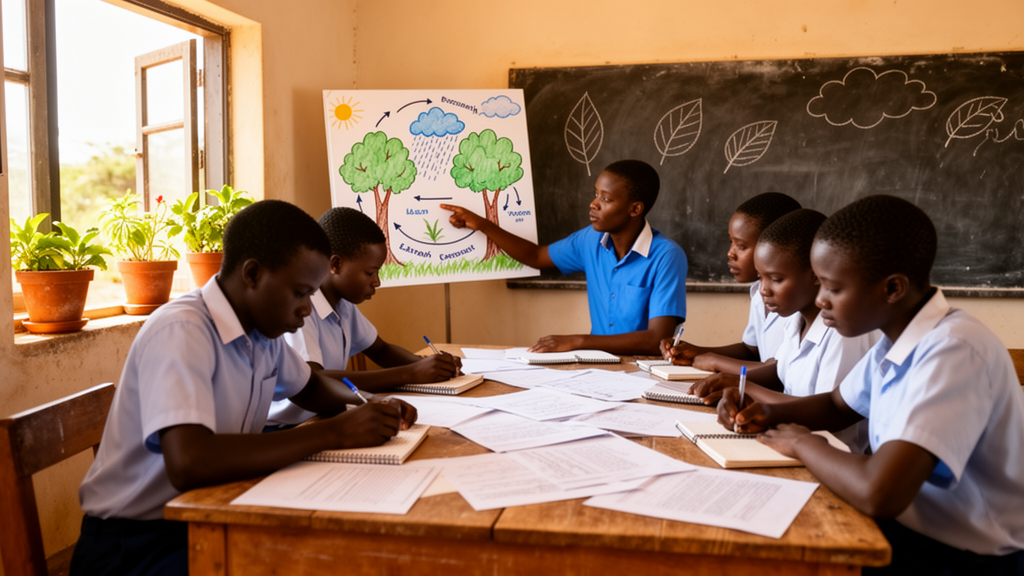
The central output is a green pedagogical framework built around teacher continuous professional development. The framework also includes greening assessment, learner reflexivity, problem-solving activities, and climate projects that celebrate indigenous knowledge, all oriented toward ESD readiness in Sub-Saharan African foundational learning. In practical terms, the author suggests the model could influence sustainability learning goals such as transdisciplinary knowledge, critical thinking, problem-solving skills, and climate adaptation in marginalised communities.
Beyond classroom practice, the article argues that climate-resilient discourse and foundational pedagogy policy must expand beyond curriculum propositions alone, so that environmental challenges can be meaningfully conceptualised for children in vulnerable communities. The contribution is thus aimed at both teacher educators and policymakers, proposing that professional development pathways and assessment design be aligned with sustainability objectives from the earliest years of schooling.
Readers should note the limitations inherent in the article’s design. As a perspective piece published open access in September 2026, it sets out a proposed framework and conceptual arguments; it does not report tested effects on teacher practice or pupil outcomes, and any impact on sustainability learning in African classrooms remains a prediction of the model rather than a demonstrated finding. Its value lies in offering a structured starting point for researchers, teacher-training institutions, and education ministries seeking to connect foundational learning with climate education in contexts where such integration has received limited scholarly attention.
Subject of Research: Foundational teachers’ greening curriculum readiness for advancing education for sustainable development targets in Sub-Saharan Africa
Article Title: Foundational teachers’ greening curriculum readiness for advancing education for sustainable development targets in Sub-Saharan Africa
Article References: Anapey, G. M. (2026). Foundational teachers’ greening curriculum readiness for advancing education for sustainable development targets in Sub-Saharan Africa. Discover Sustainability. https://doi.org/10.1007/s43621-026-04465-2
Image Credits: AI Generated
DOI: 10.1007/s43621-026-04465-2
Keywords: Foundational, teachers, greening, curriculum, readiness, advancing, education, sustainable, development, targets, Sub-Saharan, Africa
Cite Scienmag News
Sloane Callahan. (October 27, 2026). Green Pedagogy Framework Aims to Ready Sub-Saharan Teachers for Climate Curricula. Scienmag. https://scienmag.com/green-pedagogy-framework-aims-to-ready-sub-saharan-teachers-for-climate-curricula/
Sloane Callahan. "Green Pedagogy Framework Aims to Ready Sub-Saharan Teachers for Climate Curricula." Scienmag, 27 October 2026, https://scienmag.com/green-pedagogy-framework-aims-to-ready-sub-saharan-teachers-for-climate-curricula/. Accessed 28 October 2026.
Sloane Callahan. "Green Pedagogy Framework Aims to Ready Sub-Saharan Teachers for Climate Curricula." Scienmag. October 27, 2026. https://scienmag.com/green-pedagogy-framework-aims-to-ready-sub-saharan-teachers-for-climate-curricula/