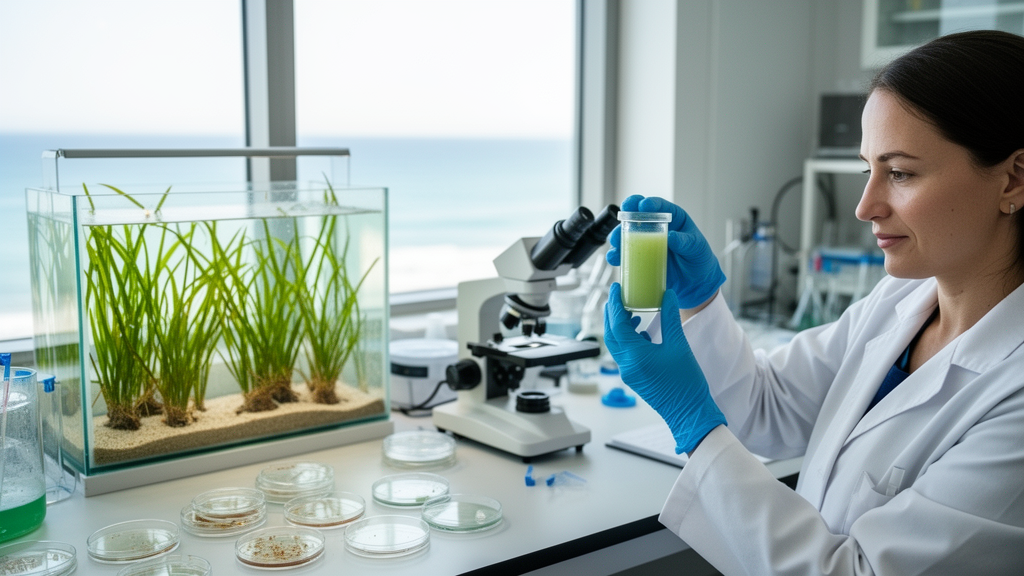
A new open-access study in Environmental Microbiome reports a cultivation-based effort to find bacteria that could help these plants cope, identifying a six-member bacterial community that the authors predict is likely to promote the growth of the seagrass Zostera marina and support restoration efforts.
The research team, led by Diane-Marie Brache-Smith and colleagues including E. Maggie Sogin, isolated bacteria from three compartments of the seagrass plant: the rhizosphere, the rhizoplane and the endosphere. Using plant-based growth media, they obtained 201 bacterial isolates from Z. marina. Among these were 17 potentially novel species, as well as genera that had not been detected in the team’s amplicon sequencing survey of the same material, suggesting that cultivation can recover microbial diversity that standard DNA surveys miss.
From this collection, the researchers sequenced the genomes of 61 pure cultures and subjected them to genomic and phenotypic analyses. The central question was whether these seagrass-associated bacteria carry the functions that, based on evidence from terrestrial plant-microbe systems, are expected to benefit marine plants: supplying nitrogen and phosphorus, detoxifying sulfur compounds and producing phytohormones.
The genomic survey revealed that nitrogen mobilization was widespread among the sequenced taxa, but mostly through catabolic pathways. In total, 83 percent of the genomes encoded the ability to cleave carbon-nitrogen bonds, 71 percent carried genes for dissimilatory nitrate reduction to ammonia, and 51 percent had pathways for denitrification. Notably, six of the isolates, representing new lineages of the genus Agarivorans, coded for the nitrogenase gene cassette.
Other plant-relevant traits were also common. Sulfur or thiosulfate oxidation genes appeared in 52 percent of the genomes, genes associated with phosphorus solubilization in 88.5 percent, and the capacity to produce indole-3-acetic acid, a phytohormone, in 60.5 percent. These functions map directly onto the expected benefits of a growth-promoting community, from unlocking mineral nutrients to modulating plant development.
One of the study’s most technically interesting findings concerns metabolic completeness. The genomic analysis showed that some pathways, including denitrification and the dissimilatory reduction of nitrite to ammonia, could not be completed by any single taxon. No one isolate contained all the genes required to run these pathways from start to finish, implying that such transformations depend on cross-species cooperation within the microbial community rather than on individual strains acting alone.
Integrating draft genome models with the results of phenotypic assays, the team proposed a minimal microbial community of six isolates: Streptomyces sp. (Iso23 and Iso384), Mesobacillus sp. (Iso127), Roseibuim sp. (Iso195), Peribacillus sp. (Iso49) and Agarivorans sp. (Iso311). The members of this consortium were selected because their complementary traits cover the range of predicted plant growth-promoting functions identified in the wider collection.
The authors are careful to frame this consortium as a prediction rather than a demonstrated outcome. The community is described as one that they predict likely promotes seagrass growth and enhances restoration efforts; the study itself provides genomic and phenotypic characterization of the isolates, not field trials of restoration performance. Testing whether the predicted benefits materialize in real meadows remains a task for future work.
Even so, the study offers a detailed resource for seagrass microbiology. It documents which plant-growth-promoting traits are present among culturable bacteria from Z. marina, highlights how incomplete metabolic pathways may be distributed across species, and delivers a set of characterized isolates, including potentially novel species, that can now be tested in controlled experiments.
Subject of Research: Bacterial isolates from seagrass rhizosphere predicted to promote plant growth
Article Title: Identification of putative bacterial candidates predicted to promote the growth of the seagrass Zostera marina
Article References: Brache-Smith, D.-M., Badillo, J., Maeda, S., & Sogin, E. M. (2026). Identification of putative bacterial candidates predicted to promote the growth of the seagrass Zostera marina. Environmental Microbiome. https://doi.org/10.1186/s40793-026-00980-x
Image Credits: AI Generated
DOI: 10.1186/s40793-026-00980-x
Keywords: seagrass, Zostera marina, plant growth-promoting bacteria, microbiome, restoration, nitrogen cycling, phosphorus solubilization, denitrification, nitrogenase, rhizosphere, sulfur oxidation, phytohormones
Cite Scienmag News
Morgan Morrow. (October 27, 2026). Scientists isolate bacteria predicted to boost seagrass growth and restoration. Scienmag. https://scienmag.com/scientists-isolate-bacteria-predicted-to-boost-seagrass-growth-and-restoration/
Morgan Morrow. "Scientists isolate bacteria predicted to boost seagrass growth and restoration." Scienmag, 27 October 2026, https://scienmag.com/scientists-isolate-bacteria-predicted-to-boost-seagrass-growth-and-restoration/. Accessed 28 October 2026.
Morgan Morrow. "Scientists isolate bacteria predicted to boost seagrass growth and restoration." Scienmag. October 27, 2026. https://scienmag.com/scientists-isolate-bacteria-predicted-to-boost-seagrass-growth-and-restoration/