


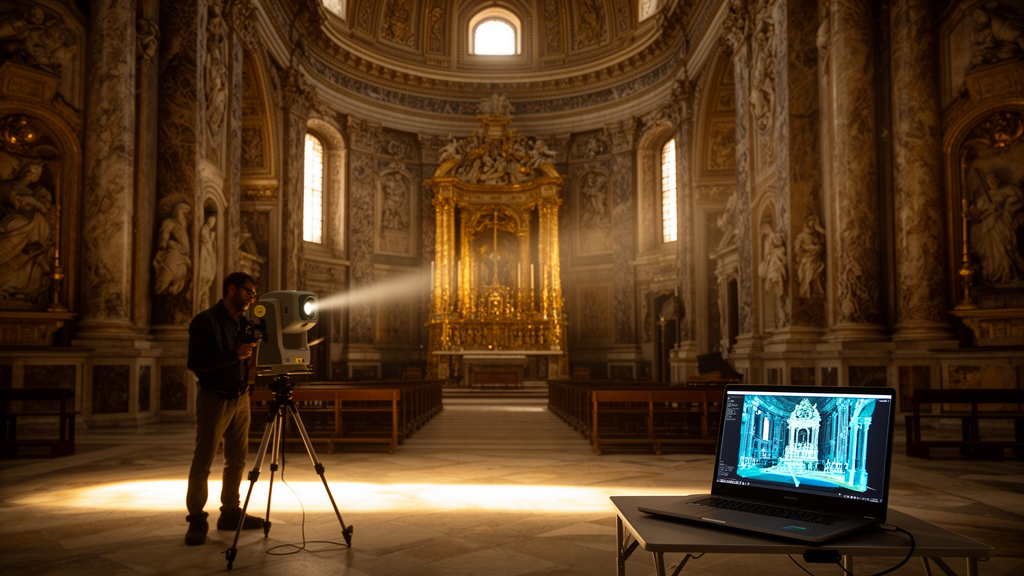
Researchers have developed a reproducible Scan-to-HBIM workflow for documenting the “Holy Trinity” church in Popoli, Italy, a Baroque building with a central plan, a shallow spherical-cap dome and richly decorated surfaces. The study, published in the journal City, Territory and Architecture, integrates static terrestrial laser scanning with UAV photogrammetry to produce a complete and metrically reliable point cloud of the complex structure, including its indoor and outdoor spaces.
The combined point cloud serves as the geometric foundation for the entire documentation pipeline. It supports geometric analysis, heritage building information modelling (HBIM) and immersive visualization. A central focus of the work is the church’s dome: the surveyed geometry was compared against an idealized spherical-cap model to assess its regularity, identify deviations from the theoretical form, and guide the level of abstraction used in the modelling process.
The resulting HBIM model is organized through levels, sections, geometric primitives and customized BIM families, and is exported in interoperable formats for visualization and information management. This structure allows the model to be used not only as a metric record but also as a semantic database in which individual building components carry information relevant to conservation and management.
Two complementary dissemination strategies are examined alongside the modelling work. The first is a virtual tour based on equirectangular panoramic images acquired during the laser scanning survey, offering an accessible way for the public to explore the building. The second is a BIM-based virtual reality environment in which users can interact with semantic building components, connecting immersive experience to the underlying structured model.
According to the authors, the results demonstrate that the proposed workflow supports accurate documentation, geometric understanding and accessible communication of complex heritage architecture, providing a framework for conservation, management and public dissemination. The study is published as open access, and the version shared online is a peer-reviewed, accepted manuscript that is citable and carries a permanent DOI, subject to further editorial edits before the final Version of Record.
Subject of Research: Digital documentation of a Baroque church using 3D point clouds, HBIM and virtual reality
Article Title: Digital documentation of complex architecture through 3D point clouds, BIM, and virtual reality: the baroque church of Popoli (Italy) as a case study
Article References: Palumbo, D., Pepe, M., Dewedar, A. K. H., & Spacone, E. (2026). Digital documentation of complex architecture through 3D point clouds, BIM, and virtual reality: the baroque church of Popoli (Italy) as a case study. City, Territory and Architecture. https://doi.org/10.1186/s40410-026-00330-x
Image Credits: AI Generated
DOI: 10.1186/s40410-026-00330-x
Keywords: HBIM, 3D point clouds, terrestrial laser scanning, UAV photogrammetry, virtual reality, Baroque architecture, heritage documentation, dome geometry, digital survey, Popoli, virtual tour, BIM
Cite Scienmag News
Courtney Benton. (October 27, 2026). Scan-to-HBIM workflow brings a Baroque Italian church into virtual reality. Scienmag. https://scienmag.com/scan-to-hbim-workflow-brings-a-baroque-italian-church-into-virtual-reality/
Courtney Benton. "Scan-to-HBIM workflow brings a Baroque Italian church into virtual reality." Scienmag, 27 October 2026, https://scienmag.com/scan-to-hbim-workflow-brings-a-baroque-italian-church-into-virtual-reality/. Accessed 27 October 2026.
Courtney Benton. "Scan-to-HBIM workflow brings a Baroque Italian church into virtual reality." Scienmag. October 27, 2026. https://scienmag.com/scan-to-hbim-workflow-brings-a-baroque-italian-church-into-virtual-reality/


