Thursday, October 29, 2026
Science
No Result
View All Result
  • Login
  • HOME
  • SCIENCE NEWS
  • CONTACT US
  • HOME
  • SCIENCE NEWS
  • CONTACT US
No Result
View All Result
Scienmag
No Result
View All Result
Home Science News Agriculture

Avocado Seeds from Northern Tanzania Show Antibacterial and Antioxidant Activity in Lab Tests

October 27, 2026
in Agriculture
Alan Morgan
By Alan Morgan Scienmag Editorial Profile - Precision Agriculture
Reading Time: 3 mins read
0
Avocado Seeds from Northern Tanzania Show Antibacterial and Antioxidant Activity in Lab Tests

Avocado Seeds from Northern Tanzania Show Antibacterial and Antioxidant Activity in Lab Tests

65
SHARES
587
VIEWS
Share on FacebookShare on Twitter
ADVERTISEMENT

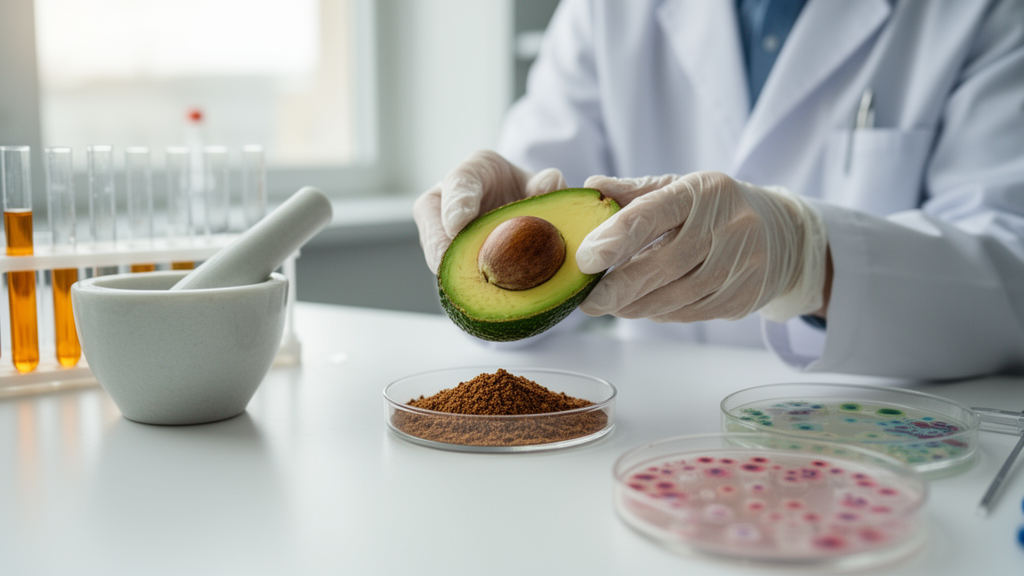
Seeds that most people throw away after eating an avocado may hold useful chemistry, according to a new study of locally cultivated avocado trees in Korogwe District, northern Tanzania. Researchers dried and ground ripe avocado seeds, extracted them with 70% ethanol, and tested the resulting extract against two common bacteria and for free-radical scavenging in the laboratory.

The antibacterial evaluation used the agar disc diffusion method against Escherichia coli, a Gram-negative bacterium, and Staphylococcus aureus, a Gram-positive one. The extract was tested at concentrations ranging from 25 to 100 mg/mL. Inhibition zones grew larger as the concentration increased, reaching a mean diameter of 19.6 mm against E. coli and 19.2 mm against S. aureus at the highest concentration tested.

Both bacterial species responded, meaning the extract showed activity against a Gram-negative and a Gram-positive organism. However, the zones of inhibition were significantly smaller than those produced by the standard antibiotic used for comparison, so the seed extract was weaker than conventional treatment in this assay.

The antioxidant side of the study relied on the DPPH free radical-scavenging assay, a laboratory test in which a sample's ability to neutralize a stable radical is measured. Scavenging activity rose with concentration, from approximately 49% at 1 × 10⁻⁴ mg/mL to approximately 95% at 1 mg/mL, a substantial concentration-dependent effect across the tested range.

The study was explicitly framed as preliminary. The authors note that avocado seeds are commonly discarded during fruit processing despite their high levels of bioactive compounds, and they position these results as early evidence supporting further investigation into potential applications in food preservation and natural product development.

Several limitations follow directly from the design. The work tested a single seed extract from one district against only two bacterial species using one antibacterial method, and DPPH is only one of several antioxidant assays. The authors themselves recommend that future studies include additional antioxidant tests such as ABTS, FRAP, and hydroxyl radical assays before drawing broader conclusions.

Because the experiments were conducted in vitro, the findings do not demonstrate any clinical benefit or safety in humans or animals. Disc diffusion results indicate whether a compound can slow bacterial growth on an agar plate, not whether the extract would work as a preservative in real food systems or as a medicine, both of which would require further testing.

The research also carries local significance. The avocado germplasm examined came from trees cultivated in northern Tanzania, a population the authors describe as understudied. Documenting the bioactivity of seeds from locally grown varieties could inform how processing waste from the region’s avocado harvest is valued, although any such application remains speculative until further studies are completed.

Its concrete contributions are the measured inhibition zones against E. coli and S. aureus, the quantified DPPH scavenging curve from roughly 49% to 95% over five orders of magnitude of concentration, and a documented baseline for a local Tanzanian avocado variety.

Subject of Research: Antibacterial and antioxidant activity of avocado seed extracts from locally cultivated avocados in northern Tanzania

Article Title: Antibacterial and antioxidant properties of local avocado (Persea americana Mill.) seeds grown in northern Tanzania

Article References: Hassani, A. A., & Yangaza, I. S. (2026). Antibacterial and antioxidant properties of local avocado (Persea americana Mill.) seeds grown in northern Tanzania. Discover Food. https://doi.org/10.1007/s44187-026-01328-7

Image Credits: AI Generated

DOI: 10.1007/s44187-026-01328-7

Keywords: avocado seeds, Persea americana, northern Tanzania, antibacterial activity, antioxidant, DPPH assay, Escherichia coli, Staphylococcus aureus, agar disc diffusion, food preservation, natural products, bioactive compounds

Cite Scienmag News

Alan Morgan. (October 27, 2026). Avocado Seeds from Northern Tanzania Show Antibacterial and Antioxidant Activity in Lab Tests. Scienmag. https://scienmag.com/avocado-seeds-from-northern-tanzania-show-antibacterial-and-antioxidant-activity-in-lab-tests/

Alan Morgan. "Avocado Seeds from Northern Tanzania Show Antibacterial and Antioxidant Activity in Lab Tests." Scienmag, 27 October 2026, https://scienmag.com/avocado-seeds-from-northern-tanzania-show-antibacterial-and-antioxidant-activity-in-lab-tests/. Accessed 29 October 2026.

Alan Morgan. "Avocado Seeds from Northern Tanzania Show Antibacterial and Antioxidant Activity in Lab Tests." Scienmag. October 27, 2026. https://scienmag.com/avocado-seeds-from-northern-tanzania-show-antibacterial-and-antioxidant-activity-in-lab-tests/
Tags: agar disc diffusionantibacterial activityantimicrobial research in Tanzaniaantioxidantantioxidant activity of avocado seedsAvocado seed antibacterial propertiesavocado seedsbioactive compoundsbotanical extracts against E. coli and Staphylococcus aureusDPPH assayEscherichia coliethnobotanical studies of avocadofood preservationfree radical scavenging in plant extractslaboratory testing of plant-based antimicrobialsnatural antibacterial agents from plant sourcesnatural antioxidant sources from tropical plantsnatural productsnorthern TanzaniaPersea americanaphytochemicals in avocado seedspotential health benefits of avocado seedsStaphylococcus aureustraditional uses of avocado seeds
Share26Tweet16
Previous Post

New Augmented Multiscale Method Sharpens Simulations of Incompressible Fluid Flow

Next Post

AI fears enter Americans’ top 10 for the first time, Chapman’s 2026 survey finds

Related Posts

AI Learns to Recognise Untagged Pigs Day After Day on the Farm
Agriculture

AI Learns to Recognise Untagged Pigs Day After Day on the Farm

October 29, 2026
Hydroponic oat fodder can replace a fifth of dairy concentrate without cutting milk yield
Agriculture

Hydroponic oat fodder can replace a fifth of dairy concentrate without cutting milk yield

October 29, 2026
New French Database Links Forest Stands to Soil Quality at 583 Sites
Agriculture

New French Database Links Forest Stands to Soil Quality at 583 Sites

October 29, 2026
Citrus Bitterness Compounds May Do More Than Ruin Your Juice
Agriculture

Citrus Bitterness Compounds May Do More Than Ruin Your Juice

October 29, 2026
Smartphone framework reads food labels to flag ingredients and allergens
Agriculture

Smartphone framework reads food labels to flag ingredients and allergens

October 29, 2026
Corn Steep Liquor, a Corn Industry Byproduct, Boosts Drought Tolerance in Tea Plants
Agriculture

Corn Steep Liquor, a Corn Industry Byproduct, Boosts Drought Tolerance in Tea Plants

October 29, 2026
Next Post
AI fears enter Americans’ top 10 for the first time, Chapman’s 2026 survey finds

AI fears enter Americans' top 10 for the first time, Chapman's 2026 survey finds

  • Mothers who receive childcare support from maternal grandparents show more optimized

    Mothers who receive childcare support from maternal grandparents show more parental warmth, finds NTU Singapore study

    27656 shares
    Share 11059 Tweet 6912
  • University of Seville Breaks 120-Year-Old Mystery, Revises a Key Einstein Concept

    1061 shares
    Share 424 Tweet 265
  • Bee body mass, pathogens and local climate influence heat tolerance

    682 shares
    Share 273 Tweet 171
  • Researchers record first-ever images and data of a shark experiencing a boat strike

    546 shares
    Share 218 Tweet 137
  • Groundbreaking Clinical Trial Reveals Lubiprostone Enhances Kidney Function

    531 shares
    Share 212 Tweet 133
Science

Embark on a thrilling journey of discovery with Scienmag.com—your ultimate source for cutting-edge breakthroughs. Immerse yourself in a world where curiosity knows no limits and tomorrow’s possibilities become today’s reality!

RECENT NEWS

  • New Ultrasound Score for Rheumatoid Arthritis Focuses on Wrists, Hands, Ankles and Toes
  • Extrachromosomal DNA Emerges as Possible Breast Cancer Liquid Biopsy Marker
  • Hamadryas Baboons Blamed for Heavy Livestock Losses Around Ethiopian National Park
  • Laccase Enzyme Transforms Quercetin and Caffeic Acid into More Soluble Derivatives

Categories

  • Agriculture
  • Anthropology
  • Archaeology
  • Athmospheric
  • Biology
  • Biotechnology
  • Blog
  • Bussines
  • Cancer
  • Chemistry
  • Climate
  • Earth Science
  • Editorial Policy
  • Marine
  • Mathematics
  • Medicine
  • Pediatry
  • Policy
  • Psychology & Psychiatry
  • Science Education
  • Science News
  • Social Science
  • Space
  • Technology and Engineering

Subscribe to Blog via Email

Enter your email address to subscribe to this blog and receive notifications of new posts by email.

Join 5,150 other subscribers

© 2025 Scienmag - Science Magazine

Welcome Back!

Login to your account below

Forgotten Password?

Retrieve your password

Please enter your username or email address to reset your password.

Log In
No Result
View All Result
  • HOME
  • SCIENCE NEWS
  • CONTACT US

© 2025 Scienmag - Science Magazine

Discover more from Science

Subscribe now to keep reading and get access to the full archive.

Continue reading