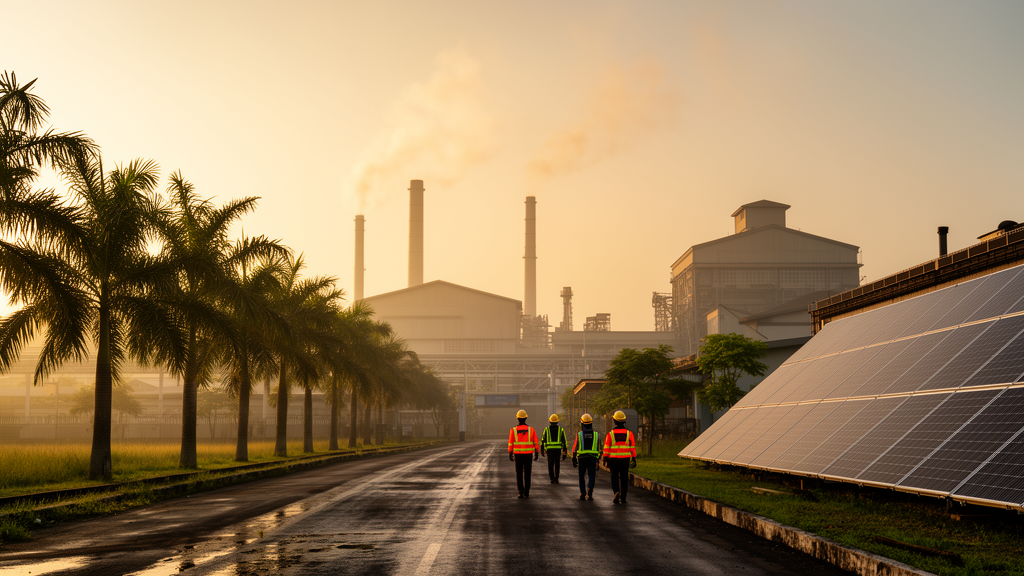
Indonesia’s three largest contributors to gross domestic product—the food and beverage, coal and petroleum refining, and chemical and pharmaceutical subsectors—provide only weak support for the United Nations Sustainable Development Goals, according to a study published in Discover Sustainability. The sample, selected through a saturated sampling approach, comprised 415 published reports: 300 annual reports, 95 sustainability reports, and 20 combined reports covering 2017 to 2022 from companies in the three subsectors that dominate Indonesia’s industrial GDP. The team developed a scoring assessment ranging from 0 to 8 to evaluate how thoroughly each company implemented targets, strategies, and achievements supporting each of the 17 Sustainable Development Goals.
This quantitative framework allowed the researchers to compare disclosure performance across subsectors and across years. The results showed that support for the goals remained at low density across all three subsectors. The only exception was Goal 3, which concerns good health and well-being, where the chemical and pharmaceutical subsector achieved medium-density support.
The food and beverage subsector supported Goals 3 and 12, the latter addressing responsible consumption and production, but its support for Goal 2 on zero hunger was judged insignificant. The coal and oil and gas refining subsector had not yet focused on Goals 6, 12, 14, and 15, which cover clean water and sanitation, responsible consumption, life below water, and life on land respectively. Comparisons between the subsectors revealed no significant differences in 2017, but consistent and statistically significant disparities emerged from 2018 to 2020, indicating a clear divergence in disclosure performance over time.
While disclosure levels differed significantly between 2017 and 2021, the comparison between 2021 and 2022 showed no significant variation, suggesting that disclosure practices stabilized during the most recent period. The authors argue that the top three GDP-contributing subsectors need to increase their support for the goals to promote sustainable economic growth, and that policies to promote the SDGs are critical. The study is limited to published corporate reports from a single country and measures disclosed commitments rather than verified on-the-ground outcomes.
Subject of Research: Sustainable Development Goal disclosure performance in Indonesia's three largest industrial subsectors
Article Title: Sustainable development goal performances in top three GDP leading industrial subsectors
Article References: Gunawan, J., Liu, Y. C., Chen, H.-Y., Brigitta, N., & Morris, N. (2026). Sustainable development goal performances in top three GDP leading industrial subsectors. Discover Sustainability. https://doi.org/10.1007/s43621-026-04628-1
Image Credits: AI Generated
DOI: 10.1007/s43621-026-04628-1
Keywords: Sustainable Development Goals, Indonesia, corporate sustainability reporting, food and beverage industry, coal and petroleum refining, chemical and pharmaceutical industry, content analysis, GDP, sustainability disclosure, Discover Sustainability, Sustainable, development
Cite Scienmag News
Violet Maxwell. (October 27, 2026). Indonesia’s Biggest Industrial Subsectors Still Lag on Sustainable Development Goals. Scienmag. https://scienmag.com/indonesias-biggest-industrial-subsectors-still-lag-on-sustainable-development-goals/
Violet Maxwell. "Indonesia’s Biggest Industrial Subsectors Still Lag on Sustainable Development Goals." Scienmag, 27 October 2026, https://scienmag.com/indonesias-biggest-industrial-subsectors-still-lag-on-sustainable-development-goals/. Accessed 28 October 2026.
Violet Maxwell. "Indonesia’s Biggest Industrial Subsectors Still Lag on Sustainable Development Goals." Scienmag. October 27, 2026. https://scienmag.com/indonesias-biggest-industrial-subsectors-still-lag-on-sustainable-development-goals/