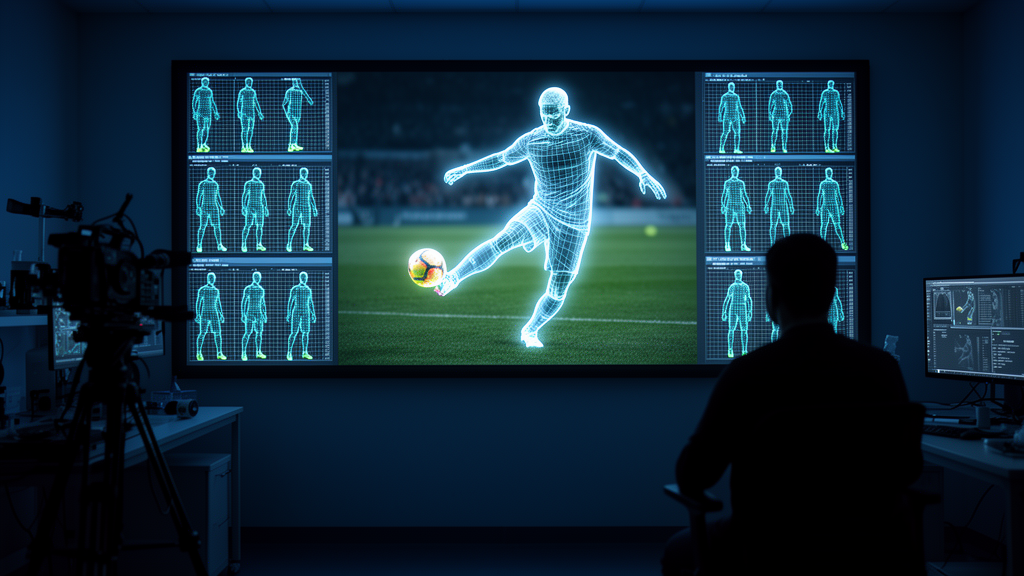
A computer vision framework that uses a genetic algorithm to fine-tune how video frames are segmented has shown it can track athletes' limb movements with enough precision to flag visually abnormal joint motions that may hint at elevated injury risk. The research addresses a persistent weakness in sports analytics pipelines: segmentation, trajectory tracking, and risk warning are usually treated as separate modules, each tuned in isolation. When the segmentation masks that outline an athlete's body flicker or drift between frames, the downstream measurements—centroid displacement, joint angles, boundary curvature—become distorted, and any risk estimate built on them inherits that noise.
The new framework instead lets a single genetic algorithm search across segmentation thresholds, convolutional kernel sizes, stride lengths, filter configurations, loss weights, and feature-fusion coefficients simultaneously, so that the parameters chosen for pixel-level segmentation are the same ones that keep trajectories smooth and warnings reliable. The genetic algorithm operated with a population of 40 candidate parameter vectors, a crossover probability of 0.8, a mutation probability of 0.05, and a maximum of 60 evolutionary generations. In preliminary convergence tests, the fitness score climbed rapidly during the first 20 generations and stabilized around generation 38, with no meaningful gains beyond generation 60 even though computational cost kept rising.
Each candidate was scored by a fitness function that weighed segmentation overlap, segmentation error, boundary continuity, and the temporal stability of extracted trajectory features, ensuring that a configuration producing crisp masks but jittery trajectories would not survive selection. Once the segmentation network produces binary masks for the knee, ankle, elbow, and trunk regions, the trajectory extraction module converts them into structured motion descriptors. For each body region and each frame, the system computes the centroid of the segmented pixels, the principal-axis direction derived from the covariance of pixel coordinates, the average boundary displacement between adjacent frames, and the rate of area change.
These quantities are fused into a state vector and refined through a recursive trajectory formula that blends the previous frame's estimate with the current observation and local displacement corrections, using a 20-frame sliding window sampled at 30 frames per second. On the private test set of 320 video clips—collected with participant consent and institutional ethical approval, and split at the video level so that clips from the same motion sequence never straddled training and test subsets—the optimized model reached a weighted mean intersection-over-union of 85.6 percent, pixel accuracy of 91.9 percent, and a boundary F1 score of 87.2 percent. Track-and-field footage, with its regular trajectories and uniform backgrounds, yielded the best boundary preservation at 86.4 percent mIoU, while basketball's frequent direction changes, body occlusions, and lighting shifts pulled segmentation down to 84.9 percent.
Badminton's fast racket swings and jumping-induced motion blur still allowed a boundary F1 of 87.1 percent, which the authors attribute to the multi-scale 3-by-3 and 5-by-5 convolutional kernels retained by the search. Trajectory accuracy followed a similar pattern. Average centroid errors across the four tracked regions ranged from 1.72 pixels for the trunk to 2.03 pixels for the ankle, with angular errors between 2.12 and 2.56 degrees.
In basketball clips, where occlusion is most common, centroid errors rose to between 2.18 and 2.51 pixels and angular errors climbed by roughly half a degree relative to track and field. The trunk consistently showed the smallest errors, consistent with its greater shape stability compared with fast-swinging limbs. The warning stage fuses twelve trajectory variables over a 16-frame sliding window into a risk representation vector, then applies an adaptively updated threshold to decide when a frame warrants an alert.
The abnormal-motion labels used for evaluation came from 287 annotated frames showing visible knee hyperextension, ankle inversion, or hip external rotation, labeled by two annotators with sports biomechanics experience and adjudicated by a third reviewer, with an inter-annotator Cohen's kappa of 0.86. Against these labels, the model detected knee hyperextension with 94.2 percent sensitivity and ankle inversion with 93.1 percent, with mean lead times of 5.8 to 6.3 frames before the annotated abnormal pattern. Performance dipped in basketball, where sensitivity fell by roughly 3.5 to 5.4 percentage points and false alarms rose to 0.45 to 0.51 per minute.
The genetic algorithm's contribution was substantial in controlled comparisons. Against a default U-Net with fixed 3-by-3 kernels, a stride of 2, and a 0.5 threshold, the optimized version lifted mIoU by 7.3 percentage points, cut the average centroid error from 3.42 to 2.18 pixels, and raised warning sensitivity from 82.5 to 91.2 percent. Ablation experiments showed the gains came from the components working together: parameter selection alone raised mIoU from 78.3 to 82.4 percent, adaptive loss weighting pushed it to 83.6 percent, weighted feature fusion reduced centroid error from 2.74 to 2.35 pixels, and adaptive threshold updating lifted sensitivity from 89.6 to 91.2 percent while trimming false alarms.
Under simulated Gaussian noise and 20 percent limb occlusion, performance degraded by less than 3.5 percent, though the authors stress this reflects dataset-level robustness rather than proof of stability across all sports environments. The framework also outperformed baselines including DeepLabV3+, Mask R-CNN, YOLOv8-Seg, SegFormer-B2, Swin-UNet, optical-flow Kalman tracking, and a temporal convolutional network on the same test videos. Five-fold stratified cross-validation confirmed the improvements were statistically significant, with p-values below 0.01.
Practical deployment looks feasible on current hardware. The optimized U-Net contains 31.2 million trainable parameters and requires 54.6 gigaflops per 512-by-512 frame; segmentation alone runs at 18.7 milliseconds per frame, and the full pipeline of preprocessing, segmentation, trajectory extraction, and risk scoring averages 24.6 milliseconds, corresponding to about 40.7 frames per second—fast enough to keep pace with 30-frames-per-second acquisition. Peak GPU memory consumption was 3.9 gigabytes.
An additional external validation on the public JHMDB human motion dataset, conducted without altering the genetically selected parameters, supported the transferability of the segmentation and trajectory modules to new camera angles, backgrounds, and body proportions. The authors are careful to bound what the system actually demonstrates. The warning labels were derived from visible motion abnormalities and trajectory changes, not from clinical diagnoses, imaging findings, rehabilitation records, or prospective injury follow-up, so the model should be read as a visual motion-anomaly detector and potential injury-risk indicator rather than a clinical injury prediction tool.
Whether the abnormal patterns it detects actually precede real injuries remains unverified and would require prospective biomechanical or clinical studies. The internal dataset, drawn from just three sports and roughly 42 minutes of footage, cannot cover all body types, camera setups, and training intensities, and the model's sensitivity drops under severe occlusion and fast motion blur. Future work, the study notes, will expand subject and venue samples, combine visual trajectories with wearable biomechanical signals, compare the genetic algorithm against particle swarm and Bayesian optimization, and shrink the model for edge-device deployment in real training environments.
Subject of Research: Genetic algorithm-optimized image segmentation for sports motion trajectory extraction and motion abnormality detection
Article Title: Genetic algorithm optimized image segmentation for sports motion trajectory extraction motion abnormality detection and potential injury risk indication
Article References: Duan, K. (2026). Genetic algorithm optimized image segmentation for sports motion trajectory extraction motion abnormality detection and potential injury risk indication. Discover Artificial Intelligence, 6(1), Article 1023. https://doi.org/10.1007/s44163-026-02146-7
Image Credits: AI Generated
DOI: 10.1007/s44163-026-02146-7
Keywords: genetic algorithm, U-Net, image segmentation, sports motion analysis, trajectory extraction, injury risk, motion anomaly detection, computer vision, deep learning, biomechanics, JHMDB, early warning
Cite Scienmag News
Juliet Wilcox. (October 27, 2026). Genetic Algorithm Sharpens Video Segmentation to Flag Risky Sports Movements. Scienmag. https://scienmag.com/genetic-algorithm-sharpens-video-segmentation-to-flag-risky-sports-movements/
Juliet Wilcox. "Genetic Algorithm Sharpens Video Segmentation to Flag Risky Sports Movements." Scienmag, 27 October 2026, https://scienmag.com/genetic-algorithm-sharpens-video-segmentation-to-flag-risky-sports-movements/. Accessed 28 October 2026.
Juliet Wilcox. "Genetic Algorithm Sharpens Video Segmentation to Flag Risky Sports Movements." Scienmag. October 27, 2026. https://scienmag.com/genetic-algorithm-sharpens-video-segmentation-to-flag-risky-sports-movements/