Wednesday, October 28, 2026
Science
No Result
View All Result
  • Login
  • HOME
  • SCIENCE NEWS
  • CONTACT US
  • HOME
  • SCIENCE NEWS
  • CONTACT US
No Result
View All Result
Scienmag
No Result
View All Result
Home Science News Chemistry

Dissolved iron impurities drive green hydrogen electrolyzer degradation during power interruptions

October 27, 2026
in Chemistry
Bethany Barker
By Bethany Barker Scienmag Editorial Profile - Catalysis
Reading Time: 2 mins read
0
Dissolved iron impurities drive green hydrogen electrolyzer degradation during power interruptions

Dissolved iron impurities drive green hydrogen electrolyzer degradation during power interruptions

65
SHARES
587
VIEWS
Share on FacebookShare on Twitter
ADVERTISEMENT

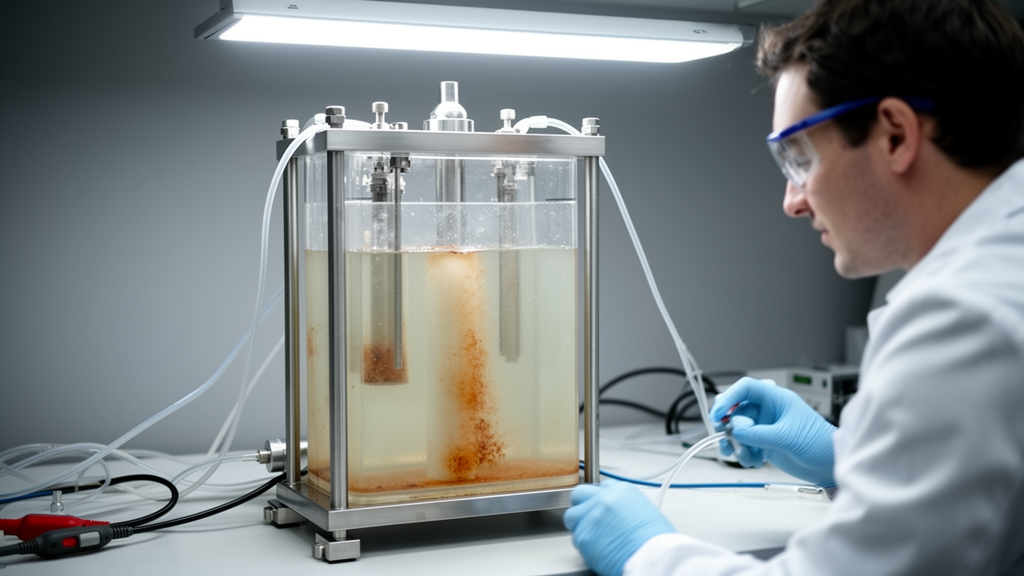
Alkaline water electrolyzers, the cheapest existing technology for producing hydrogen from electricity, have long been known to degrade when their power supply is interrupted and then restored — a stability problem that has been difficult to pin down. A new study led by University of Oregon chemist Paul Kempler traces that instability to trace levels of dissolved iron within the system, identifying it as a controlling factor in performance loss during power transients. The research publishes Sept. 9 in the journal Chem Catalysis, in a paper titled “Reverse Polarization Degradation of Nickel Iron Oxyhydroxide Anodes in Alkaline Water Electrolysis.”

The intermittency problem matters because wind and solar power are inherently on-again, off-again energy sources. If electrolyzers cannot tolerate repeated interruptions and restorations of power, they cannot be paired directly with renewable generation, which limits how cleanly and affordably hydrogen can be produced. That sensitivity has become a significant bottleneck for scaling up green hydrogen, since the technology’s low cost is one of its main advantages over alternatives.

By pinpointing dissolved iron impurities as the mechanism behind the degradation, the researchers see a potential path toward a solution. Rather than trying to eliminate impurities from the electrolyzer system entirely, they propose purifying the system and then reintroducing a controlled, specific amount of iron — or possibly other elements — afterward. If this impurity-engineering approach holds up in practice, it could make electrolyzers more resilient to the intermittent power that renewable sources deliver, directly addressing one of the key barriers to renewable-powered hydrogen production.

The finding reframes a persistent engineering challenge as a problem of chemistry control rather than an unavoidable limitation of the technology. Because the degradation during power cycling is tied to a specific, identifiable impurity, future electrolyzer designs and operating protocols may be able to manage iron levels deliberately instead of treating contamination as an uncontrolled variable. The work, conducted at the University of Oregon, offers a concrete target for follow-up research aimed at making the cheapest route to hydrogen from electricity compatible with the variable output of wind and solar power.

Subject of Research: Dissolved iron impurities controlling alkaline water electrolyzer degradation during intermittent power supply

Article Title: New study identifies the impurity behind green hydrogen's power-cycling problem

Article References: New study identifies the impurity behind green hydrogen's power-cycling problem. Original publication (Bibliographic details unavailable.)

Image Credits: AI Generated

DOI: Not provided

Keywords: green hydrogen, alkaline water electrolysis, dissolved iron impurities, power cycling degradation, renewable energy intermittency, nickel iron oxyhydroxide anodes, electrocatalysis, Chem Catalysis, University of Oregon, hydrogen production, electrolyzer stability, impurity engineering

Cite Scienmag News

Bethany Barker. (October 27, 2026). Dissolved iron impurities drive green hydrogen electrolyzer degradation during power interruptions. Scienmag. https://scienmag.com/dissolved-iron-impurities-drive-green-hydrogen-electrolyzer-degradation-during-power-interruptions/

Bethany Barker. "Dissolved iron impurities drive green hydrogen electrolyzer degradation during power interruptions." Scienmag, 27 October 2026, https://scienmag.com/dissolved-iron-impurities-drive-green-hydrogen-electrolyzer-degradation-during-power-interruptions/. Accessed 28 October 2026.

Bethany Barker. "Dissolved iron impurities drive green hydrogen electrolyzer degradation during power interruptions." Scienmag. October 27, 2026. https://scienmag.com/dissolved-iron-impurities-drive-green-hydrogen-electrolyzer-degradation-during-power-interruptions/

Tags: alkaline water electrolysischallenges of intermittency in wind and solar energyChem Catalysischemistry of electrolyzer material degradationdissolved iron impuritiesdissolved iron impurities in alkaline water electrolysiseffects of power transients on electrolyzer performanceElectrocatalysiselectrolyzer degradation during power interruptionselectrolyzer stabilitygreen hydrogengreen hydrogen electrolyzer stabilityHydrogen Productionimpact of trace metals on hydrogen productionimproving green hydrogen production efficiencyimpurity engineeringnickel iron oxyhydroxide anode degradationnickel iron oxyhydroxide anodespower cycling degradationpurification strategies for electrolyzer systemsrenewable energy integration challenges with electrolyzersrenewable energy intermittencyscaling up green hydrogen technologyUniversity of Oregon
Share26Tweet16
Previous Post

Laser-carved microvalves turn brain catheters into one-way streets against backflow

Next Post

Improved Problem-Based Learning Boosts Specific Skills in Endodontic Resident Training

Related Posts

Copper or nickel: metal choice steers dye capture in cellulose-MOF films
Chemistry

Copper or nickel: metal choice steers dye capture in cellulose-MOF films

October 28, 2026
Room-Temperature Electrodeposition Yields Aluminium-Modified Bismuth Oxide Films for Transparent Electronics
Chemistry

Room-Temperature Electrodeposition Yields Aluminium-Modified Bismuth Oxide Films for Transparent Electronics

October 28, 2026
Skipping Purification Steps May Not Compromise Radiopharmaceutical Quality, Study Finds
Medicine

Skipping Purification Steps May Not Compromise Radiopharmaceutical Quality, Study Finds

October 28, 2026
Chicken Manure Biochar Strips Zinc from Smelter Wastewater at Scale
Chemistry

Chicken Manure Biochar Strips Zinc from Smelter Wastewater at Scale

October 28, 2026
Graphene-Doped Cobalt Carbon Beads Strip Antibiotic Pollutants from Water in Minutes
Chemistry

Graphene-Doped Cobalt Carbon Beads Strip Antibiotic Pollutants from Water in Minutes

October 28, 2026
Encapsulated Fennel, Clove and Ajowan Oils Ease Zearalenone Damage in Mice
Chemistry

Encapsulated Fennel, Clove and Ajowan Oils Ease Zearalenone Damage in Mice

October 28, 2026
Next Post
Improved Problem-Based Learning Boosts Specific Skills in Endodontic Resident Training

Improved Problem-Based Learning Boosts Specific Skills in Endodontic Resident Training

  • Mothers who receive childcare support from maternal grandparents show more optimized

    Mothers who receive childcare support from maternal grandparents show more parental warmth, finds NTU Singapore study

    27656 shares
    Share 11059 Tweet 6912
  • University of Seville Breaks 120-Year-Old Mystery, Revises a Key Einstein Concept

    1061 shares
    Share 424 Tweet 265
  • Bee body mass, pathogens and local climate influence heat tolerance

    682 shares
    Share 273 Tweet 171
  • Researchers record first-ever images and data of a shark experiencing a boat strike

    546 shares
    Share 218 Tweet 137
  • Groundbreaking Clinical Trial Reveals Lubiprostone Enhances Kidney Function

    531 shares
    Share 212 Tweet 133
Science

Embark on a thrilling journey of discovery with Scienmag.com—your ultimate source for cutting-edge breakthroughs. Immerse yourself in a world where curiosity knows no limits and tomorrow’s possibilities become today’s reality!

RECENT NEWS

  • Bacteria split into distinct water and sediment communities in South Africa’s Knysna Estuary
  • Fire Severity Drives Nonlinear Shifts in Subalpine Forest Soil Carbon
  • New benchmark exposes persistent weaknesses in AI molecular design tools
  • Parasite Larvae and Their Vesicles Push Gut Cells in Opposite Directions in Lab Study

Categories

  • Agriculture
  • Anthropology
  • Archaeology
  • Athmospheric
  • Biology
  • Biotechnology
  • Blog
  • Bussines
  • Cancer
  • Chemistry
  • Climate
  • Earth Science
  • Editorial Policy
  • Marine
  • Mathematics
  • Medicine
  • Pediatry
  • Policy
  • Psychology & Psychiatry
  • Science Education
  • Science News
  • Social Science
  • Space
  • Technology and Engineering

Subscribe to Blog via Email

Enter your email address to subscribe to this blog and receive notifications of new posts by email.

Join 5,151 other subscribers

© 2025 Scienmag - Science Magazine

Welcome Back!

Login to your account below

Forgotten Password?

Retrieve your password

Please enter your username or email address to reset your password.

Log In
No Result
View All Result
  • HOME
  • SCIENCE NEWS
  • CONTACT US

© 2025 Scienmag - Science Magazine

Discover more from Science

Subscribe now to keep reading and get access to the full archive.

Continue reading