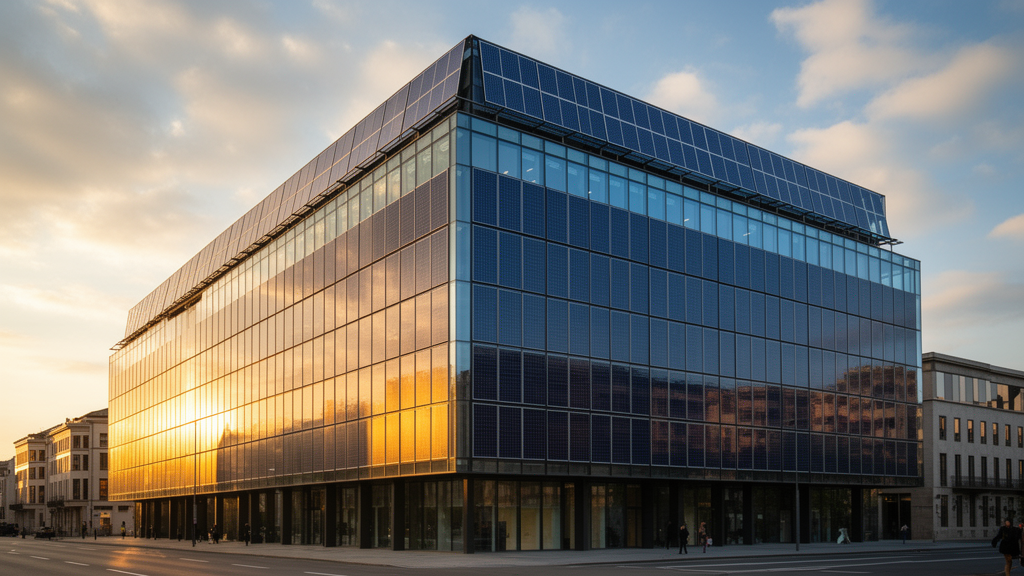
Building-integrated photovoltaics (BIPV) are widely promoted as a way to cut building energy use and carbon emissions, but most design optimization studies rely on historical weather datasets that may not reflect the conditions buildings will actually face. A new computational study finds that this gap matters: conventional EPW weather files systematically under-predict the modeled performance of BIPV envelope systems, particularly in Berlin and Los Angeles.
Researchers led by Elyas Hannoufa and Eric Johlin developed a multi-objective optimization framework that uses future climate projections from the CanESM5 model under the SSP3-7.0 scenario. They examined two system configurations—awning shades and thin-film window coatings—in four cities with diverse climates: Berlin, Los Angeles, Chicago and Singapore. The optimization integrated electricity generation, thermal loads and daylighting quality to capture building-level trade-offs, comparing results from conventional EPW files, NASA 2023 historical data and projected 2046–2050 conditions.
Under the 2046–2050 projected conditions, all four cities showed modeled performance gains for optimized BIPV systems: substantial in Berlin, Chicago and Los Angeles, and marginal in Singapore, with the largest absolute gains in Los Angeles. The study also found that by 2050, unshaded windows transition to being consistently detrimental for the building energy balance, strengthening the case for active envelope treatments.
Perhaps the most counterintuitive result concerns thin-film window coatings. The optimization achieved its best outcomes at high absorptance, in the 80–90% range, contrary to current low-absorption design practice. This suggests that under warmer projected climates, coatings that absorb more solar energy—when optimized alongside electricity generation, thermal loads and daylighting—can outperform the low-absorption designs favored today.
The authors emphasize that these findings apply within the CanESM5 SSP3-7.0 scenario examined, and that the results are model projections rather than measurements of installed systems. Even so, the work indicates that projected climate conditions can substantially reshape the modeled performance landscape of BIPV systems. The researchers argue that building design optimization should incorporate forward-looking climate projections rather than relying solely on historical datasets, and that BIPV is likely to grow in importance for climate-adaptive and resilient urban buildings.
Subject of Research: Modeling the performance of optimized building-integrated photovoltaic systems under projected future climate conditions
Article Title: Climate change impacts on the predicted performance of optimized building-integrated photovoltaics
Article References: Hannoufa, E., & Johlin, E. (2026). Climate change impacts on the predicted performance of optimized building-integrated photovoltaics. PLOS Climate, 5(10), e0001087. https://doi.org/10.1371/journal.pclm.0001087
Image Credits: AI Generated
DOI: 10.1371/journal.pclm.0001087
Keywords: building-integrated photovoltaics, climate change, SSP3-7.0, CanESM5, building energy performance, window coatings, awning shades, daylighting, thermal loads, climate adaptation, urban buildings, energy modeling
Cite Scienmag News
Sloane Callahan. (October 27, 2026). Future Climates Could Reshape How Building-Integrated Solar Performs. Scienmag. https://scienmag.com/future-climates-could-reshape-how-building-integrated-solar-performs/
Sloane Callahan. "Future Climates Could Reshape How Building-Integrated Solar Performs." Scienmag, 27 October 2026, https://scienmag.com/future-climates-could-reshape-how-building-integrated-solar-performs/. Accessed 28 October 2026.
Sloane Callahan. "Future Climates Could Reshape How Building-Integrated Solar Performs." Scienmag. October 27, 2026. https://scienmag.com/future-climates-could-reshape-how-building-integrated-solar-performs/