


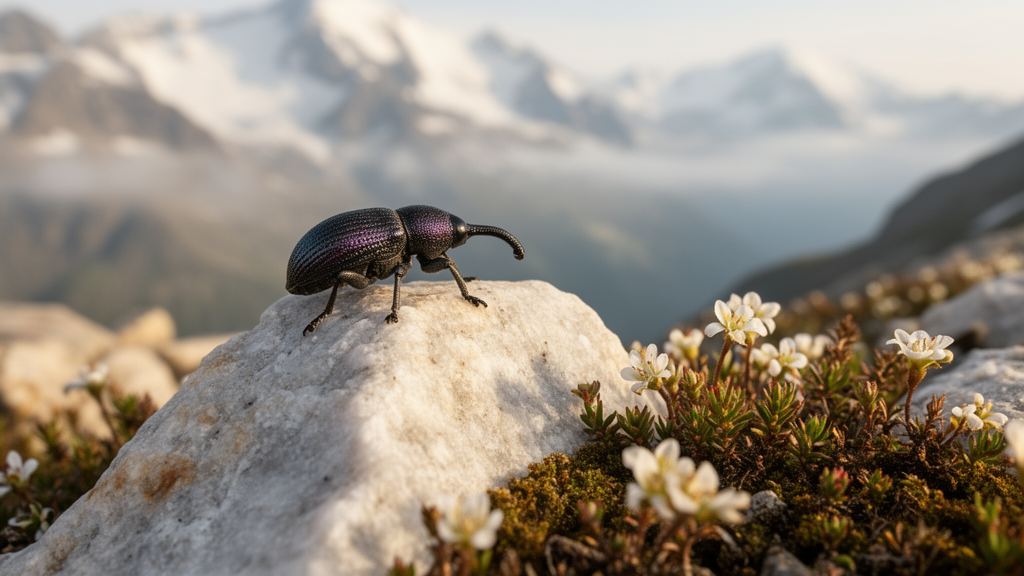
A tiny weevil known for more than sixty years from a single female collected in the French Maritime Alps has finally turned up again, and the discovery came from an unexpected direction. During an excursion to Zinal in the canton of Valais on 2 July 2020, six larvae of an unknown species of the weevil tribe Hyperini were collected from plants of Astragalus leontinus growing along a path at the bottom of an east-facing scree slope at 1650 metres above sea level. Breeding of the larvae in the laboratory confirmed their identity as Hypera temperei Hoffmann, 1958, an enigmatic alpine species that until then had never been recorded outside its French type locality at the Col de la Cayolle. The find, reported in the journal Alpine Entomology, not only extends the known range of the species into Switzerland but also overturns long-held assumptions about its closest relatives.
The story of the discovery is unusual because the larvae, rather than the adult beetles, led the way. Larvae of the weevil subfamily Hyperinae live exposed on their host plants and are morphologically more similar to caterpillars of lycaenid butterflies than to typical beetle larvae. They can be identified to species level using chaetotaxy, the arrangement of their bristles, and in several cases also by their colouration and cuticular characteristics. Often these larvae are easier to find and rear than searching for the camouflaged adult beetles, and that was exactly the case at Zinal. Three of the collected larvae, which represented at least two different larval stages based on their size differences, reached the last larval instar in captivity and spun net cocoons whose colour ranged from transparent-whitish to slightly brownish. They pupated within five days, and after sixteen to eighteen days three adults hatched: one female and two males. After one or two further days the freshly emerged beetles developed their characteristic dark colouration.
A second excursion to the same site on 22 and 23 July 2020 aimed to estimate the size of the habitat, assess the abundance of the host plant and test the surrounding area for suitable conditions. The scree slope is surrounded by a forest of larch and spruce, and the host plants proved to be restricted to an artificial path that had been cut through the scree in a north-south direction. The plants grew on both sides of the path in finer crushed rock, which appears to be an ideal substrate for them. Along a sixty-metre stretch of the path, more than 120 individual Astragalus leontinus plants were counted, but in the surrounding forest and in the scree itself, on or between the rocks, no further plants could be detected. This suggests that no other suitable habitats exist in the closer vicinity, making the population remarkably localised. Under the host plants the searchers also found two adult weevils from the old, hibernated generation, identified by the thickened male sternite IX that distinguishes overwintered specimens from freshly hatched ones, in which this structure remains thin and feebly sclerotised for longer. In the leaves of one host plant a cocoon containing a not yet pupated larva was discovered, and twelve of the twenty-one larvae counted in total were taken home for breeding.
The search extended beyond the scree slope. In a flood plain called Les Plats de la Lé along the rivulet La Navisence, three additional larvae were collected from Astragalus penduliflorus, a related legume, and their identity as H. temperei was confirmed after successful breeding. Notably, despite testing thirty specimens of this plant, no more larvae were found, hinting that the weevil may prefer A. leontinus or that microclimatic conditions in the scree-slope habitat were more favourable. This preference question deepened when a thorough search for H. temperei in September 2020 at Chalbermatten near Zermatt, where Astragalus leontinus is abundant at 1800 to 2000 metres, remained unsuccessful. There the ground beneath the plants consists of dense stone split, which may be difficult for the adults to use for hiding, adding a further microhabitat requirement to the species’ apparently narrow ecological niche.
The morphological re-investigation that accompanied the discovery produced the study’s second major result. Hoffmann described Hypera temperei in 1958 in a short supplement to the Faune de France, based on a single female collected by Gaston Tempère on 24 July 1956 at the Col de la Cayolle at 2300 metres in the southwestern Alps. From the outset the species was compared with its supposed sister species H. viciae, from which it was said to differ in a darker brownish colour, a bigger rostrum, reddish antennae and legs, finer bifid scales on the elytra, simple scales in the middle of the pronotum, longer and somewhat elevated white bristles on the elytra, and well-visible striae. Tempère rediscovered the species at the type locality on 21 July 1958 and added notes on its variation in 1961, which the new study confirms. The Swiss specimens match this description, although their elytral integument is more maculate than in the type specimen, and the shape of the male penis, with its characteristic lateral constriction in the apical part, agrees with the drawing published by Tempère.
However, a thorough comparison with the common and widespread Hypera postica, which in the Alps reaches altitudes up to 1800 metres, proved decisive. Based on its morphology, H. temperei looks much more similar to H. postica than to H. viciae and can easily be confused with it, especially when the colour patterns are strongly contrasting as in the Swiss specimens. Even the larva resembles that of H. postica, although all H. temperei larvae had a dull surface whereas those of H. postica are shining. The larva of H. viciae, by contrast, appears grey to greyish-black due to numerous black grains in its yellowish-white skin, a character clearly absent in H. temperei. The rostral-length character used in an existing identification key to separate the postica group from other Hypera turned out to be difficult, or in the case of H. temperei not really possible, to apply, because the rostrum is simultaneously short and robust, pointing to the postica group, and long and slender, pointing to H. temperei.
To resolve this ambiguity, the study provides additional traits that separate H. temperei from H. postica when male specimens are available. H. temperei has a slightly more slender habitus with weakly pronounced humeral calli, a much darker colouration, whitish scales on the lateral bandings of pronotum and elytra that are cut to only about one third of the scale depth rather than one half, simple rather than bifid scales in the dark middle band of the pronotum, a penis with a short and basally constricted tip that appears more rounded in lateral view, and internal sclerites of the penis in which the paired sclerite is more strongly sclerotised and the single middle sclerite is narrower and more sword-like than the broader, tube-like structure of H. postica. The only remaining similarity with H. viciae is the shape of the scales on the elytra and pronotum. Female genitalia did not provide relevant differences, so the new characters rely on males.
Because the habitus of H. temperei is more gracile, the hind wings of all collected adults were examined, and in every specimen they were rudimentary. Yet this character is not unique to the species: hind wings of H. postica from high-altitude Swiss localities, including Tschierv at 1720 metres in Grisons, Tschlin at 1500 metres in the lower Engadine and Griesalp at 1400 metres in the Kiental, also showed only short rudiments, even though flight capability and long functional hind wings are widespread in other populations of that species and can vary between geographically close populations, even at low altitudes in the Netherlands.
Armed with the new morphological insight, the author searched collections for specimens of H. temperei hidden under the label of the common H. postica. The effort paid off with three Swiss records from the canton of Grisons, in chronological order: a male from above Samedan collected on 15 July 1975 above 1700 metres; two males from the surroundings of Ftan collected at 1700 metres on 19 June 2006, originally misidentified as H. postica; and two males from Piz Clünas above Ftan, collected on 10 August 2011 at 2500 to 2700 metres from plant debris on rocky ledges and reared from Fabaceae, also originally determined as H. postica. A single female from the Rothorn above Brienz in the canton of Bern, sifted from mosses at an assumed altitude of 2300 metres in August 2000, could only be assigned to H. temperei with doubts, and male specimens are needed to confirm that record. The Piz Clünas records show that the species can be expected at high alpine altitudes in Switzerland, considerably extending its known range eastwards along the alpine arc.
The study also clears up a historical confusion. Focarile once mentioned H. temperei in an article on beetles from Val Piora in Ticino, a surprising record at the time, but a revision of that specimen, agreed in 2012, showed it was a misidentified Hypera plantaginis, a widely distributed and often misinterpreted species. The possibility of occurrence in the Swiss Alps nevertheless remained, and is now corroborated by the discoveries in southern Valais and Grisons. The validated host plant Astragalus leontinus may serve as a first search aid to locate further populations, although the finds on A. penduliflorus show that more species are accepted, and the plant on which Tempère found his specimens, Oxytropis jacquinii, may have been confused with the similar-looking A. leontinus, served merely as a hiding place, or reflects development on several species of Astragalus and Oxytropis, as most Hypera species are oligophagous. The author recommends that future searches test different plant species of these genera, and that a molecular investigation with a broad set of markers should follow, since a barcode study of the related H. nigrirostris species group produced no separate clades, likely due to recent speciation and incomplete lineage sorting. A thorough investigation of the whole Hypera postica species complex is seen as a precondition before focusing on H. temperei, which is evidently part of it.
Subject of Research: Rediscovery of the alpine weevil Hypera temperei in Switzerland, with new biological and morphological findings
Article Title: Hypera temperei Hoffmann, 1958 – first discovery of the western alpine element in the Swiss Alps with biological details, and new morphological insights ( Coleoptera , Curculionidae )
Article References: Germann, C. (2021). Hypera temperei Hoffmann, 1958 – first discovery of the western alpine element in the Swiss Alps with biological details, and new morphological insights (Coleoptera, Curculionidae). Alpine Entomology, 5, 5-13. https://doi.org/10.3897/alpento.5.61597
Image Credits: AI Generated
Keywords: Hypera temperei, weevils, Curculionidae, alpine entomology, Switzerland, Valais, host plants, Astragalus leontinus, morphology, species distribution, Hypera postica, larval biology
Cite Scienmag News
Margaret Porter. (October 27, 2026). Rare Alpine Weevil Rediscovered in Switzerland After Decades of Obscurity. Scienmag. https://scienmag.com/rare-alpine-weevil-rediscovered-in-switzerland-after-decades-of-obscurity/
Margaret Porter. "Rare Alpine Weevil Rediscovered in Switzerland After Decades of Obscurity." Scienmag, 27 October 2026, https://scienmag.com/rare-alpine-weevil-rediscovered-in-switzerland-after-decades-of-obscurity/. Accessed 27 October 2026.
Margaret Porter. "Rare Alpine Weevil Rediscovered in Switzerland After Decades of Obscurity." Scienmag. October 27, 2026. https://scienmag.com/rare-alpine-weevil-rediscovered-in-switzerland-after-decades-of-obscurity/


