Wednesday, October 28, 2026
Science
No Result
View All Result
  • Login
  • HOME
  • SCIENCE NEWS
  • CONTACT US
  • HOME
  • SCIENCE NEWS
  • CONTACT US
No Result
View All Result
Scienmag
No Result
View All Result
Home Science News Biology

Single Gene Drives Male Mosquitoes’ Attraction to Female Flight Sounds

October 27, 2026
in Biology
Juliet Wilcox
By Juliet Wilcox Scienmag Editorial Profile - Human Genetics
Reading Time: 2 mins read
0
Single Gene Drives Male Mosquitoes’ Attraction to Female Flight Sounds

Single Gene Drives Male Mosquitoes' Attraction to Female Flight Sounds

65
SHARES
587
VIEWS
Share on FacebookShare on Twitter
ADVERTISEMENT

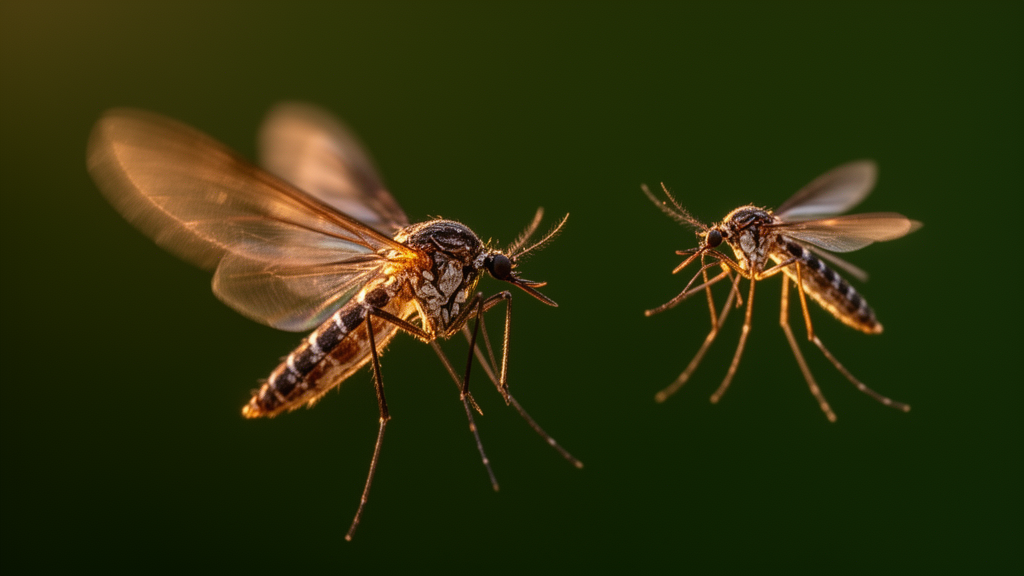
A new study published in PLOS Biology reports that a single male-specific gene, fruitless, is essential for this behavior. When the male-specific isoform of fruitless, known as fruM, was disrupted in the mosquitoes, mutant males showed a complete abolition of sound attraction behaviors, leaving them unable to locate females for mating.

In mutant males lacking FruM, the ear’s ability to amplify female flight sounds was severely disrupted. The mutant male ears also propagated frequency-specific, sound-evoked electrical signals at about one-sixth the magnitude seen in control males, significantly reducing the amount of auditory information relayed to the brain. In contrast, female mosquitoes do not show any sound attraction behaviors, a behavioral dimorphism that had been documented for almost a century without a known molecular explanation.

According to the study, fruitless plays a significant role in determining proper male peripheral hearing function underlying mating. Transcriptomic analyses of the mosquito ears identified essential hearing genes that sit under the transcriptional influence of FruM, whether through direct or indirect actions. These findings suggest that the gene shapes male-specific hearing cellular machineries that support the males’ attraction to female flight sounds, effectively commanding male-specific hearing behaviors involved in mating by directly controlling the earliest stages of auditory organ performance: sound amplification and acoustic signal detection.

The work demonstrates that FruM is essential for male-specific reproductive behaviors in mosquitoes, tying a sex-specific transcription factor to the very first steps of hearing rather than only to downstream brain circuits. Because the findings come from experiments in Aedes aegypti mosquitoes, they describe the molecular basis of a mosquito behavior rather than an immediate application, but the identification of the genes under FruM’s control may inform future research into how male mosquitoes find their mates.

Subject of Research: The role of the fruitless gene in male mosquito attraction to female flight sounds

Article Title: fruitless is essential for male Aedes aegypti mosquito attraction to female flight sounds

Article References: Loh, Y. M., Thornton, A. J., Loh, W., Lee, T.-T., Chen, W.-T., Xu, Y. Y. J., Yap, J. X., Tsuchiya, Y., Eberl, D. F., Su, M. P., & Kamikouchi, A. (2026). fruitless is essential for male Aedes aegypti mosquito attraction to female flight sounds. PLOS Biology, 24(10), e3004041. https://doi.org/10.1371/journal.pbio.3004041

Image Credits: AI Generated

DOI: 10.1371/journal.pbio.3004041

Keywords: Aedes aegypti, fruitless gene, mosquito mating, flight sounds, hearing, auditory organ, fruM, PLOS Biology, sound attraction, transcriptomics, male mosquitoes, fruitless

Cite Scienmag News

Juliet Wilcox. (October 27, 2026). Single Gene Drives Male Mosquitoes’ Attraction to Female Flight Sounds. Scienmag. https://scienmag.com/single-gene-drives-male-mosquitoes-attraction-to-female-flight-sounds/

Juliet Wilcox. "Single Gene Drives Male Mosquitoes’ Attraction to Female Flight Sounds." Scienmag, 27 October 2026, https://scienmag.com/single-gene-drives-male-mosquitoes-attraction-to-female-flight-sounds/. Accessed 28 October 2026.

Juliet Wilcox. "Single Gene Drives Male Mosquitoes’ Attraction to Female Flight Sounds." Scienmag. October 27, 2026. https://scienmag.com/single-gene-drives-male-mosquitoes-attraction-to-female-flight-sounds/
Tags: Aedes aegyptiauditory organbehavioral dimorphism in mosquitoesflight soundsfruitlessfruitless genefruitless gene in insect auditory responsefruMgene influence on insect communicationgenetic basis of mosquito mating ritualsgenetic control of mosquito reproductionhearingmale mosquito auditory systemmale mosquitoesmale-specific gene drive mosquitoesmolecular regulation of insect hearingmosquito flight sound attraction mechanismsmosquito matingMosquito mating behavior geneticsPLOS Biologyrole of FruM in mosquito matingsound attractiontranscriptomic analysis of mosquito earsTranscriptomics
Share26Tweet16
Previous Post

Cryo-EM reveals how unrelated phage peptides converge on the same bacterial target

Next Post

Cancer genome profiling uncovers hidden inherited cancer risk in one in ten patients

Related Posts

Engineered Microbes Move Closer to Replacing Plant Oils as the Source of a Valued Anti-Inflammatory Fatty Acid
Biotechnology

Engineered Microbes Move Closer to Replacing Plant Oils as the Source of a Valued Anti-Inflammatory Fatty Acid

October 28, 2026
Long Non-Coding RNA LINC01140 Shows Dual Roles Across Human Cancers, Review Finds
Biology

Long Non-Coding RNA LINC01140 Shows Dual Roles Across Human Cancers, Review Finds

October 28, 2026
Soybean Oil Diet Raises DNA Damage Markers in Mice Compared with Coconut Oil
Biology

Soybean Oil Diet Raises DNA Damage Markers in Mice Compared with Coconut Oil

October 28, 2026
Fungal extract boosts diosmin in bioreactor-grown plant cell cultures
Biotechnology

Fungal extract boosts diosmin in bioreactor-grown plant cell cultures

October 28, 2026
Chicken genome study reveals males pass on twice as many new mutations as females
Agriculture

Chicken genome study reveals males pass on twice as many new mutations as females

October 28, 2026
Astrocytic RET protein shields neurons after brain hemorrhage in mouse study
Biology

Astrocytic RET protein shields neurons after brain hemorrhage in mouse study

October 28, 2026
Next Post
Cancer genome profiling uncovers hidden inherited cancer risk in one in ten patients

Cancer genome profiling uncovers hidden inherited cancer risk in one in ten patients

  • Mothers who receive childcare support from maternal grandparents show more optimized

    Mothers who receive childcare support from maternal grandparents show more parental warmth, finds NTU Singapore study

    27656 shares
    Share 11059 Tweet 6912
  • University of Seville Breaks 120-Year-Old Mystery, Revises a Key Einstein Concept

    1061 shares
    Share 424 Tweet 265
  • Bee body mass, pathogens and local climate influence heat tolerance

    682 shares
    Share 273 Tweet 171
  • Researchers record first-ever images and data of a shark experiencing a boat strike

    546 shares
    Share 218 Tweet 137
  • Groundbreaking Clinical Trial Reveals Lubiprostone Enhances Kidney Function

    531 shares
    Share 212 Tweet 133
Science

Embark on a thrilling journey of discovery with Scienmag.com—your ultimate source for cutting-edge breakthroughs. Immerse yourself in a world where curiosity knows no limits and tomorrow’s possibilities become today’s reality!

RECENT NEWS

  • Short Sleep Linked to Higher LDL Cholesterol in Children with Obesity
  • Engineered Microbes Move Closer to Replacing Plant Oils as the Source of a Valued Anti-Inflammatory Fatty Acid
  • Depression may curb misinformation effects in eyewitnesses, PTSD does not, study finds
  • Long Non-Coding RNA LINC01140 Shows Dual Roles Across Human Cancers, Review Finds

Categories

  • Agriculture
  • Anthropology
  • Archaeology
  • Athmospheric
  • Biology
  • Biotechnology
  • Blog
  • Bussines
  • Cancer
  • Chemistry
  • Climate
  • Earth Science
  • Editorial Policy
  • Marine
  • Mathematics
  • Medicine
  • Pediatry
  • Policy
  • Psychology & Psychiatry
  • Science Education
  • Science News
  • Social Science
  • Space
  • Technology and Engineering

Subscribe to Blog via Email

Enter your email address to subscribe to this blog and receive notifications of new posts by email.

Join 5,151 other subscribers

© 2025 Scienmag - Science Magazine

Welcome Back!

Login to your account below

Forgotten Password?

Retrieve your password

Please enter your username or email address to reset your password.

Log In
No Result
View All Result
  • HOME
  • SCIENCE NEWS
  • CONTACT US

© 2025 Scienmag - Science Magazine

Discover more from Science

Subscribe now to keep reading and get access to the full archive.

Continue reading