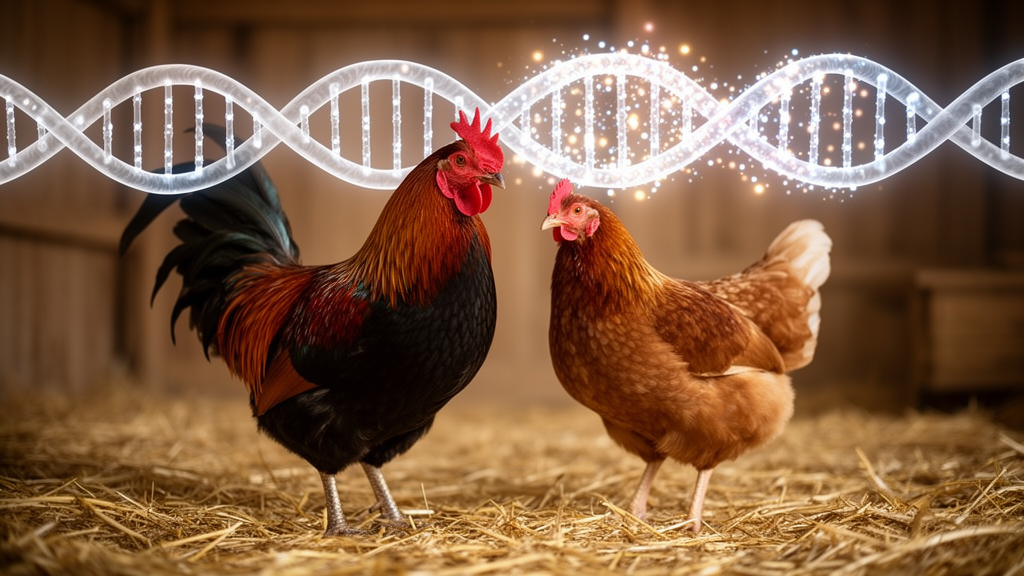
Researchers have produced the largest direct estimate to date of the rate at which new mutations arise in the germline of any bird or livestock species, using whole-genome sequencing data from 194 chicken trios drawn from a commercial pedigree line. The team, led by Eugenio López-Cortegano and colleagues, counted 1206 single nucleotide mutations across 342 individuals from the Aviagen breeding programme and calculated a mutation rate of µ = 3.45 × 10⁻⁹ per nucleotide site per generation, a figure closely matching earlier chicken estimates and sitting within the range reported for other bird species.
Each chicken, the study found, inherits on average 6.2 new single nucleotide mutations per generation, and the distribution of these counts across individuals followed a Poisson pattern with a rate parameter of λ = 6.2. A goodness-of-fit test did not reject this model (χ213 = 10.97, p = 0.61), indicating only minimal overdispersion relative to the Poisson expectation, where the observed mean was 6.2 and the variance 6.7. The analysis covered 869.8 megabases of the 1.1 gigabase nuclear genome, roughly 80 percent, classified as high-quality callable sites, with 297.5 gigabases of sequencing data generated in total.
One of the most striking findings concerns the parental origin of these mutations. Using a read-based phasing approach, the researchers assigned the parent of origin for 323 autosomal mutations with unambiguous inheritance and found that two thirds, 66.6 percent, came from the male parent. This implies that roosters contribute approximately twice as many new mutations to their offspring as hens do, a male bias that persisted when the team analysed all 398 mutations carrying phasing information using probability-weighted assignments based on paternal haplotype support. The result aligns with a previously inferred male-to-female mutation bias of α = 1.8 in birds and echoes a similar, though typically larger, bias documented in mammals.
Interestingly, the mutational spectra of male- and female-inherited mutations showed no substantial differences. This observation carries mechanistic weight: in mammals, differences in DNA-repair pathways have been proposed to explain male-biased mutation rates, but such alterations are often linked to changes in the mutational spectrum. Since the chicken spectra look alike, the authors suggest that a different explanation, such as differences in germline replication between the sexes, may underlie the avian sex bias. The study also examined whether parental age influenced mutation counts, finding no correlation (Pearson’s correlation, t192 < 0.4, r < 0.03, p > 0.68), though a post hoc power analysis showed the design could only detect correlations larger than r > 0.5, and the breeders were all aged between 30 and 48 weeks, a narrow and young window that limits conclusions about age effects over the full reproductive lifespan.
The genomic distribution of new mutations was far from uniform. Microchromosomes, the small, gene-dense chromosomes characteristic of bird genomes, showed a collective mutation rate of µ = 3.81 × 10⁻⁹, roughly 8 percent higher than the macrochromosome estimate of µ = 3.53 × 10⁻⁹. The researchers attribute this likely to the higher GC content of microchromosomes and a mutation spectrum dominated by C→T transitions, which occur preferentially at GC sites. They caution, however, that the 95 percent bootstrap confidence intervals overlap between the two chromosome classes, so the difference should be interpreted carefully. The lower callable fraction of microchromosomes, 59.9 percent versus 87.9 percent for macrochromosomes, probably reflects their GC richness combined with the known bias of short-read sequencing against GC-rich sequences.
The mutation spectrum itself revealed a strong C→T bias. Half of all inherited mutations, 3.1 of the 6.2 per generation, are C→T transitions, with the remainder distributed among A→G (17.7 percent), C→A (11.9 percent), A→T (9.6 percent), C→G (5.8 percent) and A→C (5.1 percent). After adjusting for the genome’s GC content of 42.5 percent, or 40.5 percent at callable sites, the C→T bias stood out at a ratio of 3.68 relative to expectation, and this substitution type alone showed a higher-than-average mutation rate of µ = 4.41 × 10⁻⁹. Most mutations landed in intronic (54.5 percent) and intergenic regions (34.5 percent), with only 4.1 percent in coding sequences and 6.9 percent in untranslated regions, proportions consistent with simulated expectations and suggesting similar mutation rates across genic and intergenic DNA.
Because only 49 mutations fell within coding sequences, the team turned to computer simulations to explore the functional consequences of the observed spectrum. By introducing synthetic mutations into coding sequences and annotating their predicted effects with SnpEff, they found that C→T transitions, owing to their sheer frequency, contributed the most in absolute terms to moderate (44.7 percent) and high-effect (53.7 percent) mutations per generation. Most high-effect C→T mutations are expected to strike glutamine (59.4 percent) and tryptophan (30.8 percent) codons, converting them into stop codons or functionally altered residues, while C→A and A→T transversions disproportionately affect codons for glutamic acid and lysine.
Building on this spectrum, the researchers constructed a codon transition matrix and derived a metric called the PRIME score, which ranks each of 13,256 protein-coding genes by its expected contribution to mutational variance, the quantity of new phenotypic variation arising each generation from mutation. The score integrates three factors: coding sequence length, nucleotide composition, and codon composition. Both PRIME variants correlated strongly with coding sequence length (r > 0.98), reflecting the larger mutational target of longer genes, with the gigantic titin gene, essential for muscle and cardiac function, emerging as a clear outlier at roughly 33 kilobases of coding sequence. After correcting for length, codon composition alone determined the expected mutational effects, and genes involved in immunity and development ranked among those most prone to non-silent mutations.
Gene ontology enrichment analysis, performed on human orthologs to exploit their richer functional annotation, revealed that length-normalized PRIMEM outlier genes were strongly associated with tissue development and organization as well as detoxification processes, with 16 of 143 upward outliers belonging to the collagen family, whose members are packed with glycine and proline repeats. Length-normalized PRIMEH outliers, by contrast, were enriched for immune response regulation, cellular respiration and sensory perception, and carried elevated levels of tryptophan (2.41 percent versus a genomic 1.19 percent) and glutamine (8.07 percent versus 4.27 percent). Examples include c-type lectin-like 17, an immunity gene from the major histocompatibility complex region, and the FOXP2 transcription factor, known for its role in vocal learning and behaviour. Nine genes, including several NADH dehydrogenase and ATP synthase family members, were downward outliers for both metrics, suggesting codon compositions relatively robust against deleterious substitutions.
From a breeding perspective, the findings carry practical weight. The authors estimate that approximately 171 codon-altering mutations arise per generation in a flock of 1000 birds, and since traits of economic importance such as muscle growth and immune function are predicted to be among those most affected, breeders could in principle capture and exploit this stream of novel variation. At the same time, unmonitored deleterious mutations may drift to high frequency or fixation in small populations, a process implicated in inheritable disorders of dairy cattle. The authors note that their estimates rest on a single commercial pedigree line with a history of intensive selection, so extrapolation to chickens more broadly warrants caution, and they emphasize that the PRIME framework, while offering a mechanistic bridge between quantitative genetics and molecular biology, still requires empirical validation through systems such as mutation accumulation lines.
Subject of Research: Germline mutation rate and spectrum in commercial chicken pedigree lines
Article Title: The rate and spectrum of germline mutations in chicken from a commercial pedigree line
Article References: López-Cortegano, E., Sosa-Madrid, B. S., & Kranis, A. (2026). The rate and spectrum of germline mutations in chicken from a commercial pedigree line. Genetics Selection Evolution, 58(1), Article 70. https://doi.org/10.1186/s12711-026-01085-2
Image Credits: AI Generated
DOI: 10.1186/s12711-026-01085-2
Keywords: chicken, germline mutation rate, de novo mutations, male mutation bias, microchromosomes, mutation spectrum, C-to-T transitions, mutational variance, PRIME score, animal breeding, whole-genome sequencing, codon composition
Cite Scienmag News
Juliet Wilcox. (October 28, 2026). Chicken genome study reveals males pass on twice as many new mutations as females. Scienmag. https://scienmag.com/chicken-genome-study-reveals-males-pass-on-twice-as-many-new-mutations-as-females/
Juliet Wilcox. "Chicken genome study reveals males pass on twice as many new mutations as females." Scienmag, 28 October 2026, https://scienmag.com/chicken-genome-study-reveals-males-pass-on-twice-as-many-new-mutations-as-females/. Accessed 28 October 2026.
Juliet Wilcox. "Chicken genome study reveals males pass on twice as many new mutations as females." Scienmag. October 28, 2026. https://scienmag.com/chicken-genome-study-reveals-males-pass-on-twice-as-many-new-mutations-as-females/