


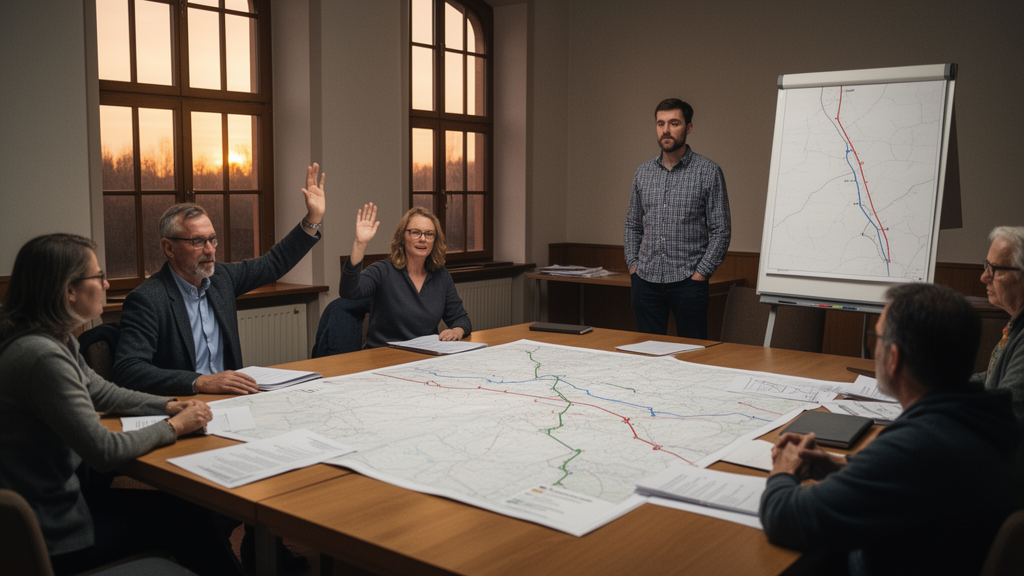
A railway line and a station are to be built near your home. Whether you welcome that prospect or fight it in court may depend far less on your age, education or distance to the nearest platform than on how confident you feel in coping with the changes the project would bring. That is the central message of a new Germany-wide study, published in Frontiers in Sustainable Cities, which combined a large survey with a randomized experiment on public participation announcements and found that socio-psychological evaluations explained roughly 84 percent of the variation in acceptance, while all socio-demographic, place-based and mobility factors together explained less than 8 percent.
The research, conducted by Maria Levints of the University of Vienna and the German Centre for Rail Traffic Research and Philipp Rollin of the German Centre for Rail Traffic Research in Dresden, addressed a persistent problem in German transport planning. Large-scale railway projects regularly encounter public reservations and protests, with concerns typically centring on noise and environmental pollution, prolonged construction periods and substantial cost overruns. Such opposition, and the legal challenges that often accompany it, contributes significantly to delays and even to the failure of planned projects. The classic pattern is the so-called not-in-my-backyard phenomenon: infrastructure is generally supported as long as it is not built in the immediate vicinity of one’s own residence.
Because expanding rail infrastructure is considered central to the transport sector’s shift toward climate sustainability, including emission reductions through modal shifts and improved accessibility, the authors set out to identify what actually shapes public acceptance. They also asked whether public participation, which has gradually become associated with expectations of increased acceptance, can realistically deliver that outcome. To date, systematic evaluations of acceptance processes have remained scarce, partly because no generally accepted explanatory model exists for Germany and partly because decades may pass between initial participation and actual project implementation, making longitudinal evidence extremely difficult to collect.
The study drew on a nationwide online survey of 3,134 people aged 16 or older, recruited through a commercial panel provider in April 2026 with roughly equal quotas across small towns under 20,000 inhabitants, medium-sized towns of 20,000 to 99,999 inhabitants, and large cities of at least 100,000 inhabitants. After quality checks on straightlining, completion time and the plausibility of demographic and geographic information, 2,632 completed responses formed the final analytical sample. The authors note that the sampling design does not ensure national representativeness, which limits generalizability.
Each respondent was randomly assigned to one of seven conditions in a 2 × 3 factorial vignette experiment. All participants read the same baseline scenario: a railway line and a station are to be built near their apartment or house. Six groups additionally received a participation announcement varying the responsible actor, Deutsche Bahn or the local municipality, and the format, information via a brochure, consultation via an invitation to discuss the project, or cooperation via an invitation to plan the implementation, for example the route alignment and station location. A control group received no participation information. The assigned vignette was repeated at two further points in the questionnaire to reinforce the manipulation.
The analysis proceeded in two stages. Hierarchical regression and structural equation modelling examined which characteristics relate to acceptance of the hypothetical project, while analyses of variance compared evaluations across the randomly assigned experimental conditions. In the regression, socio-demographic factors alone explained just 1.1 percent of the variance in acceptance. Adding place-based characteristics raised this to 2.1 percent, and mobility-related variables added a further 5.7 percentage points, for a final model explaining 7.8 percent. The strongest predictor was train use frequency, with a standardized coefficient of 0.253, meaning more frequent rail users reported higher acceptance. Social identity with people in the local area, male gender and older age showed smaller positive associations, while municipality size showed a small negative one. Education, travel time to the nearest station, previous experience with rail projects and car use frequency were not significant in the final model.
The structural equation model, built on Social Cognitive Theory and extended with a social norm construct, painted a very different picture. The model explained approximately 84 percent of the variance in acceptance, although the authors caution that content overlaps between constructs measured in the same questionnaire may have contributed, and that the R² values from the two approaches are only limitedly comparable because acceptance was modelled as a factor score in the regression and as a latent construct in the SEM. Within the model, self-efficacy, the belief that one can successfully cope with project-related challenges, emerged as the strongest predictor, with a direct standardized effect of 0.760 on acceptance and an additional indirect effect of 0.081 via perceived risk, yielding the largest total effect in the model at 0.840. Perceived risk itself showed a significant negative association with acceptance, at −0.165.
Several hypothesized pathways did not hold. Positive affect did not show a significant direct association with perceived risk, so that hypothesis was rejected, although affect strongly predicted self-efficacy at 0.707 and exerted a large indirect effect on acceptance through that route. Neither trust in the transport operator nor trust in the municipality showed a significant direct association with acceptance; instead, both showed positive indirect associations mediated primarily through self-efficacy. Unexpectedly, trust in the transport operator showed a small positive relationship with perceived risk, opposite to the hypothesized direction, which the authors suggest could reflect a suppression effect within the overall model. Perceived social justice was not directly associated with acceptance but showed a small negative relationship with perceived risk, and perceived social norms positively predicted acceptance at 0.164. The authors emphasize that all these cross-sectional relationships do not allow causal conclusions.
The experimental results were strikingly modest. The one-way analyses of variance found no significant differences across the seven conditions in acceptance, perceived risk, trust in either actor, or self-efficacy. Only perceived social justice differed significantly, and even there the effect size was small, with η² of 0.005. Dunnett-adjusted comparisons against the control condition showed higher perceived social justice when consultation was announced by either the transport operator or the municipality, and when cooperation was announced by the municipality. Within the six participation conditions, the format of participation, whether purely informational or more interactive, showed no significant main effect on any outcome. The announcing actor did matter slightly: when the transport operator rather than the municipality announced the participation, both perceived risk and trust in the transport operator were slightly higher, with effects significant at unadjusted p-values and very small effect sizes of 0.002.
The authors draw a nuanced conclusion. The findings challenge the assumption that more intensive participation formats automatically produce higher acceptance, and they stress that the study evaluated announcements of participation, not actual participation processes, which respondents never experienced. The brief vignettes may also have oversimplified the depicted processes. Given the central role of self-efficacy, they suggest future research should examine whether participatory formats that strengthen citizens’ perceived ability to cope with project-related changes contribute to acceptance, a hypothesis they note remains to be tested in practice. They also argue that participation should not be judged solely by its contribution to acceptance, since the higher social justice ratings in some announcement conditions suggest perceived fairness deserves attention as an outcome in its own right. Longitudinal field studies tracking real projects over time, they conclude, remain the necessary next step.
Subject of Research: Determinants of public acceptance of railway infrastructure projects and the role of public participation in Germany
Article Title: Switching tracks: from resistance to acceptance in railway infrastructure projects
Article References: Levints, M., & Rollin, P. (2026). Switching tracks: from resistance to acceptance in railway infrastructure projects. Frontiers in Sustainable Cities, 8, Article 1959278. https://doi.org/10.3389/frsc.2026.1959278
Image Credits: AI Generated
DOI: 10.3389/frsc.2026.1959278
Keywords: railway infrastructure, public acceptance, public participation, NIMBY, Social Cognitive Theory, structural equation modeling, self-efficacy, perceived risk, vignette experiment, social trust, social justice, Germany
Cite Scienmag News
Denise Maddox. (October 27, 2026). What really decides whether Germans accept new railway lines. Scienmag. https://scienmag.com/what-really-decides-whether-germans-accept-new-railway-lines/
Denise Maddox. "What really decides whether Germans accept new railway lines." Scienmag, 27 October 2026, https://scienmag.com/what-really-decides-whether-germans-accept-new-railway-lines/. Accessed 27 October 2026.
Denise Maddox. "What really decides whether Germans accept new railway lines." Scienmag. October 27, 2026. https://scienmag.com/what-really-decides-whether-germans-accept-new-railway-lines/


