


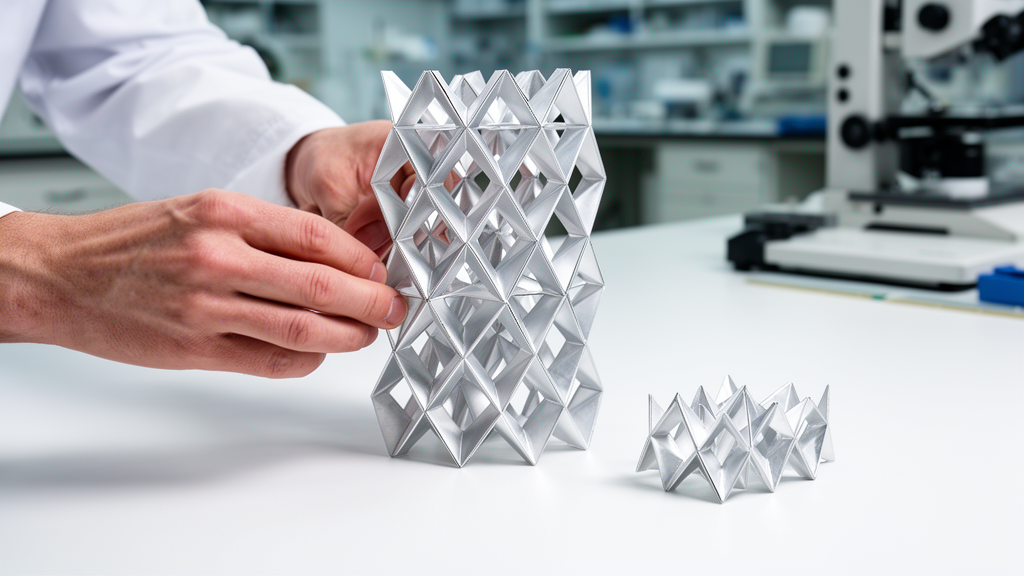
Engineers at MIT have developed a new origami-based construction method that can produce complex, lightweight structures that are stiffer, stronger, and easier to assemble than other types of architectural origami, while consuming less material. The system, described in a paper published in the International Journal of Solids and Structures, simplifies the design and fabrication of rigid structural shells from modular components that can be cut from flat sheets of material and then folded into shape. According to the researchers, the approach could make certain forms of construction cheaper, faster, and more sustainable than some conventional techniques.
The method draws its inspiration from the folded tessellations of Ron Resch, an artist and scientist who in the 1960s used repeating patterns of polygonal unit cells to create complex three-dimensional structures such as honeycombs. Where Resch’s tessellations were folded from a single continuous piece of material, the MIT team took a different path: they fabricate individual unit cells, fold each one separately, and then connect them to build up the final three-dimensional structure. By designing the building blocks one by one, the researchers can simplify fabrication and unlock far more complex shapes than a monolithic fold would allow.
The key structural insight came from Alfonso Parra Rubio, a graduate student in MIT’s Center for Bits and Atoms (CBA), who developed the method while working in the laboratory of Tomohiro Tachi, a professor at the University of Tokyo. Parra Rubio found a way to combine two tripod-shaped unit cells from a Resch tessellation into a single building block with zero degrees of freedom, meaning it is completely rigid and locked in place. These rigid blocks can then be connected into a network of interwoven beams that form a three-dimensional structure with extremely high stiffness and stability at very low weight. “This helps us build strong structures while minimizing the amount of material we are using,” Parra Rubio explains.
Designing such structures by hand, however, would be enormously challenging. Polygonal building blocks must satisfy a user’s geometric constraints while remaining individually foldable, a combinatorial problem that resists manual solution. To overcome this, Parra Rubio teamed up with fellow CBA graduate student Erik Strand to build an automated solver that designs a series of manufacturable unit cells capable of forming the desired structure. “On the computational part, we break this big problem down into many small subproblems,” Strand says. “Now, we solve each cell independently to make sure that it is foldable, and then we globally assemble them after that.” The resulting design files can be sent directly to a CNC milling machine, which automatically cuts the building blocks from flat sheets of material such as aluminum.
Assembly is deliberately simple. Builders fold the individual units into shape and connect them into a finished structure using only hand tools, such as screwdrivers. No large-scale welding equipment is required, which the researchers say could make the process simpler, faster, and cheaper than some other forms of construction. The unit cells are also designed so that they adjust naturally into their correct shape as the structure comes together. “The way the unit cells are designed, the structure can only exist in one configuration,” Parra Rubio says. “The connection is the same everywhere, even though each unit cell is different.” The units form a strong, load-bearing structural shell that does not need interior support columns.
The performance claims rest on both simulation and physical demonstration. Simulations indicated that the method yields structures about 3.5 times stiffer than those made with some other origami-based techniques, while using less material. More broadly, the researchers report that their technique can generate structures many times stiffer than those built with some other forms of structural origami while requiring only about two-thirds as much material, a ratio they suggest could make this a more sustainable form of construction. Parra Rubio adds that the resulting structures could be strong enough for some architectural applications.
To prove the approach works at scale, the team went beyond small prototypes and fabricated a room-sized folded aluminum sculpture, a 23-foot structure assembled from pieces of folded aluminum and hung from the ceiling of the atrium at the Boston Public Library. The sculpture was installed as an exhibition inaugurated for the annual Fab Lab Conference and Symposium. Notably, the team that built it had no professional construction experience, yet they completed the entire structure in a matter of days. “It was really fun to work on something at such a quick pace where the theory was really meeting a practical use for it,” Strand says. “We had to think a lot about how we could tweak the design to achieve each objective.”
The researchers see several practical applications for the system. It could be particularly well suited to disaster relief shelters that can be rapidly fabricated and shipped efficiently as flat panels, then set up quickly by workers at the site of an earthquake or flood. It could also be used to develop strong, lightweight components for airplanes or modular robots, or architectural elements such as sound-dampening panels and building facades.
“This work shows that the power of digital manufacturing can go beyond personal fabrication projects and start touching the real world, enhancing the way we design houses and large structures,” says Parra Rubio. “We are demonstrating structural origami on building scales.” Senior author Neil Gershenfeld, an MIT professor and director of the CBA, is similarly direct about the outlook: “This work shows that folding metal is a method that is ready to be used for building structures. We can do it big enough and strong enough, now that we can bring it out of the lab and to the construction site.”
The paper on the method was led by Parra Rubio and joined by Riccardo Foschi, a researcher at the University of Bologna in Italy; Rupert Maleczek, a senior scientist at the University of Innsbruck in Austria; Tachi of the University of Tokyo; and Gershenfeld. The research was funded in part by the Center for Bits and Atoms Research Consortia, the University of Bologna, and the Austrian Research Agency.
Subject of Research: A modular origami-based structural system for designing and assembling lightweight, rigid architectural shells from folded unit cells
Article Title: Origami-based construction method yields complex structures that are cheaper and easier to assemble
Article References: Origami-based construction method yields complex structures that are cheaper and easier to assemble. Original publication (Bibliographic details unavailable.)
Image Credits: AI Generated
DOI: Not provided
Keywords: origami, structural engineering, MIT, modular construction, Resch tessellation, lightweight structures, disaster relief shelters, aerospace components, digital fabrication, unit cells, CNC milling, Boston Public Library
Cite Scienmag News
Courtney Benton. (October 27, 2026). MIT Origami Construction Builds Stiffer Structures With Less Material. Scienmag. https://scienmag.com/mit-origami-construction-builds-stiffer-structures-with-less-material/
Courtney Benton. "MIT Origami Construction Builds Stiffer Structures With Less Material." Scienmag, 27 October 2026, https://scienmag.com/mit-origami-construction-builds-stiffer-structures-with-less-material/. Accessed 27 October 2026.
Courtney Benton. "MIT Origami Construction Builds Stiffer Structures With Less Material." Scienmag. October 27, 2026. https://scienmag.com/mit-origami-construction-builds-stiffer-structures-with-less-material/


