


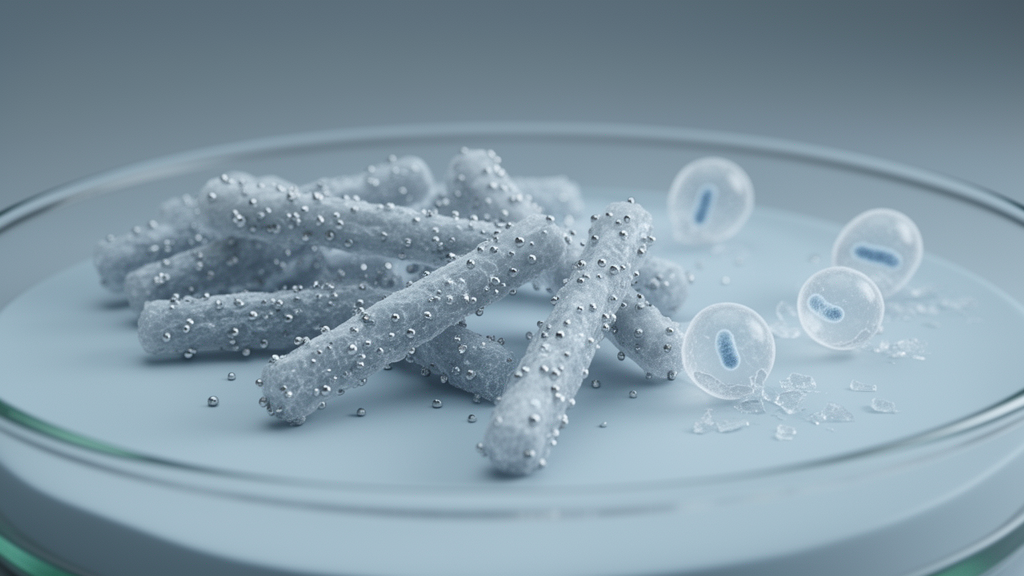
Researchers have synthesized nanohydroxyapatite particles doped with three different weight percentages of silver and reported that the silver-containing versions inhibited and killed two test bacteria at concentrations far below those needed by the undoped material, while remaining no more toxic to cultured cells than a commercial dental ceramic in statistical comparisons. The work, published in Results in Chemistry, combined materials characterization, antimicrobial testing and a cell viability assay in a single laboratory study aimed at identifying a silver loading that balances germ-killing activity against cytotoxicity.
Hydroxyapatite, a calcium phosphate compound with the formula Ca₅(PO₄)₃(OH) and a calcium-to-phosphorus ratio of 1.67, is the primary mineral constituent of bone and teeth and one of the most widely used calcium phosphate ceramics for hard-tissue repair. The authors note that although it is highly biocompatible and bioactive, its porous structure and relatively weak mechanical strength limit some applications. Nanoscale hydroxyapatite, by contrast, offers superior physical, chemical, mechanical and biological characteristics and is already used across implantology, surgery, periodontology, cosmetic dentistry and preventive care. Applied to the tooth surface, it forms a thin but strong layer bonded to the enamel crown and has been shown to promote enamel remineralization; toothpastes containing hydroxyapatite have demonstrated remineralizing effects comparable to fluoride-containing products in managing early carious lesions.
The motivation for adding silver rests on a long-standing antimicrobial track record. The limitations and vulnerability of conventional antibiotics have renewed interest in silver, and advances in nanoscience have produced silver nanoparticles with novel properties and morphologies. Increasing the surface-area-to-volume ratio of metallic silver nanoparticles alters their physical and chemical properties and can enhance their antibacterial efficacy. Several nanomaterials, including nano-sized calcium phosphate, carbonate hydroxyapatite nanocrystals, amorphous calcium phosphate nanoparticles and bioactive glass nanoparticles, have previously been reported to help prevent dental caries in its early stages.
A distinctive feature of the new synthesis is its green chemistry approach. The team used Aloe vera extract as a natural, biodegradable and eco-friendly capping agent. According to the authors, bioactive compounds in Aloe vera, including polysaccharides, flavonoids, phenolic compounds and functional groups such as hydroxyl and carboxyl groups, can interact with the surface of growing nanoparticles and with calcium ions on the apatite structure, reducing excessive aggregation, controlling crystal growth and improving colloidal stability. Compared with potentially toxic synthetic capping agents such as CTAB, SDS or PEG, the plant-derived route offers a greener and more biocompatible path to hydroxyapatite nanoparticles with controlled size and improved dispersion.
The synthesis itself followed a wet-chemical procedure. Calcium nitrate was dissolved in double-distilled water with lactose as a capping agent and stirred at 50 degrees Celsius for one hour, with the pH adjusted to alkaline conditions using ammonia. A separate solution of sodium dihydrogen phosphate was then added dropwise under continuous stirring, producing a white precipitate that confirmed hydroxyapatite formation. The washed powder was dispersed in water and silver nitrate was gradually added at concentrations corresponding to 10, 20 and 30 weight percent silver, with the mixture held at elevated temperature for one hour to ensure homogeneous adsorption and distribution of silver species on the hydroxyapatite particles. After repeated washing, the formation of a gray powder indicated successful preparation of the silver-doped material.
Characterization confirmed both the apatite phase and the incorporated silver. X-ray diffraction showed peaks at 2θ values of approximately 25.9, 31.8, 39.8, 46.7 and 49.5 degrees corresponding to the crystallographic planes of hexagonal hydroxyapatite, while the doped samples displayed additional peaks at 38.1, 44.3, 64.5 and 77.4 degrees attributed to face-centered cubic metallic silver. The apparent reduction in hydroxyapatite peak intensity was attributed to overlap with strong silver reflections rather than disappearance of the apatite phase. Fourier-transform infrared spectroscopy retained the characteristic phosphate and hydroxyl bands after silver incorporation, indicating the apatite framework remained intact. Crystallite sizes estimated with the Debye–Scherrer equation were 17 nanometers for pure hydroxyapatite and 20 nanometers for the doped material, and scanning electron microscopy revealed spherical particles ranging from roughly 31 to 47 nanometers depending on silver content. Energy-dispersive spectroscopy measured approximately 18.12 weight percent silver in the nominally 20 percent sample, and no detectable carbon peak in the doped product suggested that residual organic species from the capping agent were effectively removed during washing.
Antimicrobial performance was assessed against Streptococcus mutans and Escherichia coli using minimum inhibitory concentration and minimum bactericidal concentration assays in 96-well plates with resazurin as a growth indicator, with all tests run in triplicate. Pure nanohydroxyapatite and cold ceramic, a composite dental material used as the comparison, both showed MIC values greater than 10 milligrams per milliliter against both strains, indicating limited antibacterial activity. In contrast, the silver-doped samples containing 10, 20 and 30 percent silver all showed MIC values of 2.5 milligrams per milliliter. MBC values followed a similar pattern: pure nanohydroxyapatite and cold ceramic exceeded 10 milligrams per milliliter, the 10 and 30 percent silver samples reached 2.5 milligrams per milliliter, and the 20 percent sample measured 5 milligrams per milliliter. For context, the standard antibiotics were far more potent still, with ciprofloxacin showing MIC and MBC values of 2 and 4 micrograms per milliliter against E. coli and penicillin 1 and 2 micrograms per milliliter against S. mutans.
Cytotoxicity was evaluated with the MTT assay on HeLa cells, which the authors used as an in vitro cell model regardless of tissue origin, testing serial concentrations from 31.2 to 2000 micrograms per milliliter in triplicate. The concentration reducing cell viability to 50 percent, the IC₅₀, was 840 micrograms per milliliter for cold ceramic, 650 for pure nanohydroxyapatite, 220 for the 10 percent silver sample, 160 for the 20 percent sample and 170 for the 30 percent sample. Pure nanohydroxyapatite and cold ceramic showed no significant difference in cytotoxicity (P = 0.38). Silver incorporation lowered the IC₅₀ values, indicating increased cytotoxicity, but the differences between each silver-doped sample and cold ceramic were not statistically significant (P = 0.099, 0.093 and 0.07 respectively), with P values below 0.05 considered significant.
The authors attribute silver’s cytotoxic mechanism to combined effects including silver ion release, oxidative stress driven by excessive reactive oxygen species generation, protein dysfunction, and damage to cell membranes and organelles. Increased reactive oxygen species can cause lipid peroxidation of cell membranes, protein oxidation and DNA damage, potentially activating apoptotic signaling pathways or, in severe cases, necrotic cell death. Silver nanoparticles can also directly interact with the plasma membrane, increasing permeability and causing structural disruption, while internalized particles may accumulate in mitochondria and lysosomes. The extent of cytotoxicity depends strongly on nanoparticle concentration, size, surface chemistry and the rate of ion release.
The findings should be read with the study’s scope in mind. This was an in vitro laboratory investigation using a single cancer-derived cell line and two bacterial strains, not a test of a finished dental filling in patients, and the authors themselves state that further optimization is required to balance antibacterial efficacy with cytocompatibility. Within those limits, they conclude that the nanohydroxyapatite–silver composite, with its antibacterial activity, acceptable cytotoxicity profile relative to cold ceramic, potential safety and cost-effectiveness, may serve as a promising basis for developing dental filling materials, and they suggest such materials could address unmet clinical needs in bone surgery, orthopedics and dentistry, in line with earlier reports that silver-doped nanohydroxyapatite scaffolds exhibit antimicrobial activity while stimulating bone tissue regeneration.
Subject of Research: Synthesis of silver-doped nanohydroxyapatite nanoparticles and evaluation of their antibacterial activity and cytotoxicity for potential dental applications
Article Title: Preparation and characterization of nanohydroxyapatite doped with silver and investigation of their antibacterial and cytotoxicity properties
Article References: Akbary, M., Ghobaei-Arani, M., Farahmand, N., Nejati, M., Hasanabad, A. M., Mohammadi, A. H., Fasihi-Ramandi, M., Pourmasoud, S., & Sobhaninasab, A. (2026). Preparation and characterization of nanohydroxyapatite doped with silver and investigation of their antibacterial and cytotoxicity properties. Results in Chemistry, 31, Article 103977. https://doi.org/10.1016/j.rechem.2026.103977
Image Credits: AI Generated
DOI: 10.1016/j.rechem.2026.103977
Keywords: nanohydroxyapatite, silver nanoparticles, antibacterial, cytotoxicity, dental materials, MTT assay, Aloe vera synthesis, green chemistry, Streptococcus mutans, Escherichia coli, hydroxyapatite, dentistry
Cite Scienmag News
Bethany Barker. (October 27, 2026). Silver-doped nanohydroxyapatite shows antibacterial promise in lab tests. Scienmag. https://scienmag.com/silver-doped-nanohydroxyapatite-shows-antibacterial-promise-in-lab-tests/
Bethany Barker. "Silver-doped nanohydroxyapatite shows antibacterial promise in lab tests." Scienmag, 27 October 2026, https://scienmag.com/silver-doped-nanohydroxyapatite-shows-antibacterial-promise-in-lab-tests/. Accessed 27 October 2026.
Bethany Barker. "Silver-doped nanohydroxyapatite shows antibacterial promise in lab tests." Scienmag. October 27, 2026. https://scienmag.com/silver-doped-nanohydroxyapatite-shows-antibacterial-promise-in-lab-tests/


