


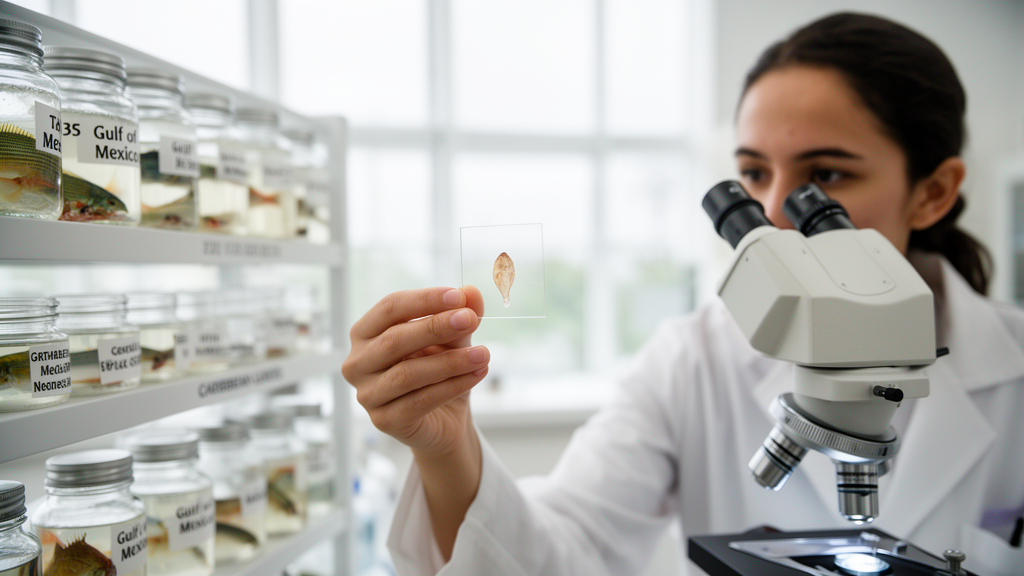
A Mexican research team has placed the country’s first digital collection of fish otoliths online, documenting 214 species from 67 families across the Gulf of Mexico, the Caribbean Sea, and the freshwater and brackish systems of the Yucatan Peninsula. The Otolith Collection of Fishes from the Gulf of Mexico and Caribbean Sea, registered with the Mexican Ministry of Environment and Natural Resources under code DGVS-CC-305-18, now holds 3,001 lots of specimens and roughly 2,600 high-resolution images captured with optical and scanning electron microscopy. The entire archive is freely accessible through a public database at otolitos.unam.mx, marking what the researchers describe as the first digital otolith collection in Mexico and a step toward a national platform for otolith data analysis.
Otoliths are non-skeletal calcareous structures that grow within the inner ear of bony fishes. Each fish carries three pairs: the sagitta in the sacculus, the lapillus in the utricle, and the asteriscus in the lagena. Composed of calcium carbonate in the form of aragonite, with crystals embedded in a fibrous protein matrix called otolin, these structures are deposited concentrically around a nucleus and play a crucial role in balance, orientation, and sound detection. Because their chemistry reflects both metabolic processes and environmental conditions, otoliths record information about the physiology of the fish and the waters in which it lived, making them key tools in research on age and growth, population dynamics, trophic studies, and the reconstruction of past environments.
The sagitta in particular carries a species-specific morphology, varying in shape, size, and structural detail enough to distinguish between phylogenetically close species. In the new collection, that diversity is striking: saccular otoliths range from simple ellipsoids to complex forms with projections and invaginations unique to individual species. Dorsal and ventral margins may be smooth, scalloped, lobed, or serrated, while the anterior and posterior regions can be pointed, rounded, truncate, lanceolate, bilobed, or irregular. Many species show an indentation in the anterior region, the ostial fissure, whose depth and angulation shape the rostral and antirostral sections of the structure. The acoustic sulcus, a longitudinal depression along the medial face of the sagitta, consists of the ostium anteriorly and the cauda posteriorly, sometimes flanked by thickened edges known as cristae.
Building the collection required years of fieldwork. Since 2011, sampling campaigns have been conducted at multiple localities across the Gulf of Mexico and the Caribbean Sea, using different fishing gears under catch permits from the competent authorities. Researchers also visited markets, fish markets, and ports, and established agreements with local fishermen to direct sampling toward species of interest. The collection was further enriched by incorporating the earlier Mexican Atlantic Fish Otolith Collection. Specimens were identified to the species level using taxonomic keys and guides, and biometric data such as total length, standard length, cephalic length, body height, weight, and, where possible, sex were recorded alongside capture locality, date, and geographic coordinates.
Extraction technique matters enormously for the long-term value of the material. Otoliths must come from fresh or frozen specimens, because structures preserved in unneutralized formalin or alcohol degrade, reducing the chances of correct identification and limiting their usefulness as collection specimens. Two extraction methods are employed, both performed under a stereoscopic microscope: one involves lifting the operculum, removing the gills, and breaking the bony capsules to expose the otoliths with forceps; the other separates the head from the body and uses scissors inserted into the center of the first vertebra as a lever to lift the ventral bone of the capsule. Once extracted, the otoliths are cleaned of residual tissue, and detailed morphometric measurements, including perimeter, area, height, width, and acoustic sulcus dimensions, are obtained using Zen Pro software. Each specimen is stored in a labeled vial with a unique identification code, and the vials are kept in boxes under controlled temperature and humidity.
Digitization is the collection’s defining feature. High-resolution images are captured with a Zeiss AxioZoom stereo microscope, whose continuous magnification and depth of field capture the morphological details needed for taxonomic identification and morphometric study. A scanning electron microscope, a Jeol 7600F FESEM, adds ultrastructural detail not perceptible with optical microscopy. Each image is edited to standardize the black background and enhance contrast, and a watermark with the collection logo is added to guarantee provenance. The images are stored in a database management system linked to the biometric and capture data of the corresponding specimen, and data quality is verified before publication on the website.
The online catalog is designed for academics, students, and anyone interested in fish biology. It offers search functions by taxon at the family, genus, or species level, along with keyword searches on otolith characteristics. Each entry includes species, location, specimen size and weight, collector, and morphological parameters of the otolith, together with detailed descriptions of the left sagitta and a gallery of microscopy photographs. Didactic resources, including videos on otolith extraction and description techniques, round out the offering. The collection’s web presence aligns it with international digitization initiatives such as iDigBio, DiSSCo, and ICEDIG, programs that promote the networking of collections worldwide under the concept of a global museum.
The holdings themselves reveal the composition of the regional ichthyofauna. Sciaenidae, the drums and croakers, is the best-represented family with 17 species, followed by Carangidae with 15 and Haemulidae with 11. The species with the most specimens are Menticirrhus americanus with 191 lots, Ariopsis felis with 108, Bagre marinus with 106, and Haemulon plumierii with 102, and each lot typically contains all three pairs of otoliths. Geographically, the collection draws on specimens from the coasts of Tamaulipas, Veracruz, Campeche, and Yucatan, with Yucatan the best-represented state at 1,700 lots, followed by Campeche with 894 and Veracruz with 368. Twenty-three lots come from Cuba. Taken together, the 214 species represent just over 11 percent of the 1,816 species recorded for the Gulf of Mexico and the Caribbean Sea, within a national fish fauna of at least 2,763 species in a world total of roughly 36,893 valid species.
The collection is already feeding into downstream research. A catalog with descriptive cards of the sagittal otoliths of 155 fish species from the Gulf of Mexico has been published, and a second edition covering recently added species is in preparation. A software package called Invariant Otolith Shape Analysis, or IOSA, has been developed to automatically derive morphometric descriptors and shape invariants from otolith images; because these descriptors are independent of rotation, scale, or translation, they deliver consistent results and extend the analytical toolkit beyond traditional measures such as area or perimeter, which is particularly useful in taxonomic studies that rely on limited structures for identification. The collection has also recently been used to corroborate the presence of fish remains in the Mayan archaeological record, information that the researchers say will deepen understanding of pre-Hispanic fishing practices and allow possible changes in some regional fish populations to be inferred.
The team is candid about the limits of digital access and the pressures facing such infrastructure. Digital information complements but does not replace physical specimens, which remain the primary source of verifiable data, and increased online accessibility often leads to more visits to collections and more loan requests, making the preservation of physical material under optimal conditions a primary curatorial task. The researchers also note that the contributions of biological collections to knowledge, education, and innovation are immense but often unrecognized, and that many scientific communities have highlighted the risks of inadequate funding for maintaining the infrastructure these collections require. Despite the financial and logistical challenges of building and maintaining biological collections, they argue, the otolith collection demonstrates its value as an essential resource for taxonomic, systematic, and ecological studies, as well as for biodiversity education, and its online availability promotes innovation and international collaboration in the study of fishes and their habitats.
Subject of Research: First digital collection of fish otoliths from the Gulf of Mexico and the Caribbean Sea
Article Title: Diversity of fish otoliths from the Gulf of Mexico and the Caribbean Sea: Report on the first digital collection of fish otoliths ( Actinopterygii ) from the Atlantic region of Mexico
Article References: Badillo Alemán, M., Solís Gómez, A., Gallardo Torres, A., Pacheco Gongora, E., & Chiappa-Carrara, X. (2024). Diversity of fish otoliths from the Gulf of Mexico and the Caribbean Sea: Report on the first digital collection of fish otoliths (Actinopterygii) from the Atlantic region of Mexico. Acta Ichthyologica et Piscatoria, 54, 249-260. https://doi.org/10.3897/aiep.54.134294
Image Credits: AI Generated
Keywords: fish otoliths, Gulf of Mexico, Caribbean Sea, biological collections, digitization, Yucatan Peninsula, sagitta, morphometrics, scanning electron microscopy, biodiversity, ichthyology, SEMARNAT
Cite Scienmag News
Margaret Porter. (October 27, 2026). Mexico launches first digital fish otolith collection spanning Gulf and Caribbean species. Scienmag. https://scienmag.com/mexico-launches-first-digital-fish-otolith-collection-spanning-gulf-and-caribbean-species/
Margaret Porter. "Mexico launches first digital fish otolith collection spanning Gulf and Caribbean species." Scienmag, 27 October 2026, https://scienmag.com/mexico-launches-first-digital-fish-otolith-collection-spanning-gulf-and-caribbean-species/. Accessed 27 October 2026.
Margaret Porter. "Mexico launches first digital fish otolith collection spanning Gulf and Caribbean species." Scienmag. October 27, 2026. https://scienmag.com/mexico-launches-first-digital-fish-otolith-collection-spanning-gulf-and-caribbean-species/


