

Tuesday, October 27, 2026
Science
No Result
View All Result
  • Login
  • HOME
  • SCIENCE NEWS
  • CONTACT US
  • HOME
  • SCIENCE NEWS
  • CONTACT US
No Result
View All Result
Scienmag
No Result
View All Result
Home Science News Biology

Bacterial symbiont Chromobacterium anophelis disrupts mosquito swarming and mating in semi-field tests

October 27, 2026
in Biology
Drew Townsend
By Drew Townsend Scienmag Editorial Profile - Cell Biology
Reading Time: 2 mins read
0
Bacterial symbiont Chromobacterium anophelis disrupts mosquito swarming and mating in semi-field tests

Bacterial symbiont Chromobacterium anophelis disrupts mosquito swarming and mating in semi-field tests

65
SHARES
587
VIEWS
Share on FacebookShare on Twitter
ADVERTISEMENT

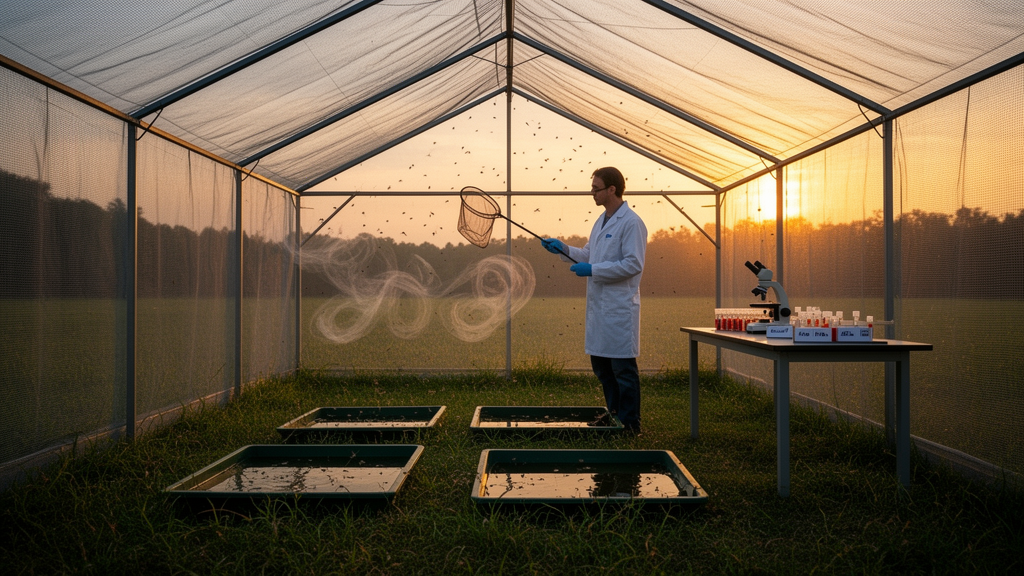
A semi-field study of the malaria mosquito Anopheles coluzzii reports that exposure to the bacterium Chromobacterium anophelis and its cell-free supernatant sharply reduced both survival and reproductive behavior, with the strongest effects seen at the highest doses tested.

C. anophelis is an entomopathogenic bacterium originally isolated from malaria mosquitoes. Under laboratory conditions it has previously shown both larvicidal and adulticidal effects, but its influence on mosquito reproductive behavior and survival under semi-field conditions had remained insufficiently explored, according to the researchers behind the new work.

In the study, mosquitoes were exposed to varying concentrations of bacterial suspensions (Ca) or of the bacterium’s cell-free supernatant (Sup) through sugar feeding. Survival probability was monitored daily for 14 days, and behavioral and reproductive parameters were recorded during dusk swarming events.

Exposure to both the bacterial suspensions and the supernatant significantly reduced mosquito survival. In the highest-dose treatment groups, complete mortality was observed within 10 days.

Swarm size was markedly reduced in the Ca_10p6 and Sup_30% treatments, which the authors describe as indicating strong behavioral impairment. Mating attempts and insemination rates were also substantially lower in these high-exposure groups.

In some cases, males were observed to participate in swarms and attempt mating but failed to inseminate females. The researchers suggest this points to physiological disruption beyond simple behavioral suppression.

By contrast, control mosquitoes and low-dose treatments (Sup_10% and Ca_10p5) maintained relatively high survival and reproductive performance, indicating that the effects were dose-dependent.

The analyses included Kaplan–Meier survival estimates, analysis of variance, and behavioral comparisons across seven treatment groups.

The authors conclude that C. anophelis and its metabolites impair both survival and reproductive success in An. coluzzii through a combination of lethal and sublethal effects. They suggest that microbial agents of this kind could help disrupt mosquito reproductive behavior and reduce vector population replacement.

The team notes that its data identify C. anophelis and its cell-free supernatant as candidates for further evaluation as complementary tools for mosquito vector control. The findings come from a semi-field experimental design, and the authors frame the work as an early step requiring further evaluation rather than a demonstrated field intervention.

Subject of Research: Effects of Chromobacterium anophelis bacteria on the survival, swarming and mating of Anopheles coluzzii mosquitoes under semi-field conditions.

Article Title: Influence of Chromobacteriumanophelis bacteria on Anopheles coluzzii mosquito swarming behavior and its reproductive potential

Article References: Gnambani, J. E., Millogo, D., Lamy, D. L., Ilboudo, S., Diabaté, A., & Bilgo, E. (2026). Influence of Chromobacteriumanophelis bacteria on Anopheles coluzzii mosquito swarming behavior and its reproductive potential. Parasites & Vectors. https://doi.org/10.1186/s13071-026-07613-9

Image Credits: AI Generated

DOI: 10.1186/s13071-026-07613-9

Keywords: Chromobacterium anophelis, Anopheles coluzzii, mosquito vector control, malaria, swarming behavior, insemination, bacterial symbionts, cell-free supernatant, semi-field experiment, survival, reproductive success, entomopathogenic bacteria

Cite Scienmag News

Drew Townsend. (October 27, 2026). Bacterial symbiont Chromobacterium anophelis disrupts mosquito swarming and mating in semi-field tests. Scienmag. https://scienmag.com/bacterial-symbiont-chromobacterium-anophelis-disrupts-mosquito-swarming-and-mating-in-semi-field-tests/


Drew Townsend. "Bacterial symbiont Chromobacterium anophelis disrupts mosquito swarming and mating in semi-field tests." Scienmag, 27 October 2026, https://scienmag.com/bacterial-symbiont-chromobacterium-anophelis-disrupts-mosquito-swarming-and-mating-in-semi-field-tests/. Accessed 27 October 2026.

Drew Townsend. "Bacterial symbiont Chromobacterium anophelis disrupts mosquito swarming and mating in semi-field tests." Scienmag. October 27, 2026. https://scienmag.com/bacterial-symbiont-chromobacterium-anophelis-disrupts-mosquito-swarming-and-mating-in-semi-field-tests/

Tags: Anopheles coluzziibacterial biocontrol of malaria mosquitoesbacterial impact on mosquito swarmingbacterial larvicidal and adulticidal effectsbacterial supernatant mosquito behavioral effectsbacterial symbiontsbiological mosquito control methodscell-free supernatantChromobacterium anophelisChromobacterium anophelis mosquito reproductive disruptioneffects of bacteria on mosquito mortalityentomopathogenic bacteriaentomopathogenic bacteria mosquito survivalinnovative malaria vector control strategiesinseminationmalariamicrobiome influence on mosquito matingmosquito swarming and mating impairmentmosquito vector controlreproductive successsemi-field experimentsemi-field mosquito behavior studiessurvivalswarming behavior
Share26Tweet16
Previous Post

Fewer Than 2% of Uterine Transplant Applicants Ultimately Qualified at a Major Referral Center

Next Post

Varied Diet Linked to Lower Peptic Ulcer Risk in Older Chinese Adults

Related Posts

Marine Vibrio strain strips weight from LDPE plastic in lab test
Biology

Marine Vibrio strain strips weight from LDPE plastic in lab test

October 27, 2026
Sulfur takes center stage in a thioxoacetamide crystal and docking study
Biology

Sulfur takes center stage in a thioxoacetamide crystal and docking study

October 27, 2026
Spider Mite Genus Demoted as New Species Joins Saudi Arabia’s Grass Fauna
Biology

Spider Mite Genus Demoted as New Species Joins Saudi Arabia’s Grass Fauna

October 27, 2026
TabNet brings interpretable attention to miRNA classification, but classical models still lead
Biology

TabNet brings interpretable attention to miRNA classification, but classical models still lead

October 27, 2026
Tiny web-dwelling bug discovered in China is a brand-new species
Biology

Tiny web-dwelling bug discovered in China is a brand-new species

October 27, 2026
Riboflavin rewires stress genes and redox balance in Arabidopsis seedlings
Biology

Riboflavin rewires stress genes and redox balance in Arabidopsis seedlings

October 27, 2026
Next Post
Varied Diet Linked to Lower Peptic Ulcer Risk in Older Chinese Adults

Varied Diet Linked to Lower Peptic Ulcer Risk in Older Chinese Adults

  • Mothers who receive childcare support from maternal grandparents show more optimized

    Mothers who receive childcare support from maternal grandparents show more parental warmth, finds NTU Singapore study

    27656 shares
    Share 11059 Tweet 6912
  • University of Seville Breaks 120-Year-Old Mystery, Revises a Key Einstein Concept

    1061 shares
    Share 424 Tweet 265
  • Bee body mass, pathogens and local climate influence heat tolerance

    682 shares
    Share 273 Tweet 171
  • Researchers record first-ever images and data of a shark experiencing a boat strike

    546 shares
    Share 218 Tweet 137
  • Groundbreaking Clinical Trial Reveals Lubiprostone Enhances Kidney Function

    531 shares
    Share 212 Tweet 133
Science

Embark on a thrilling journey of discovery with Scienmag.com—your ultimate source for cutting-edge breakthroughs. Immerse yourself in a world where curiosity knows no limits and tomorrow’s possibilities become today’s reality!

RECENT NEWS

  • Varied Diet Linked to Lower Peptic Ulcer Risk in Older Chinese Adults
  • Bacterial symbiont Chromobacterium anophelis disrupts mosquito swarming and mating in semi-field tests
  • Fewer Than 2% of Uterine Transplant Applicants Ultimately Qualified at a Major Referral Center
  • Sol–gel molecularly imprinted sensor selectively detects catechol in water

Categories

  • Agriculture
  • Anthropology
  • Archaeology
  • Athmospheric
  • Biology
  • Biotechnology
  • Blog
  • Bussines
  • Cancer
  • Chemistry
  • Climate
  • Earth Science
  • Editorial Policy
  • Marine
  • Mathematics
  • Medicine
  • Pediatry
  • Policy
  • Psychology & Psychiatry
  • Science Education
  • Science News
  • Social Science
  • Space
  • Technology and Engineering

Subscribe to Blog via Email

Enter your email address to subscribe to this blog and receive notifications of new posts by email.

Join 5,151 other subscribers

© 2025 Scienmag - Science Magazine

Welcome Back!

Login to your account below

Forgotten Password?

Retrieve your password

Please enter your username or email address to reset your password.

Log In
No Result
View All Result
  • HOME
  • SCIENCE NEWS
  • CONTACT US

© 2025 Scienmag - Science Magazine

Discover more from Science

Subscribe now to keep reading and get access to the full archive.

Continue reading