


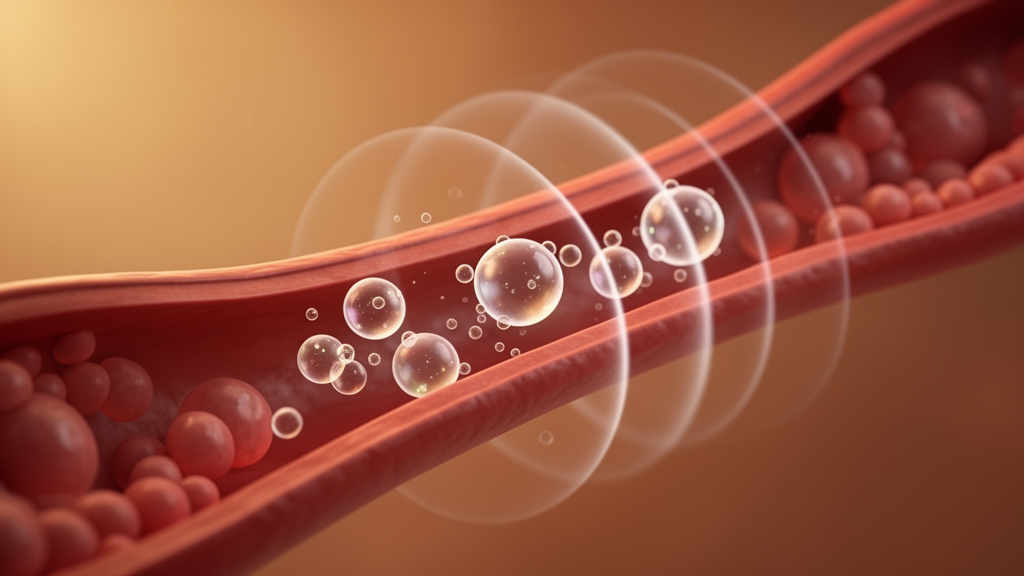
Published in Frontiers in Acoustics, this study investigates the complex interplay between acoustic radiation force, microbubble stability, and targeted adhesion in in vitro flow channel experiments. The findings challenge the conventional assumption that maximizing acoustic energy always improves molecular imaging sensitivity, revealing instead that excessive pressure can destabilize the microbubbles and reduce their ability to bind to vascular biomarkers.
Ultrasound molecular imaging relies on the adhesion of targeted microbubbles to specific endothelial biomarkers associated with pathological processes such as inflammation and angiogenesis. Acoustic radiation force enhances this process by translating circulating microbubbles toward the vessel wall, thereby increasing the likelihood of ligand-receptor interactions. However, the radial oscillations responsible for this translation also promote microbubble dissolution and potential destabilization. The study aimed to determine how peak negative pressure and pulse duration influence the balance among microbubble oscillation, translation, stability, and targeted adhesion.
The researchers employed a modified Rayleigh-Plesset equation coupled with the Marmottant shell model to predict radial oscillation, displacement, and dissolution of monodisperse 5-micrometer diameter lipid-coated microbubbles. These model predictions were evaluated using in vitro flow channel experiments with integrin-targeted microbubbles exposed to peak negative pressures of 10, 50, and 133 kilopascals. Pulse lengths of 27 and 54 cycles were used to assess the impact of acoustic exposure duration on the adhesion process. The experimental setup utilized a receptor-coated microvessel to simulate physiological flow conditions, allowing for precise measurement of microbubble attachment under controlled acoustic fields.
Model predictions indicated that increasing peak negative pressure led to greater radial expansion and displacement per pulse. However, the sequential model revealed that repeated exposure at the highest pressure of 133 kilopascals could reduce microbubble size due to accelerated dissolution. This reduction in size would shift the microbubble resonance away from the driving frequency, thereby decreasing cumulative transport efficiency. The model suggested that while higher pressures initially increase translational force, the progressive loss of microbubble volume can offset this benefit over successive pulses, leading to a longer predicted transit time to the vessel wall.
Experimental results confirmed that peak negative pressure significantly affected targeted adhesion, with the highest mean adhesion observed at 50 kilopascals for both pulse lengths. For 27-cycle pulses, mean adhesion densities were 100, 297, and 117 microbubbles per square millimeter at 10, 50, and 133 kilopascals, respectively. For 54-cycle pulses, the densities were 193, 225, and 152 microbubbles per square millimeter. Statistical analysis revealed a significant main effect of peak negative pressure, accounting for over 30 percent of the total variance, while pulse length did not show a significant main effect. These findings indicate that an intermediate pressure regime provides the most favorable conditions for radiation-force-induced targeting.
The study highlights that maximizing radiation-force-induced displacement does not necessarily maximize targeted adhesion. Successful targeting requires a balance between transport to the vessel wall, ligand accessibility, ligand-receptor binding, and resistance to hydrodynamic detachment. At low pressures, insufficient translation and shell deformation may limit wall contact and ligand-receptor interactions. Conversely, at high pressures, stronger oscillations may compromise microbubble stability before stable adhesion is established. The predicted reduction in microbubble size at 133 kilopascals provides a plausible explanation for the lower adhesion observed at the highest pressure, as a reduction in radius would shift the resonance behavior and reduce subsequent translation.
The computational framework used in the study reproduced the principal resonance-dependent trends measured in previous experiments, although the predicted velocity peak was broader and declined more gradually beyond resonance. The model does not account for pressure-dependent changes in shell elasticity, surface viscosity, or lipid shedding, which may affect the magnitude of radial oscillations at higher pressures. The Cattaneo-Supponen relationships used to predict dissolution were derived at 1.5 megahertz using 20-cycle pulses and were extrapolated to 4 megahertz with 27- and 54-cycle pulses. Frequency-dependent changes in microbubble resonance behavior and gas exchange could alter both the displacement scaling and dissolution behavior, necessitating further validation under broader acoustic conditions.
The absence of a significant main effect of pulse length provides an additional distinction between cumulative transport and successful adhesion. Although the computational model predicted that increasing pulse length increases total displacement by extending the duration of radiation-force exposure, the absence of a corresponding overall increase in microbubble adhesion suggests that additional acoustic exposure may provide diminishing returns for ligand-mediated attachment. This supports the idea that maximizing cumulative displacement is not equivalent to maximizing targeting efficiency, as the physical mechanisms governing adhesion are more complex than simple translational distance.
These results demonstrate that ultrasound molecular imaging protocols should balance microbubble transport, stability, and wall interactions, with an intermediate peak negative pressure providing the most favorable targeting conditions. The greater mean adhesion at 50 kilopascals identifies an intermediate acoustic regime for further optimization under the tested conditions, rather than defining a universal pressure optimum. The integration of per-pulse microbubble dynamics with cumulative transport modeling provides a framework for identifying acoustic conditions that enhance targeted microbubble adhesion while minimizing loss of microbubble size and function.
Further studies under a broader range of physiological and clinically relevant conditions will be necessary to validate these findings and establish the generalizability of this pressure-dependent response. Such validation will be an important step toward translating these findings to preclinical and clinical ultrasound molecular imaging studies. The study underscores the need for careful optimization of acoustic parameters to achieve effective molecular imaging without compromising the integrity of the contrast agents.
Subject of Research: Optimization of acoustic radiation force for targeted microbubble adhesion in ultrasound molecular imaging
Article Title: In vitro targeted microbubble adhesion exhibits a maximum at intermediate acoustic pressures
Article References: Castillo, J. I., Navarro-Becerra, J. A., & Borden, M. A. (2026). In vitro targeted microbubble adhesion exhibits a maximum at intermediate acoustic pressures. Frontiers in Acoustics, 4, Article 1988001. https://doi.org/10.3389/facou.2026.1988001
Image Credits: AI Generated
DOI: 10.3389/facou.2026.1988001
Keywords: ultrasound molecular imaging, microbubble adhesion, acoustic radiation force, peak negative pressure, in vitro experiments, Rayleigh-Plesset equation, Marmottant shell model, vascular biomarkers, microbubble stability, ligand-receptor binding, vitro, targeted
Cite Scienmag News
Drew Townsend. (October 27, 2026). Intermediate Acoustic Pressures Maximize Targeted Microbubble Adhesion. Scienmag. https://scienmag.com/intermediate-acoustic-pressures-maximize-targeted-microbubble-adhesion/
Drew Townsend. "Intermediate Acoustic Pressures Maximize Targeted Microbubble Adhesion." Scienmag, 27 October 2026, https://scienmag.com/intermediate-acoustic-pressures-maximize-targeted-microbubble-adhesion/. Accessed 27 October 2026.
Drew Townsend. "Intermediate Acoustic Pressures Maximize Targeted Microbubble Adhesion." Scienmag. October 27, 2026. https://scienmag.com/intermediate-acoustic-pressures-maximize-targeted-microbubble-adhesion/


