


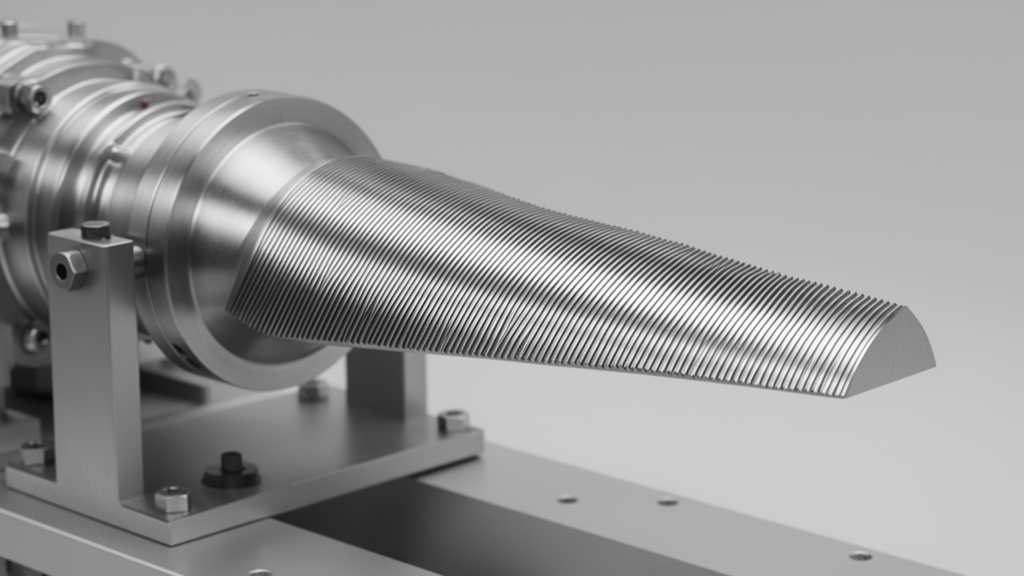
In a study published in the International Journal of Aeronautical and Space Sciences, researchers led by Kai Liu, Jinmiao Guo, Timothy Craft and Shan Zhong tested small riblets placed near the root of the blade suction surface in a linear compressor cascade, and found they could cut total pressure loss by roughly six percent at a Reynolds number of 150,000.
The team’s approach was to apply riblets close to the blade’s suction surface at its root, a location where the suction-surface boundary layer and the hub boundary layer interact and give rise to the separation.
The work combined experiment and computation. Experimental studies were carried out first to determine the optimal geometric parameters of the riblets, but the paper concentrates mainly on numerical analysis to reveal how the device works.
The simulations showed that the riblets induce spanwise fluid motion within the boundary layer on the blade’s suction side. This cross-flow component, although it increases losses in the immediate vicinity of the hub, weakens the interaction between the suction-surface and hub boundary layers.
A second mechanism emerged from the turbulent kinetic energy fields. Above the riblets, the turbulent kinetic energy in the suction-surface boundary layer increases, which delays separation and suppresses the concentrated shedding vortex in the cascade.
The loss accounting in the study points to where the savings come from. The riblets reduce both the suction-surface boundary layer loss and the secondary flow loss, and it is the reduction in secondary flow loss that the authors identify as the primary reason for the decrease in corner separation losses.
The benefit is not uniform across all operating conditions. The effectiveness of the riblets varies with incidence angle, because incidence influences the location and size of the corner separation and thereby changes the proportion of the different loss types present in the cascade.
Subject of Research: Passive blade-end riblets for suppressing corner separation and reducing total pressure loss in a linear compressor cascade
Article Title: Investigation of Blade-End Riblets to Suppress Corner Separation in a Linear Compressor Cascade
Article References: Liu, K., Guo, J., Craft, T., & Zhong, S. (2026). Investigation of Blade-End Riblets to Suppress Corner Separation in a Linear Compressor Cascade. International Journal of Aeronautical and Space Sciences. https://doi.org/10.1007/s42405-026-01306-4
Image Credits: AI Generated
DOI: 10.1007/s42405-026-01306-4
Keywords: compressor cascade, corner separation, riblets, total pressure loss, secondary flow, boundary layer, turbulent kinetic energy, incidence angle, aerodynamics, turbomachinery, Investigation, Blade-End
Cite Scienmag News
Grant Pearson. (October 27, 2026). Blade-End Riblets Cut Compressor Cascade Losses by About Six Percent. Scienmag. https://scienmag.com/blade-end-riblets-cut-compressor-cascade-losses-by-about-six-percent/
Grant Pearson. "Blade-End Riblets Cut Compressor Cascade Losses by About Six Percent." Scienmag, 27 October 2026, https://scienmag.com/blade-end-riblets-cut-compressor-cascade-losses-by-about-six-percent/. Accessed 27 October 2026.
Grant Pearson. "Blade-End Riblets Cut Compressor Cascade Losses by About Six Percent." Scienmag. October 27, 2026. https://scienmag.com/blade-end-riblets-cut-compressor-cascade-losses-by-about-six-percent/


