


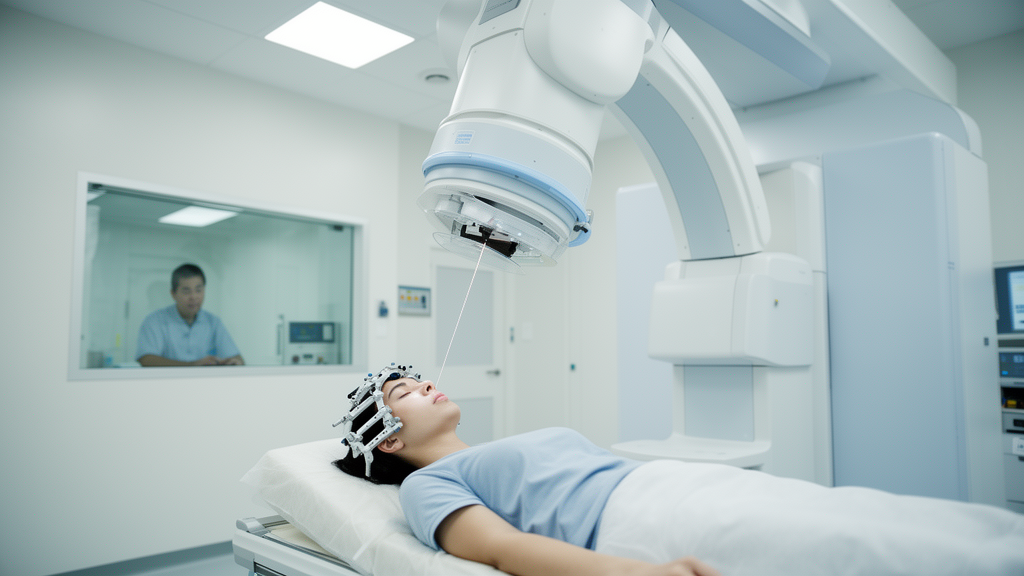
Drug-resistant mesial temporal lobe epilepsy has long posed a difficult choice for patients and neurosurgeons alike. The conventional surgical approach, anterior temporal lobectomy, carries well-recognized risks, including cognitive dysfunction, visual field deficits, and intracranial hemorrhage. Those risks disqualify a significant proportion of patients from the procedure altogether, leaving them with few options when medications fail. A new study from Mexican researchers now points to a less invasive path: stereotactic radiosurgery delivered with a clinical linear accelerator, a technique that bombards a precisely defined target inside the temporal lobe with high-dose focused radiation while sparing the surrounding healthy tissue.
The research, led by Dr. Clotilde Fuentes-Orozco of the Instituto Mexicano del Seguro Social in Mexico, was published in Volume 12 of the Chinese Neurosurgical Journal on September 8, 2026. The team set out to fill a specific gap in the literature: although various radiosurgery approaches, including laser interstitial thermal therapy, radiofrequency ablation, and stereotactic radiosurgery, have been demonstrated to be effective in epilepsy management, the therapeutic efficacy of linear accelerator-based radiosurgery in mesial temporal lobe epilepsy had not previously been evaluated. “In this study, we aimed to harness the non-invasive and targeted nature of LINAC-based stereotactic radiosurgery in managing drug-resistant MTLE,” Dr. Fuentes-Orozco said. “The findings of this study can potentially provide a new tool for neurosurgeons to manage MTLE.”
To understand why the target matters, it helps to look at what mesial temporal lobe epilepsy actually is. Epilepsy is a neurological disorder characterized by a sudden aberrant burst of electrical activity in the brain, temporarily disrupting consciousness, muscle control, and behavior. The mesial temporal variant originates from the deep structures of the temporal lobe, especially the hippocampus, the amygdala, and the parahippocampal gyrus. Under the microscope, the disease leaves characteristic marks: neuronal cell loss and alterations in glial cells, a combination pathologists call hippocampal sclerosis. A significant proportion of patients with mesial temporal lobe epilepsy who present with hippocampal sclerosis go on to develop drug-resistant epilepsy, meaning that anticonvulsant medications no longer control their seizures and surgical approaches become the mainstay of treatment.
The study itself was a single-center case series, and its scale was deliberately modest. The researchers recruited seven adult patients between the ages of 18 and 65, all of whom had drug-resistant unilateral mesial temporal lobe epilepsy, meaning the seizure focus was confined to one temporal lobe. Before any intervention, each patient underwent a thorough workup that included clinical evaluation, scalp electroencephalography to map abnormal electrical activity, and high-resolution magnetic resonance imaging to visualize the anatomy of the temporal lobe. Only then did the team proceed to LINAC-based radiosurgery, after which every patient was discharged on the same day.
Follow-up was structured and intensive. The protocol combined weekly telephone monitoring with monthly outpatient visits, and patients and their families were instructed to maintain a written record of seizures and auras, the latter being episodes of aberrant electrical activity that occur while the patient remains alert and conscious. Formal clinical, electroencephalographic, and neuroimaging assessments were scheduled at 3, 6, 12, and 24 months after the procedure, giving the researchers a two-year window into how the treated tissue and the patients’ seizure patterns evolved over time.
The headline result was a substantial, though incomplete, reduction in seizure burden. LINAC-based radiosurgery decreased seizure frequency by 75.6 percent across the cohort, but it did not completely stop epilepsy in these patients. Among the four patients who experienced auras before surgery, the frequency of those auras fell by 60.0 percent at 24 months post-surgery.
But the treatment was not without cost. The procedure was associated with several adverse events that the authors documented in detail. Three patients developed visual field deficits, the same complication that makes many patients ineligible for anterior temporal lobectomy in the first place, and one patient developed recent memory impairment. Psychotic episodes requiring intervention were noted in two patients, and headaches were the main systemic symptom reported by the cohort.
These findings place the study in a broader context of ongoing efforts to treat focal epilepsies without opening the skull. The Mexican team’s results suggest that the same principle can be applied to the hippocampus and its neighbors in drug-resistant mesial temporal lobe epilepsy, offering an option for the substantial group of patients whose anatomy, comorbidities, or personal circumstances rule out conventional lobectomy.
Dr. Fuentes-Orozco was careful to frame the results as promising but preliminary. “LINAC radiosurgery can be an effective alternative to conventional ATL for patients with drug-resistant MTLE,” she said, while emphasizing that the path to routine clinical use runs through properly controlled studies.
For now, the study stands as a proof of concept from a single center with seven patients, and its conclusions should be read with that scope in mind. The case series design cannot establish how LINAC radiosurgery compares with anterior temporal lobectomy or with other minimally invasive techniques, and the adverse event profile, particularly the emergence of new auras and psychotic episodes in a small cohort, will need much larger samples to quantify reliably. What the work does establish is that a same-day, non-invasive radiosurgical procedure can produce a marked reduction in seizure and aura frequency in drug-resistant mesial temporal lobe epilepsy, while carrying a side-effect burden that clinicians will have to weigh carefully.
Subject of Research: Non-invasive LINAC-based radiosurgery as a treatment for drug-resistant mesial temporal lobe epilepsy
Article Title: A Chinese Neurosurgical Journal study reveals the anticonvulsant effects of non-invasive linear accelerator-based radiosurgery
Article References: A Chinese Neurosurgical Journal study reveals the anticonvulsant effects of non-invasive linear accelerator-based radiosurgery. Original publication (Bibliographic details unavailable.)
Image Credits: AI Generated
DOI: Not provided
Keywords: epilepsy, mesial temporal lobe epilepsy, radiosurgery, LINAC, neurosurgery, hippocampus, hippocampal sclerosis, seizures, visual field deficits, drug-resistant epilepsy, stereotactic radiosurgery, Chinese Neurosurgical Journal
Cite Scienmag News
Kendall Mcintyre. (October 27, 2026). LINAC-Based Radiosurgery Cuts Seizures in Drug-Resistant Temporal Lobe Epilepsy. Scienmag. https://scienmag.com/linac-based-radiosurgery-cuts-seizures-in-drug-resistant-temporal-lobe-epilepsy/
Kendall Mcintyre. "LINAC-Based Radiosurgery Cuts Seizures in Drug-Resistant Temporal Lobe Epilepsy." Scienmag, 27 October 2026, https://scienmag.com/linac-based-radiosurgery-cuts-seizures-in-drug-resistant-temporal-lobe-epilepsy/. Accessed 27 October 2026.
Kendall Mcintyre. "LINAC-Based Radiosurgery Cuts Seizures in Drug-Resistant Temporal Lobe Epilepsy." Scienmag. October 27, 2026. https://scienmag.com/linac-based-radiosurgery-cuts-seizures-in-drug-resistant-temporal-lobe-epilepsy/


