


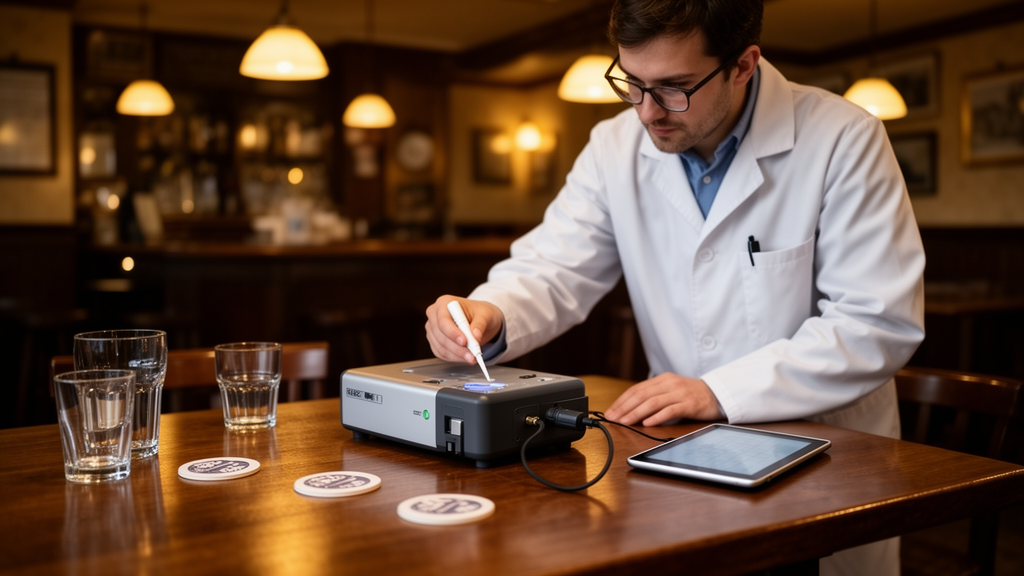
A portable mass spectrometry technique that identifies illicit drugs on surfaces in under two minutes, without any laboratory sample preparation, has been tested in a working pub in the south of England. Researchers at the University of Surrey’s School of Chemistry and Chemical Engineering collected 420 surface swabs from the venue over three weeks and found traces of cocaine and ketamine on surfaces across bathrooms, tables and bar areas, according to a study published in the Journal of Mass Spectrometry.
The method, known as atmospheric solids analysis probe mass spectrometry (ASAP-MS), departs from traditional analytical workflows in a crucial way. Conventional approaches typically require chromatographic separation, in which a sample is first sorted into its individual ingredients before each component is identified in a laboratory. ASAP-MS skips that step entirely. A sample is introduced via a glass capillary rod into a heated source, vaporised by nitrogen gas, and ionised without separation. The whole analysis takes under two minutes, a speed and simplicity that the researchers say could make rapid, on-site drug screening practical for venues, crime scenes or other locations where quick turnaround matters.
Over the three-week sampling period, the team tested three distinct workflows: direct untargeted analysis of swabs with no sample preparation, untargeted analysis of solvent-extracted samples, and targeted analysis monitoring specific chemical signatures. The targeted method using solvent-extracted samples achieved an overall diagnostic accuracy of 64.29 per cent for cocaine and 83.81 per cent for ketamine, compared against confirmatory laboratory testing.
The study found cocaine on all sampled bathroom surfaces using all three workflows. Concentrations were highest in bathroom areas, a pattern consistent with prior research showing that public bathrooms in venues are frequently used for substance consumption. Using the targeted approach, the method identified very small amounts of both cocaine and ketamine.
Those detection limits were remarkably low. The lowest levels measured were 20 picograms per microlitre for cocaine and 0.78 nanograms per microlitre for ketamine. Twenty picograms is about a millionth of the weight of a single human hair, and spread through a microlitre – a droplet far smaller than a pinhead – it is vastly less than anyone could see or feel. The ketamine figure is about 40 times higher than the cocaine figure, but it still amounts to roughly a billionth of a gram in a droplet too small to see clearly.
The technique was not without its limitations. Ketamine proved more challenging to detect than cocaine because it remains trapped in cotton swab fibres and has lower volatility, meaning it vaporises more slowly during analysis. Direct analysis of swabs missed significant amounts of ketamine that were later confirmed by traditional laboratory testing, while solvent extraction recovered those trapped compounds but added preparation time. The researchers also identified 15 false positives across the three workflows, some attributed to procaine, a cutting agent occasionally mixed with cocaine, which produces a nearly identical chemical signature to ketamine.
Andriana Michailidis, lead author and PhD student at the University of Surrey, emphasised the human dimension behind the chemical traces. “Whether we like it or not, drugs are part of daily life and are often present where nobody can see them,” she said. “Behind every one of these traces are people – staff who clean those bathrooms and work those shifts, and customers who have no idea what is on the surfaces they touch. When a venue can find out within minutes what is there, action can be taken that same night to protect them. Staff don’t have to wait days for a laboratory result while the risk goes on unseen.”
Dr Patrick Sears, corresponding author from the University of Surrey’s School of Chemistry and Chemical Engineering, said the technique offers a practical bridge between the speed needed for field screening and the sensitivity required to detect drugs at trace levels. “What excites us about this work is proving that a portable system can perform usefully in realistic, uncontrolled environments,” he said. “This matters for venue safety, for occupational health monitoring of staff, and for understanding surface contamination where it actually occurs.”
The study is among the first to assess surface contamination in an operational venue and to test whether portable mass spectrometry could serve as a practical detection tool for public health or occupational safety applications. The research was supported by Waters Corporation, which provided the RADIAN ASAP Direct Mass Detector and technical advice, and the team included collaborators from King’s College London’s Department of Infectious Diseases. The work was published in the Journal of Mass Spectrometry in October 2026.
The researchers caution that accuracy varies by drug and workflow, and that confirmatory laboratory testing remains the benchmark – but the Surrey team argues that a portable system able to flag contamination in real time could allow venues to respond to hidden risks the same night rather than days later.
Subject of Research: Rapid on-site detection of illicit drug residues on surfaces in a working pub using portable ASAP-MS
Article Title: Rapid on-site screening could help protect bar staff from hidden drug exposure
Article References: Rapid on-site screening could help protect bar staff from hidden drug exposure. Original publication (Bibliographic details unavailable.)
Image Credits: AI Generated
DOI: Not provided
Keywords: mass spectrometry, ASAP-MS, drug detection, surface contamination, cocaine, ketamine, pub hygiene, occupational safety, University of Surrey, analytical chemistry, portable detection, public health
Cite Scienmag News
Denise Maddox. (October 27, 2026). Portable mass spectrometry spots drug traces on pub surfaces in under two minutes. Scienmag. https://scienmag.com/portable-mass-spectrometry-spots-drug-traces-on-pub-surfaces-in-under-two-minutes/
Denise Maddox. "Portable mass spectrometry spots drug traces on pub surfaces in under two minutes." Scienmag, 27 October 2026, https://scienmag.com/portable-mass-spectrometry-spots-drug-traces-on-pub-surfaces-in-under-two-minutes/. Accessed 27 October 2026.
Denise Maddox. "Portable mass spectrometry spots drug traces on pub surfaces in under two minutes." Scienmag. October 27, 2026. https://scienmag.com/portable-mass-spectrometry-spots-drug-traces-on-pub-surfaces-in-under-two-minutes/


