


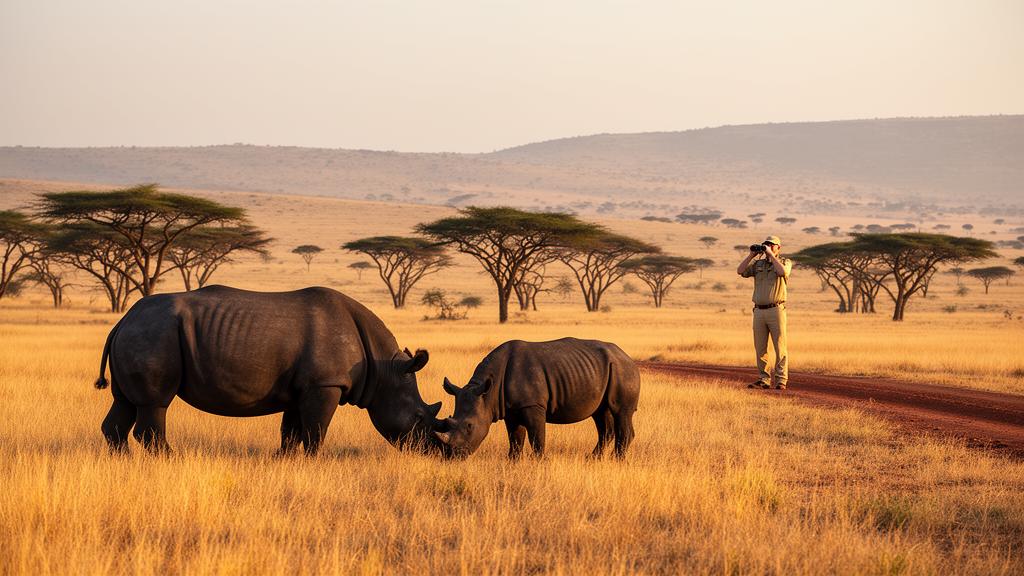
NAIROBI, Kenya — Eighteen months ago, the Kenya Rhino Range Expansion, known as KRRE, existed only as an ambitious idea: to help create the space, partnerships and investment needed for Kenya’s growing rhino populations to continue to thrive. Today, that idea is delivering results on the ground, and these early milestones mark an important next chapter in one of Africa's great conservation success stories. With catalytic support from the San Diego Zoo Wildlife Alliance, KRRE now works alongside the Kenya Wildlife Service, local communities, conservation organisations and private landowners to expand and strengthen rhino habitat across the country.
The progress achieved in less than two years is striking in its geographic breadth. In Tsavo, the opening of the largest rhino sanctuary in Africa has given the region’s black rhino population access to approximately 30 times more space than they had previously. In Central Kenya, more than ten partners have committed to opening their properties to support the expansion of rhino populations. And in the Naibunga Community Conservancy, with support from a collection of organisations including KRRE, work is underway to restore habitat for future rhino conservation — an effort that will also improve grazing for livestock and create the potential for new tourism and employment opportunities for local communities.
The urgency behind the initiative stems from an unusual problem: success. Under the vision and leadership of the Kenya Wildlife Service, Kenya has made remarkable progress in rebuilding its rhino populations, but that success has created a new challenge: several established rhino areas are reaching or exceeding their ecological carrying capacity.
The San Diego Zoo Wildlife Alliance was among the earliest partners to recognise both the urgency of the challenge and the potential of the approach developed by KRRE and the Kenya Wildlife Service. Its catalytic funding helped establish the team, the technical capacity and the wider partnerships needed to move KRRE from planning into implementation. Jamie Gaymer, chief executive officer of the Kenya Rhino Range Expansion, said the early backing proved decisive. “San Diego Zoo Wildlife Alliance backed KRRE when what we had was an ambitious idea, an urgent conservation need and a belief that Kenya could create significantly more space for rhinos,” Gaymer said. “Their early support, combined with the mandate and trust from the Kenya Wildlife Service to carry out the nation’s black rhino strategy, allowed us to build the team and partnerships needed to turn that idea into action. Eighteen months later, we are seeing real progress across some of Kenya’s most important rhino landscapes.”
One of the most significant milestones came in September, when the final fence dropped on the expanded Tsavo West Rhino Sanctuary. Covering approximately 3,200 square kilometres, the sanctuary is now the largest of its kind in Africa and has increased the space available to Tsavo West’s black rhino population by roughly thirtyfold. The scale of the undertaking extends far beyond the fence line.
Conservation scientists emphasise that the expansion is about more than simply giving animals additional room. The expanded range also strengthens protection for the wider ecosystem and the other wildlife that shares the same habitat. “Expanding their range goes beyond giving rhinos more room to grow. It is about safeguarding the ecological processes that sustain life across their native habitat,” said Dr. Nadine Lamberski, chief conservation science and wildlife health officer at the San Diego Zoo Wildlife Alliance. “As an indicator species critical to biodiversity and ecosystem balance, the health of black rhino populations reflects the health of the grasslands and woodlands that countless species depend on.”
In Central Kenya, KRRE is helping lay the groundwork for the next phase of rhino expansion. More than fourteen partners have now signed agreements committing to work towards opening their properties to expanding rhino populations. Together, these landscapes have the potential to create significant new space for rhinos while strengthening connectivity across one of Kenya’s most important wildlife areas.
In the Naibunga Community Conservancy, the approach takes on a distinctly community-centred dimension. KRRE is working in partnership with the community to restore and enhance the landscape through the removal of invasive plant species, a form of ecological restoration that contributes to a healthy, productive and resilient ecosystem supporting the well-being of both communities and wildlife. The work also enhances the landscape’s potential to support rhino conservation in the future. Crucially, any consideration of rhino conservation as part of the landscape’s future land-use options will be undertaken through an inclusive and participatory F-PIC process, ensuring that community aspirations, priorities, knowledge and decisions remain central to shaping the way forward. Gaymer framed the philosophy in simple terms: “What we are ultimately trying to create is space. Space for rhinos to grow, but also space for nature-based businesses, tourism and employment to grow alongside them. If we can get that right, expanding rhino populations becomes part of a much bigger story about healthy landscapes and the people whose futures are connected to them.”
KRRE was established on the understanding that expanding rhino range cannot be achieved by any single organisation. Its role is instead to work alongside the organisations and people already managing Kenya’s landscapes, helping identify opportunities, convene partners, provide technical expertise and direct funding towards projects that can unlock additional habitat. That means looking beyond the immediate requirements of rhino conservation to the wider systems that make expansion possible: healthy habitat, effective protection, strong community partnerships, science, infrastructure, sustainable tourism and long-term financing.
“Kenya has long set the global standard for community-driven conservation, showing that lasting results come from sustained collaboration between local communities and conservation partners,” said Dr. Stephen Chege, director of the San Diego Zoo Wildlife Alliance in Kenya. “Our work with KRRE builds directly on that success, combining proven practice with shared expertise to strengthen habitat connectivity and safeguard a resilient ecosystem that supports both people and rhinos.” The partnership between the Kenya Wildlife Service, KRRE and the San Diego Zoo Wildlife Alliance also demonstrates the role that catalytic funding can play in conservation.
Subject of Research: Rhino habitat expansion and landscape restoration in Kenya through a multi-partner conservation initiative
Article Title: From concept to conservation at scale: Partnership creates new space for Kenya’s rhinos
Article References: From concept to conservation at scale: Partnership creates new space for Kenya’s rhinos. Original publication (Bibliographic details unavailable.)
Image Credits: AI Generated
DOI: Not provided
Keywords: black rhino, Kenya, rhino conservation, Tsavo West, habitat expansion, Kenya Wildlife Service, community conservancies, San Diego Zoo Wildlife Alliance, ecological carrying capacity, landscape connectivity, Naibunga, wildlife corridors
Cite Scienmag News
Margaret Porter. (October 27, 2026). Kenya’s rhinos gain vast new territory as 18-month partnership delivers on ambitious expansion plan. Scienmag. https://scienmag.com/kenyas-rhinos-gain-vast-new-territory-as-18-month-partnership-delivers-on-ambitious-expansion-plan/
Margaret Porter. "Kenya’s rhinos gain vast new territory as 18-month partnership delivers on ambitious expansion plan." Scienmag, 27 October 2026, https://scienmag.com/kenyas-rhinos-gain-vast-new-territory-as-18-month-partnership-delivers-on-ambitious-expansion-plan/. Accessed 27 October 2026.
Margaret Porter. "Kenya’s rhinos gain vast new territory as 18-month partnership delivers on ambitious expansion plan." Scienmag. October 27, 2026. https://scienmag.com/kenyas-rhinos-gain-vast-new-territory-as-18-month-partnership-delivers-on-ambitious-expansion-plan/


