


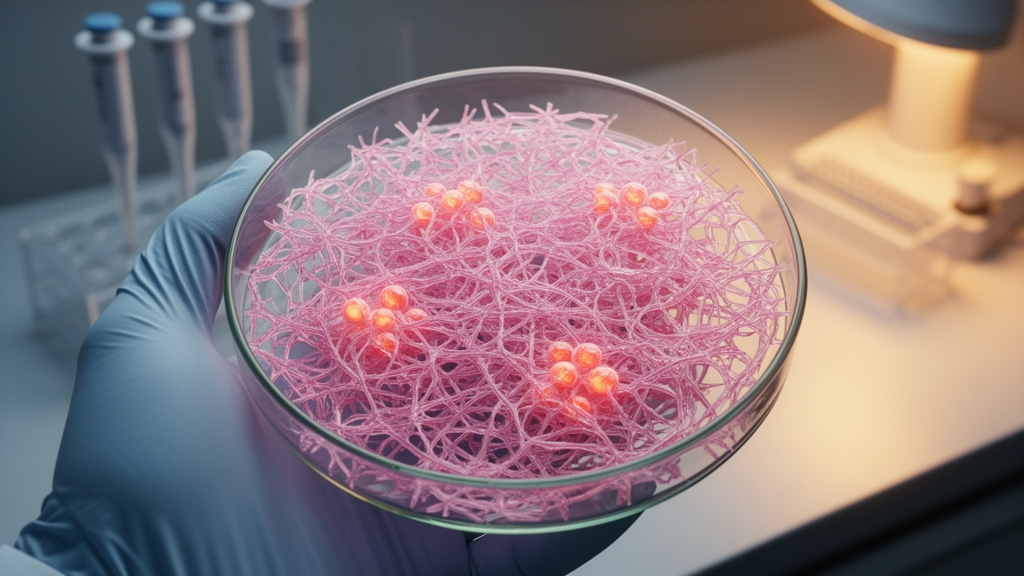
Most laboratory models of cancer are built without asking a deceptively simple question: how old is the matrix that surrounds the tumour cells? A new review published in Materials Today Bio argues that the age of the extracellular matrix, the fibrous scaffold that anchors and instructs cells in every tissue, is a biological variable that preclinical cancer research has largely ignored, and it proposes a framework for building three-dimensional models that take it seriously. The authors, led by Vanessa Farkas and Olga Piskareva, synthesise evidence from across the ageing and cancer-model literature and distil it into practical design principles for what they call age-aware cancer models.
The case for paying attention begins with demography. Cancer is predominantly a disease of later life: in the United States, 60 percent of new diagnoses occur in people aged 65 or older, and of the roughly 2.11 million new cancer cases projected for 2026, only about 15,340 are expected in children and 5,660 in adolescents. Globally, an estimated 20.6 million new cancer cases occurred in 2024, and population growth and ageing are projected to raise that figure by 67 percent to 34.4 million by 2050. Yet despite this burden, most preclinical tumour models rely on a single extracellular matrix source, donor age or matrix formulation, and therefore do not capture age-dependent variation in the tumour microenvironment.
The extracellular matrix is far more than passive scaffolding. Produced and remodelled by fibroblasts, stromal cells, immune cells and tumour cells themselves, it comprises collagens, glycoproteins, proteoglycans, glycosaminoglycans and associated molecules that assemble into tissue-specific networks. Beyond structural support, it regulates cell adhesion, migration, signalling, tissue organisation and mechanical behaviour. The review’s central argument is that ageing changes this matrix along multiple dimensions at once: composition, fibre architecture, biochemical modification, mechanical properties, turnover, basement membrane integrity and interactions with immune and vascular cells. No single molecule or mechanical measurement, the authors contend, can serve as a universal surrogate for an aged matrix.
Direct comparisons between young and aged tissues provide the closest evidence for chronological matrix ageing. The inner limiting membrane of the human retina, for example, thickens from roughly 70 nanometres at fetal stages to several micrometres by age 90, loses laminin relative to collagen IV and agrin, and becomes stiffer with age. Decellularised lung scaffolds from one-year-old mice contain less laminin alpha3 and alpha4, elastin and fibronectin, and more collagen than scaffolds from three-week-old mice, although the authors note this comparison spans the juvenile-to-adult transition rather than old age. Hyaluronan changes less uniformly: in a small autopsy series of human skin, total hyaluronan content and polymer size did not differ with age, but the tightly tissue-bound fraction rose from 7 percent of total hyaluronan in fetal skin to 23 percent in elderly skin, while collagen from aged mouse tail tendons contained about twice as much hyaluronan as young collagen.
One of the best-characterised biochemical dimensions of matrix ageing is the accumulation of advanced glycation end products, which form through non-enzymatic reactions between reducing sugars and long-lived matrix proteins. Glycation promotes covalent cross-linking of matrix proteins and can alter matrix structure, mechanical behaviour and receptor-mediated signalling. Ageing also remodels fibre architecture, producing fragmented, reoriented or more highly cross-linked collagen fibrils that change pore structure, ligand presentation and permeability without necessarily altering bulk composition. Mechanical properties shift with age across multiple tissues, but the review stresses that these changes do not follow a universal trajectory, and that increased stiffness should be regarded as one possible component of matrix ageing rather than a general proxy for it.
To bring order to a confusing terminology, the authors classify age-aware models into four methodological categories: chronologically aged extracellular matrices, defined age-associated matrix modifications, cell-mediated matrix remodelling, and mixed multicomponent ageing models. These represent complementary strategies along a continuum between biological fidelity and experimental control. Chronologically aged matrices, such as decellularised tissues from young and old animals, retain naturally accumulated combinations of changes that are difficult to reproduce independently, but they limit mechanistic resolution because many variables differ at once. Defined modification models, such as experimentally glycated collagen, offer mechanistic precision but reproduce only selected features of ageing. Cell-mediated models capture ageing as an active cellular process, including senescence-driven remodelling, but make it harder to separate matrix-dependent effects from paracrine signalling by the cells themselves.
The evidence base for these models is narrow but instructive. The authors searched PubMed for original research published between 1980 and July 2026 and included eleven primary studies in their synthesis. All eleven model adult cancers, and none uses paediatric or developmental matrix as an experimental variable. Six of the seven chronologically aged matrix studies use rodent tail-tendon collagen irrespective of the organ in which the tumour arises, only one uses organ-matched aged matrix, and only one uses matrix from aged human donors. Age definitions vary widely, from two to six versus twenty to twenty-five months in rodents to under 45 versus over 55 years in human donors, and only three studies include in vivo experiments.
Despite this narrowness, the findings are striking. Aged mouse breast matrix promoted motility, invasion and EMT-like changes in mammary epithelial and breast cancer cells, with knockdown of the enzyme LOX in the seeded cells reverting the phenotype. Collagen from aged mouse tail tendons increased proliferation of prostate epithelial and cancer cells, and its roughly doubled hyaluronan content increased proliferation of benign BPH-1 cells but not LNCaP cancer cells. Breast cancer spheroids showed enhanced invasion in aged tail-tendon collagen despite near-identical bulk mechanics, with a storage modulus of about 20 pascals in both conditions. In a screen of 720 FDA-approved drugs, 27 were effective only in young matrices and 7 performed better in aged ones. Old collagen raised the erlotinib IC50 of lung carcinoma and transformed bronchial cells by about 40 percent in three-dimensional but not two-dimensional culture, and roughly doubled the vemurafenib IC50 of two BRAF-mutant melanoma lines in old collagen, which was also substantially stiffer, with vemurafenib becoming ineffective in xenografts embedded in old collagen.
Defined modification experiments sharpen the mechanistic picture. Glucose-induced glycation of collagen I caused fibre bundling, increased pore size and storage modulus, and altered tumour-cell morphology and migration without affecting viability or proliferation, with anti-RAGE antibody attenuating the responses. In a perfused tumour-vessel chip, methylglyoxal cross-linked collagen, degraded laminin-rich basement membrane and increased cancer-cell intravasation, though it also induced endothelial senescence, so matrix and endothelial contributions could not be separated. Notably, RAGE blockade attenuated responses to glycated collagen, whereas RAGE did not mediate the proliferative response to naturally aged collagen, which instead reflected reduced DDR2 activation, suggesting that a defined modification does not necessarily reproduce the signalling of a naturally aged matrix. In cell-mediated models, senescent mesenchymal stromal cells increased spheroid growth and invasion, and matrix deposited by fibroblasts from donors over 55, lacking the protein HAPLN1, promoted melanoma invasion in three-dimensional skin constructs, with HAPLN1 restoration reversing the effect.
The review’s practical message is that the central question is not simply whether a model is aged, but which dimensions of ageing it replicates, how those dimensions have been validated, and what degree of causal inference the system allows. The authors recommend that the ageing variable be explicitly defined, that the resulting matrix phenotype be experimentally verified rather than inferred from donor age alone, that relevant biochemical, structural and mechanical properties be characterised independently, and that complexity remain proportionate to the biological question. They also flag major gaps: no study yet combines aged matrix with aged stromal, immune and vascular components, and no model uses paediatric or developmental matrix, even though cancer can be diagnosed from birth and developmental matrices differ from aged ones in composition and organisation rather than representing an unaged state. As bioprinting, organ-on-chip platforms and patient-derived systems mature, the authors argue, the most effective model will be the simplest experimentally validated system that reproduces the ageing-associated features relevant to the question at hand.
Subject of Research: Extracellular matrix ageing as an experimental variable in three-dimensional in vitro cancer models
Article Title: Extracellular matrix ageing as a biological variable in 3D cancer models: A framework for age-aware model design
Article References: Farkas, V., Ashokan, A., Struck, R., O'Neill, H., Quondamatteo, F., & Piskareva, O. (2026). Extracellular matrix ageing as a biological variable in 3D cancer models: A framework for age-aware model design. Materials Today Bio, 41, Article 103761. https://doi.org/10.1016/j.mtbio.2026.103761
Image Credits: AI Generated
DOI: 10.1016/j.mtbio.2026.103761
Keywords: extracellular matrix, ageing, 3D cancer models, tumour microenvironment, collagen, glycation, advanced glycation end products, senescence, decellularised ECM, mechanobiology, organ-on-chip, cancer modelling
Cite Scienmag News
Nathaniel Bowman. (October 27, 2026). Ageing extracellular matrix emerges as a hidden variable in 3D cancer models. Scienmag. https://scienmag.com/ageing-extracellular-matrix-emerges-as-a-hidden-variable-in-3d-cancer-models/
Nathaniel Bowman. "Ageing extracellular matrix emerges as a hidden variable in 3D cancer models." Scienmag, 27 October 2026, https://scienmag.com/ageing-extracellular-matrix-emerges-as-a-hidden-variable-in-3d-cancer-models/. Accessed 27 October 2026.
Nathaniel Bowman. "Ageing extracellular matrix emerges as a hidden variable in 3D cancer models." Scienmag. October 27, 2026. https://scienmag.com/ageing-extracellular-matrix-emerges-as-a-hidden-variable-in-3d-cancer-models/


